
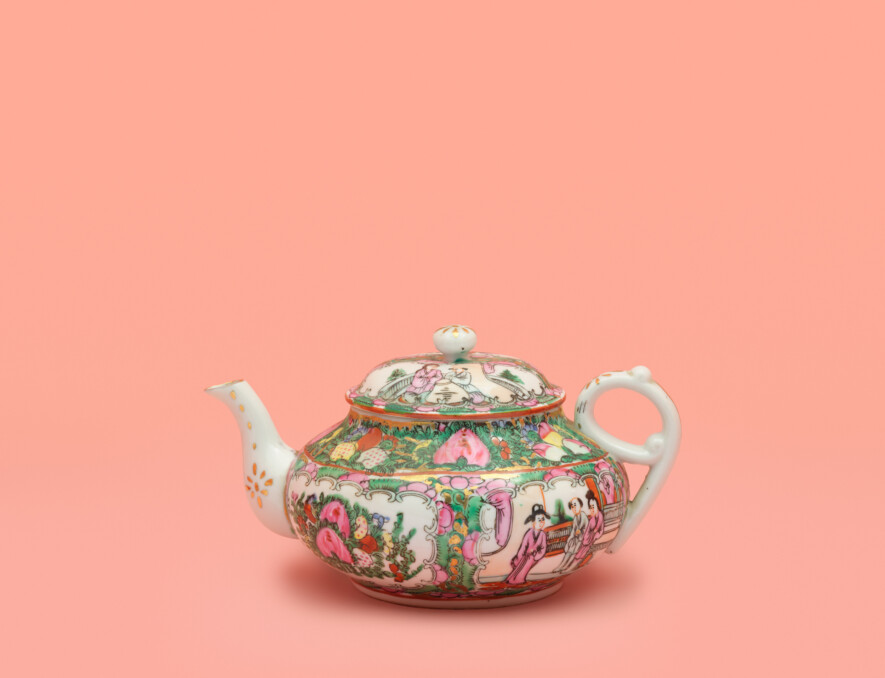
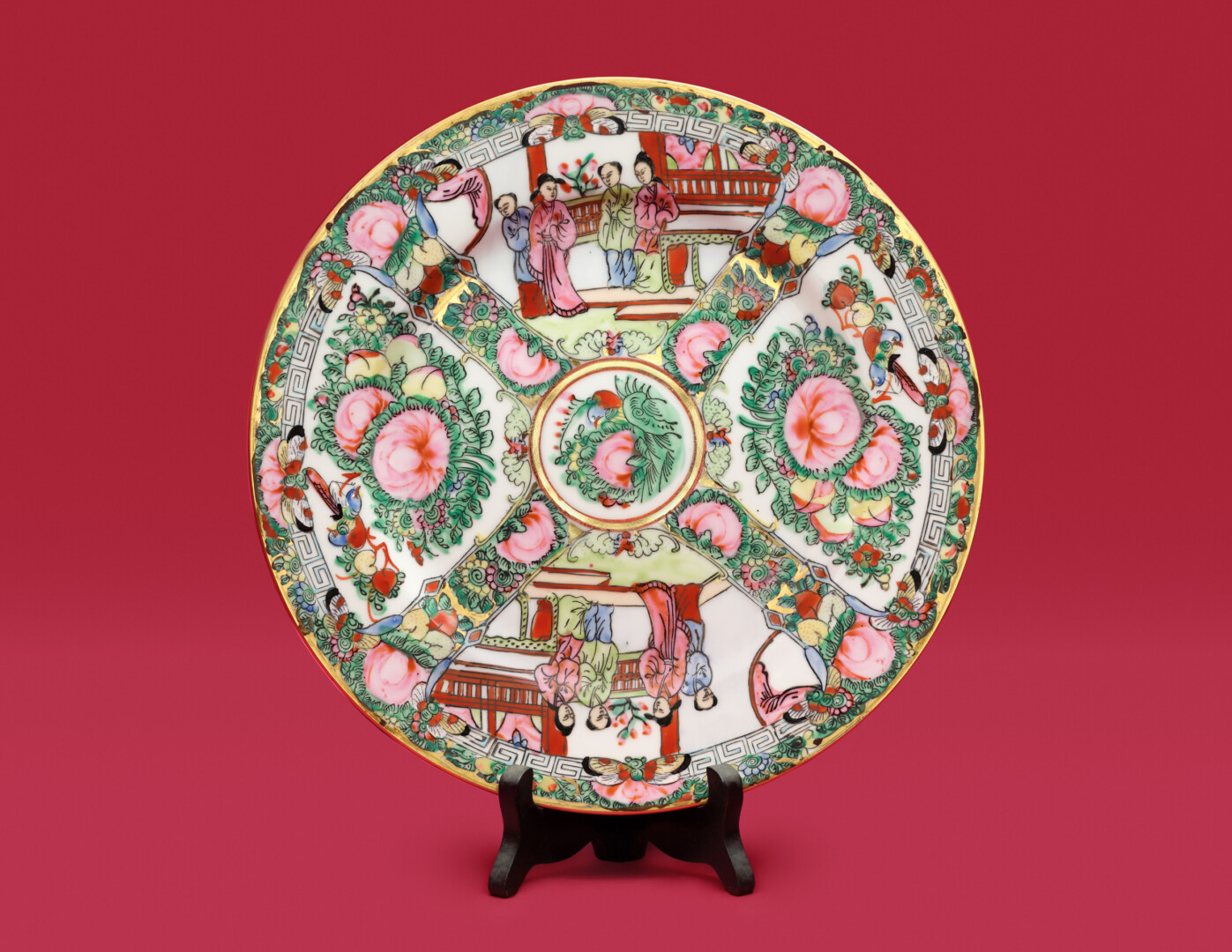
Kathy Slade from Famille Rose, photo by Rachel Topham Photography.
If one doesn’t examine the objects surrounding them, how can they know themselves? asks Vancouver-based artist Kathy Slade. Simon Fraser University’s School for the Contemporary Arts presents Slade’s Famille Rose (now until Apr. 30)—an exploration of how objects hold meaning and pass through time.
Located in SFU’s The Cabinet gallery (Room 4390), the exhibit includes teacups, dinner plates and smaller plates from her mother’s collection. The pieces are held within a pink China cabinet—propped up by wooden blocks that serve as plate holders.
“The [exhibit’s] questions would be around the oddness of having these private, domestic items in a public place,” Slade adds.
Familial inheritance
The exhibit’s title, the Famille Rose, or “of the pink family,” refers to Chinese porcelain introduced in the 17th century. It was influenced by French Jesuits residing in China; they introduced the porcelain makers to new colours such as pink, yellow, green and white.
“It wasn’t made for domestic use; it was made to sell to Europeans,” Slade adds. “I like that that’s the one my mom tried to collect—I like the interwovenness of cultures.”
The idea for Famille Rose originated—not from the porcelain itself—but two small paintings. Slade’s maternal great-grandfather captained a ship that sailed from Trieste, Italy to China, Japan, India and Sri Lanka.
During a stay in Sri Lanka, he met an artist from Prague who needed transportation back to Europe.
“In exchange for that ride, the artist gave my great-grandfather these two little paintings,” Slade shares. Dated 1909, these paintings are now in Slade’s possession—gifts from her mother. “Years later, we found out that this painter was one of the most important Czech modernist painters.”
The painter’s name was Otakar Nejedly. The same great-grandfather brought home other art pieces and artefacts. Slade recalls hearing stories of porcelain vases that were taller than her aunt.
These objects were eventually lost in the Second World War. The family left for Italy, then England. Slade’s mother made her way to Canada during the 1950s.
“My mom started collecting porcelain in Canada,” Slade says, reflecting on how objects hold meaning through time. “I came to regard my mom’s collection of porcelain as a way to re-establish a lost identity, or something that was lost.”
Playing with context
Slade is currently working with a researcher from Korčula, Croatia to trace her great-grandfather’s routes. She sees Famille Rose as the beginning of a series of projects exploring how objects hold and transfer meaning. One evolution involves creating crates to hold the porcelain.
“It’ll be out of pine—cheap crate wood—but they’ll be really fancy [and] beautiful, holding things in really particular ways,” Slade shares. “It will function as a crate, so potentially the work can ship in these crates somewhere, but when you open it up, the crate itself is the sculpture.”
Her intention is to speak on shipping items back and forth. The artist is working with Dan Phillips who coined the phrase, “crate logic”—a term that describes what Slade sees as the “simplest way to make something safe and secure.”
“In ‘The Task of the Translator,’ [German theorist Walter Benjamin] talks about how language, when it’s translated, mutates and changes over time,” Slade says. Playing on Benjamin’s philosophy, Famille Rose is described as exploring the ‘task of the inheritor.’
Slade also draws on French philosopher Jacques Derrida’s idea of deconstruction: taking things apart and reading them in different registers or contexts. She sees objects as not only influencing humans, but humans as obligated towards objects—particularly during the inheritance process.
“If we were to extrapolate further, we could think about all these different things we inherit—whether it’s attitudes [or] ways of being,” Slade says. “All these things we want to be able to change, but we’re beholden to.”
For Slade, Famille Rose is about playing with context. The private is displayed in a public setting. The domestic—as represented by the pink colouring of the cabinet—is situated in an academic space.
“[My nephew] came and said, ‘Oh, it’s strange to see grandma’s stuff here,’” Slade recalls of opening night. “’I was like, ‘That’s true, you’re the only person who would have that experience’—it used to be in her house, and now it’s here.”
For more information on the exhibition, see https://www.sfu.ca/sca/events—news/events/famille-rose.html.
For more information on Kathy Slade, see https://www.kathyslade.com/.


Comments will load once you reach the end of the article.