
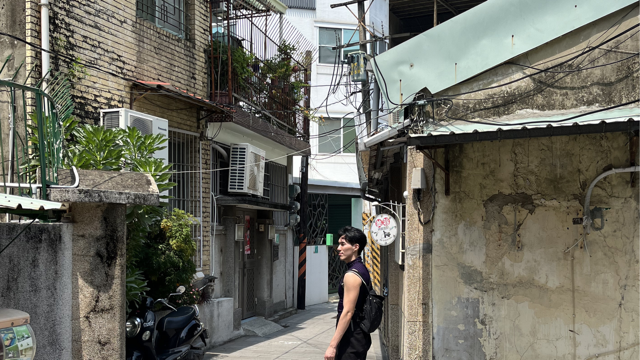
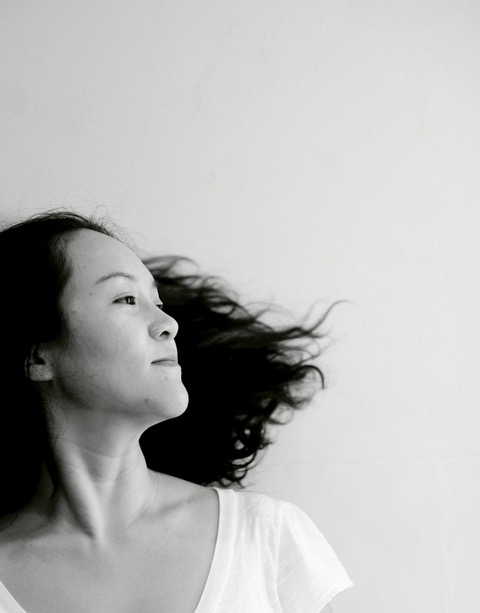
Jocelyn Yuchia Chang | Photo by Fredrick Liu.
Developing the audacity to question one’s identity, and particularly, the audacity to stay in the “weaving” rather than having the answers is key to Hymn of the Weaverbirds, says creator/performer Johnny Wu. Recognizing Asian Heritage Month, The Polygon Gallery presents Hymn of the Weaverbirds on May 28—a Taiwanese play exploring community and gender norms.
“This is a Taiwanese play, but it’s not just for Taiwanese people because Taiwanese point of view and tenacity is something that everybody can learn from,” Wu shares. “It’s really important that artists of colour do not feel like we have to silo ourselves into an echo chamber.”
“How can we put our heart in a safer place and give it enough room to react?” director/writer/creator Jocelyn Yuchia Chang adds. “I try to stand in this moment—maybe it’s not about giving an answer but tuning into the frequency, channelling [one’s] higher self and wisdom.”
Hymn of the Weaverbirds features a group of strangers looking for direction and belonging—a journey that leads to an abandoned Japanese-style bathhouse. The upcoming performance has been adapted into a monologue featuring the character Mù (translated to English as wood).
Naked community
Hymn of the Weaverbirds resulted from Wu’s desire to create theatrical works featuring Asian queer experiences. Around the time of the play’s early explorations, Taiwan became the first country in Asia to legalize same-sex marriage.
“That gave me the spark,” Wu recalls. “I was really interested in creating a piece that really explores the nuances of ‘How did we manage to do that? What are the cultural aspects of Taiwan that allowed us to break free from that?”
In 2017, Wu met Chang through the Professional Development Masterclass at Richmond’s Gateway Theatre; Chang had been invited to run the class as a visiting artist.
Two years later, Wu participated in Chang’s Cross-Cultural Creative Lab in Taiwan. The program invites artists to Taiwan, providing them space to experiment with artistic productions.
“Jocelyn is very intuitive, and a lot of the times, our working process is almost the opposite of how it works in Canada,” Wu shares, pointing out that in Canada, intense research would usually take place prior to conceptualization. “She’ll throw an idea out, like ‘It’s now a bathhouse’; we’ll perform the idea, then we’ll go back and search for the meaning of what is that quiet thing in the back of Jocelyn’s mind that told her, ‘It’s a bathhouse.’”
On one level, the bathhouse represents Taiwan’s history of Japanese colonialism—a part of the country’s identity that Wu sees as still present but “never looked at.” The bathhouse also invokes what Chang coins as “existence without acknowledgement,” which the creators see as reflecting Taiwan’s international presence.
“It’s there, but we don’t see it,” Wu explains of the theme. “It’s almost like these people living inside the bathhouse are mirroring these people living in Taiwan.”
Wu also points out that the bathhouse, for centuries, has been recognized as “a safehouse” for queer folks. The third layer to the setting’s significance lies in the Japanese philosophy of Hadaka no Tsukiai, translated as ‘naked friendships’ or ‘naked relationships.’
“It’s this concept that we all go into these bathhouses because once we strip away our clothes and the status that comes with clothes, we can actually be more honest and direct with each other,” Wu adds.
Unlearning perspectives
The play has gone through several iterations, including a 2023 performance as part of rice & beans theatre’s DBLSPK program. For Chang, 2020 was a pivotal moment: she recalls many professional changes and a reclaiming of her Taiwanese identity.
In the past, Chang was hesitant to openly state her Taiwanese heritage when working with international artists.
“If I talk about finding belonging as a Taiwanese person, can’t that also translate to someone finding belonging who might not even be Taiwanese or queer?” Wu emphasizes Hymn of the Weaverbirds, at its core, is a deeply human story. “We can keep this root of the Taiwanese story, but that root can bear fruit that everybody can enjoy.”
The play reflects a personal transformation for Wu, who was born in Taiwan and raised in Vancouver. That transformation sees the performer reclaiming his differences as a source of strength.
“My difference is what makes what I have to say actually of value and interest to you because I see the world in a way that you don’t,” he shares.
Another major theme is community. Weaverbirds are a communal species; their mating routine has males building a nest, which is then inspected by female birds. If she deems the nest insufficient, he will tear it down and start again.
“There’s this idea that connection, love and building community can only happen if we build this nest,” Wu explains of the play’s title, which references the mandarin phrase 心窩, translated as ‘heart’s nest’ or ‘the center of the heart.’ “Until we can make sure our heart is full, we won’t be able to build community, but that process of making our hearts full is very dangerous because someone can come and tear it apart.”
Creating new sounds
The upcoming performance will explore Wu’s search for “a holistic masculinity,” one that resembles Eastern concepts of gender. Wu points out that the Eastern yin-yang philosophy highlights a “divine” masculinity and femininity in each individual.
“[Chang] wrote it in a way that doesn’t look at gender in that very conventional way of men/women; she looked at gender through a very Eastern lens,” Wu shares the script reflects this theme linguistically.
In a nightmare, a character dreams of falling through the sky—learning how to catch, receive and be held by himself. According to Wu, the logograms of the word/character for “receive” is then projected, resembling “a woman with her hands out.”
“It’s a commentary of how our inability to be held and received comes from our fear of being something that is feminine,” he adds. “We all go through this process of relearning femininity because it’s not about something that comes from the female body—but it is the divine feminine, which is the yin energy.”
“In my creation style, I like to leave the lines as minimal as possible to give performers the most room to perform,” Chang says of the script.
The upcoming performance will feature a new arrangement of a famous Taiwanese Hokkien song, “Moon Night Sorrow.” The creators see the song as paralleling Taiwan’s different historical moments. A version was first recorded by a Canadian missionary; the song then underwent multiple adaptations—including by Taiwanese lyricist Chiu Thiam-ōng and the Japanese military.
“There’s a jazz version, an orchestra version…we’ll be working with the musician Cindy Kao to see how we can create this new version that belongs to us—this flying out of the nest version,” Wu shares. “What does ‘Moon Night Sorrow’ sound now as an international song?”
The performance is presented by The Polygon Gallery with the support of rice & beans theatre. Other collaborators include June Hsu (projection) and Lily Hsu (movement).
For more information on the upcoming performance, see https://thepolygon.ca/event/asian-heritage-month-hymn-of-the-weaverbirds/.


Comments will load once you reach the end of the article.