

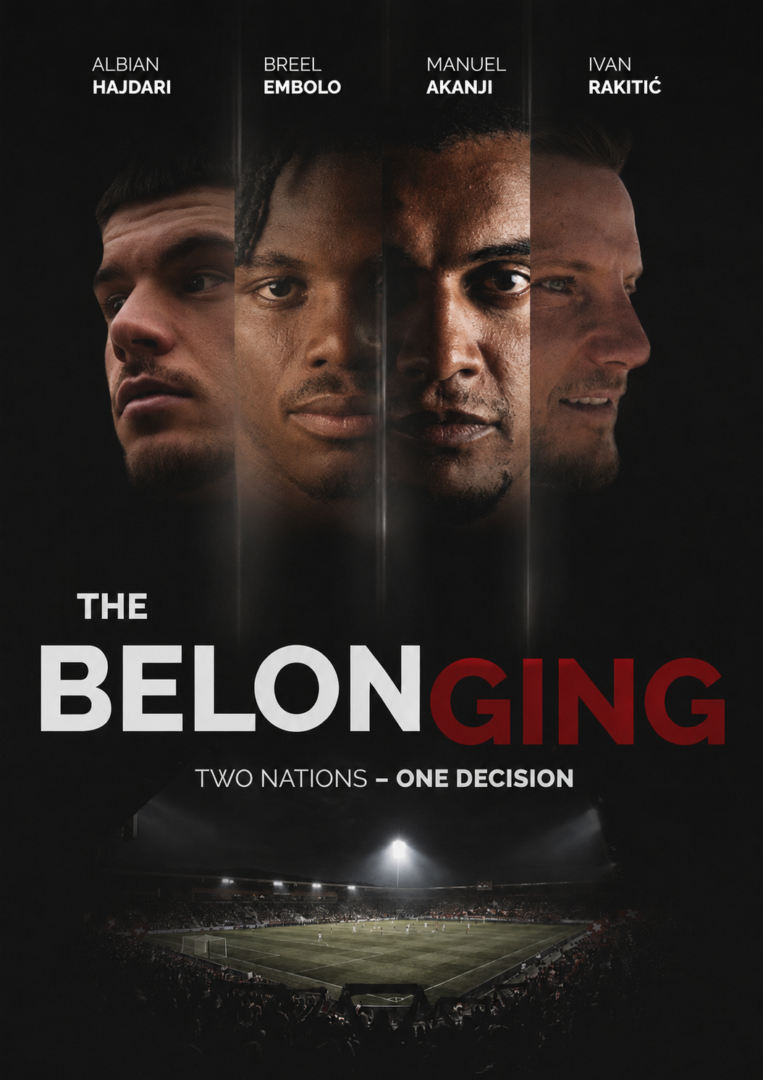
The Belonging | Photo courtesy of Lomotion AG.
The Consulate General of Switzerland in Vancouver, in partnership with SKY Switzerland, presents a special screening of The Belonging (June 23, Djavad Mowafaghian Cinema at SFU Goldcorp Centre for the Arts). The series explores the personal and professional journeys of four Swiss football players— Ivan Rakitić, Breel Embolo, Manuel Akanji and Albian Hajdari—as they navigate dual citizenship both on and off the field.
For Swiss Canadian director Josias Tschanz, these concerns are also applicable to the Canadian context.
“What is your belonging? What is your identity? What makes someone Swiss nowadays?” Tschanz says of the inspiration behind The Belonging. “What makes someone Canadian?”
The upcoming event—which takes place the evening before the Switzerland vs. Canada FIFA World Cup 2026™ match — will screen the first episode (with English subtitles) of the four-part series. The screening is followed by a Q&A with special guests.
Between two worlds
Tschanz became interested in exploring these stories while at the Switzerland vs. Serbia game during the 2018 World Cup in Russia. At the game, two Swiss players, Granit Xhaka and Xherdan Shaqiri, made what is known as a ‘double eagle gesture’—a symbol of the Albanian flag after scoring. Both players come from a Kosovan-Albanian background.
The gesture, Tschanz says, started a discussion amongst the Swiss population about dual citizenship.
“That was something I started to really think about because I’m a dual citizen myself, and I could not imagine giving one of my passports away,” says the director who immigrated to Canada with his family during his teenage years. “In football, you do—you have to make a decision [if representing one of your countries on the world stage].”
Tschanz sees these decisions as being more than just about sports: it also impacts one’s personal identity and family.
A football star featured in the series, Rakitić, eventually chose to play for Croatia. The decision led to graffiti sprayed on his car, death threats and other consequences.
“Manuel Akanji shares in one of the episodes that he got dropped from a Swiss sponsor for not looking Swiss enough,” Tschanz adds.
The series was well received during its recent premiere at a football stadium in St.Gallen, Switzerland.
“Some people were clearly shocked about some things that happened to the [football players]; some were cheering; some even had tears,” the director recalls.
An ongoing conversation
Tschanz himself is a major football fan, having been to many World Cups. The director sees football as a sport that connects cultures—a sentiment that he believes will resonate with both Swiss and Canadian audiences.
Sports, he adds, is often “a form of integration” for immigrants.
“If they’re good at it, they feel accepted,” Tschanz says. “They feel like they’re part of something bigger.”
The film’s production also crosses borders. Tschanz co-directed the series with his Switzerland-based cousin, Bänz Isler. The team navigated a nine-hour time difference.
“In a way, I really feel like I’m very much Canadian, and then in some ways, I don’t feel like I’m completely Canadian,” Tschanz shares. “When I’m in Switzerland, I feel the exact same thing: I feel I’m a bit more Canadian, but then I’m also more Swiss in certain ways.”
He doesn’t see the series as offering concrete answers to questions of citizenship and belonging. His hope is that the episodes provide space to have these conversations.
“I don’t think I’m more Swiss than Breel Embolo and Manuel Akanji just because they have different roots,” Tschanz reflects. “They are as Swiss as I am, if not more, because they live there.”
Switzerland, he adds, is still contending with these issues: football players with dual citizenship continue to face challenges—even if they chose to play for Switzerland.
“This topic is more current than ever as the demographic of Switzerland keeps evolving,” Tschanz says. “What is important is to talk about it openly and not making it taboo to speak about these challenges that still lay ahead culturally.”
For more information on the screening, see https://www.eventbrite.ca/e/the-belonging-special-screening-tickets-1990665379738. The event is free to attend. Advance registration required.
For more information on Josias Tschanz, see https://www.josiastschanz.com/.


Comments will load once you reach the end of the article.