
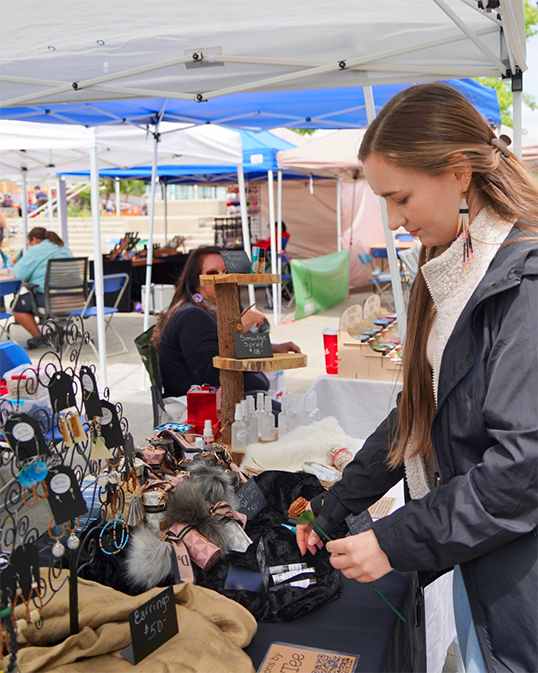

Beadwork by Glasshouse.
“Everyone is encouraged to explore Indigenous artistry and support Indigenous culture,” says vendor Kelsey Favelle, a mixed-ancestry Carrier-Sekani bead worker belonging to Ts'il Kaz Koh Nation “Buying and wearing handcrafted items or apparel from Indigenous creators isn’t something to hesitate over. It is cultural appreciation in its true form, and it directly supports Indigenous livelihoods,” she explains.
Hosted with the Office for Indigenous Peoples, The Indigenous Market takes place from 1 to 6 p.m. at sƛ̓exənew̓txʷ / Tl’e7enḵáw̓txw, First Peoples’ Gathering House, at SFU’s Burnaby campus. The market aims to celebrate and amplify Indigenous artistry, craftsmanship, and entrepreneurship. Approximately 25 vendors will offer original artwork, handmade crafts, clothing, beaded jewellery, traditional and contemporary goods, and snacks.
Audrey Heath, SFU Indigenous Student Centre Indigenous Administration and Events Coordinator, leads the event. First held four years ago in June 2022 for Indigenous Peoples Month, it moved to November to align with holiday shopping when the campus is busier.
Heath, a member of Gitxan Nation, says the market doesn’t only offer an opportunity to shop. It creates a dedicated space where Indigenous creators can showcase their work, develop business opportunities and connect with the wider campus and local community.
Beading as an act of reconciliation
Vendor Flavelle owns Glasshouse (@glasshouse.handmade) where her beadwork provides an opportunity to explore culture, identity and connection. She describes her relationship with beading as deeply personal since she had limited access to knowledge about her culture, a consequence of colonial policies and the displacement of cultural knowledge.
“So, for me, beading is an act of reconciliation with myself, my ancestors, and our histories,” she points out.
“Glasshouse is my invitation into conversation about these things with all kinds of people; it’s a love letter to the land; it’s a celebration of the gritty work of cultural preservation; it’s nervous system regulation; it’s a humble request to connect with kin,” she adds.
Favelle invites people to recognize the full breadth of Indigenous peoples – activists, parents, politicians, educators, entrepreneurs, historians, and artists – all as contributors to a future shaped by their own voices and experiences; a future, she says, that should have been their inheritance instead of theirs to reclaim.
“Thank you for taking an interest in this event and the people behind it. Misiyh (with gratitude),” she says.
An invitation to connect and learn
Similarly, SFU’s Heath encourages everyone, including those unfamiliar with Indigenous cultures or histories, to attend. She hopes the market will provide a welcoming opportunity to appreciate Indigenous artistry and support the people behind the work.
“It can sometimes feel intimidating for non-Indigenous folks to enter these spaces if they aren’t familiar with Indigenous cultures or histories,” she explains. “All are welcome at this event.”
She also emphasizes that supporting Indigenous creators should extend beyond a single event.
Visitors can follow artists on social media, share their work and purchase directly through online stores or digital channels throughout the year.
For those attending, Heath offers a few simple reminders: “General social etiquette and respect go a long way! Ask permission before touching handcrafted items or photographing artists and their work, and consider bringing cash, as some vendors appreciate it.”
Above all, she encourages visitors to arrive with an open heart and a willingness to connect.
The Indigenous Market is an opportunity to discover the talent, stories and entrepreneurial spirit of local Indigenous creators while supporting their work and livelihoods.
For more information, visit: events.sfu.ca/event/indigenous-market-2026


Comments will load once you reach the end of the article.