
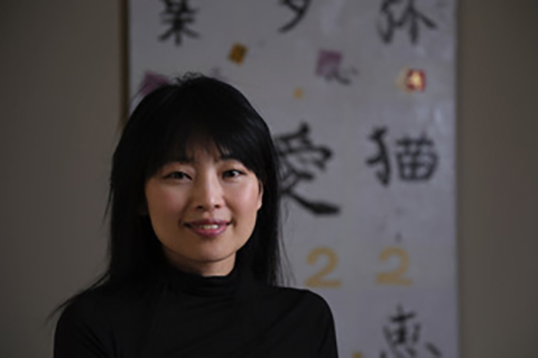
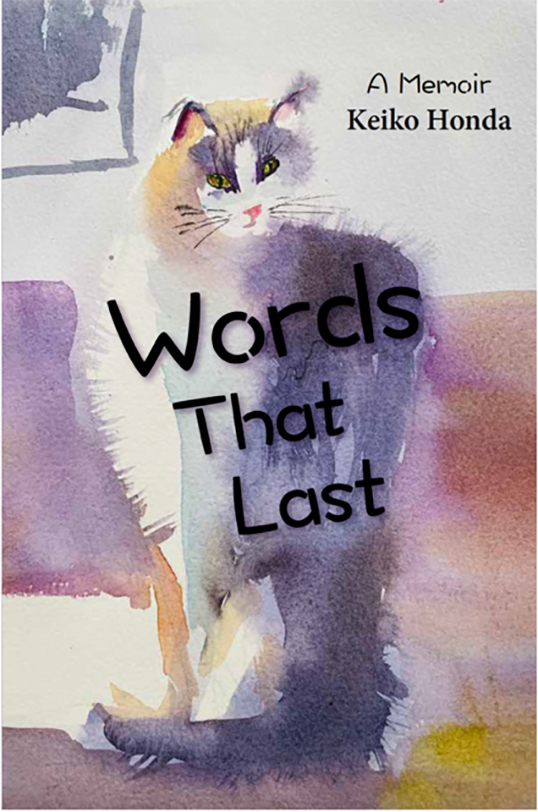
Cover of Words That Last. | Photo courtesy of Keiko Honda.
“The traditional forms asked me to be surer than I was,” says Honda. “An essay moves toward a thesis, and a thesis wants certainty.”
“When I first met zuihitsu, I did not get it,” says Honda. “Then I began to see it as closer to what Darwin called descent with modification: no blueprint, no endpoint. A piece appears, and the next is a small variation on it. Some stay, some fade and a shape emerges that I didn’t plan. I arrange what remains.”
Life in the residual
For Honda, this fragmented style is crucial to fully capturing her experiences and her reflections on them. Prior to writing Words that Last, Honda worked as an epidemiologist at Columbia University in New York. However, after contracting a rare autoimmune disease that confined her to a wheelchair, Honda ended up leaving her job and eventually moved to Vancouver in 2009 where she became involved in the city’s art scene.
“It took me longer than it should have to see that life lives in the part that refuses to resolve,” says Honda. “Then I became a wheelchair user, and not long after, a stranger on the street said something small and unplanned: ‘Hey, you got a great smile.’ It did more for me, in that moment, than anything I had ever measured.”
For Honda, that moment made her drawn to capturing “the residual,” as opposed to trying to piece together a “neat arc.”
“When I leave those silences on the page, I’m inviting readers to bring their own residual to meet mine,” says Honda. “An open question to carry long after the book is closed.”
Staying with the contradictions
For inspiration, Honda “wrote beside a thousand years of Japanese writers,” with Sei Shōnagon and Bashō serving as key influences for this work.
“From Shōnagon I learned that a list can be a way of paying attention,” says Honda. “From Bashō came karumi, lightness, which in the afterword sits beside my mother’s practice of Hawaiian hula.”
“Somewhere in that crossing, I began to see the people closest to me differently,” said Honda. “And I came to think that words may be the one thing we’ve figured out how to make outlast us.”
Honda hopes the book stays with readers long after they’ve finished reading and causes them to rethink “what stays in the air after the bell has stopped.”
“When something refuses to fit, whether it’s a plan, a diagnosis or the narrative you’ve built around yourself, the usual move is to call it noise and look away,” says Honda. “I’d like readers to stay with it and ask three questions. Is it recurring? Who does it matter to? What would you have to admit to let it stay? What you’ve been ignoring may be the most accurate thing in the room.”
“In heavy times, noticing small things can feel like a luxury,” says Honda. “Attention in the middle of loss is resistance. It is how we insist that joy and grace survive beside grief.”


Comments will load once you reach the end of the article.