
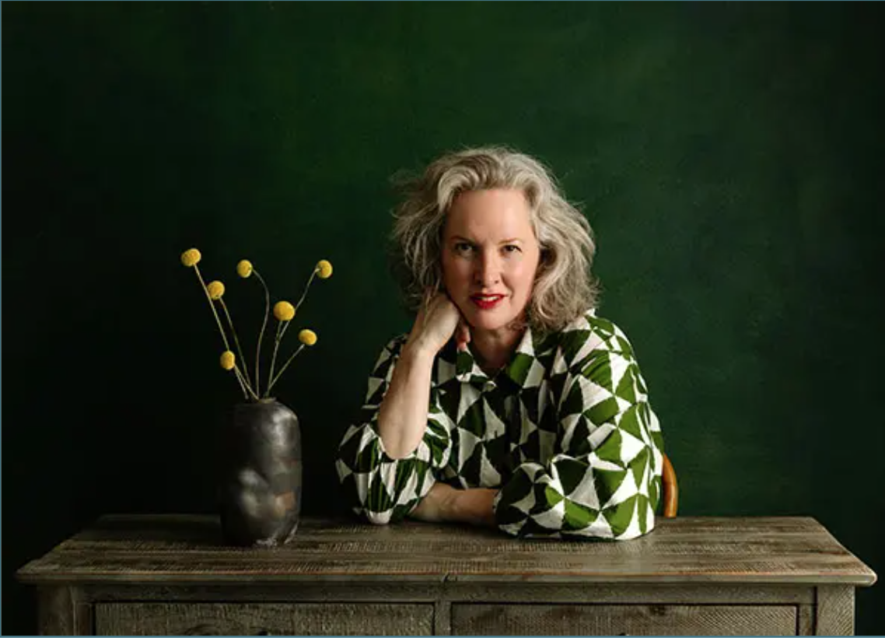
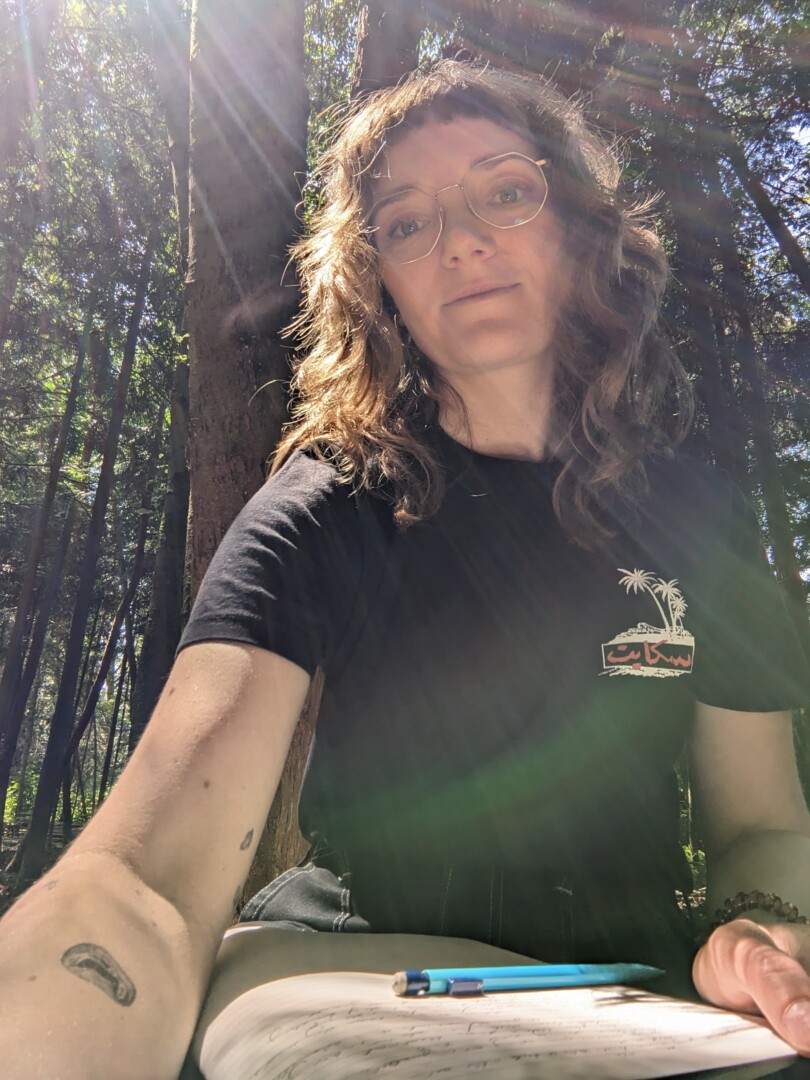
Citizen Poet Fiona Glen at UBC Farm | Courtesy of Fiona Glen.
“Poetry is very portable—a small poem can last you a very long time,” says Vancouver’s Poet Laureate Elee Kraljii Gardiner. A good poem, she adds, requires multiple readings to fully understand its intricacies—an experience that can be “very satisfying.” As part of her Poet Laureate work, Kraljii Gardiner established the Citizen Poets initiative—empowering everyone to engage with their communities through poetry.
“Every time we do an event, I’m at some place handing out these Citizen Poet buttons, and I tell people that they are now Citizen Poets,” Kraljii Gardiner calls the process a “mass deputization” of people. “And then, they are responsible for deputizing other Citizen Poets: It’s this way to engage beyond the bounds of one’s circle and allow poetry to be the vehicle.”
The program matches selected poets to a host site. Poets then undertake a residency—with the goal of bring poetry into the public sphere.
“Citizen Poethood is about claiming the space to be a poet publicly,” adds Fiona Glen, part of the Citizen Poets 2025 cohort. She notes the act of writing comes in different forms: thinking, listening, resting, engaging in conversation and other everyday practices. “That doesn’t have to be limited in any way to the people working with Elee directly—she really wants people to take it as a name, a badge, something that anyone can be.”
According to Kraljii Gardiner, the selected poets not only benefited their host sites; they also leveraged the title of Citizen Poets to establish new connections. The initiative is now seeking applicants for its new cohort.
Activating poets
Established in 2006, Vancouver’s Poet Laureate program is generously funded by scholar, educator and philanthropist Yosef Wosk. Each poet laureate—also known as “the people’s poet”—is given funding during their two-to-three-year term to create literary projects around the city.
Kraljii Gardiner was a Poetry Ambassador during Rachel Rose’s tenure as Vancouver’s Poet Laureate. Continuing this tradition of community work, Kraljii Gardiner wanted to “activate” other poets. She selected seven poets interested in being “out in the community”; each poet was given an honorarium.
“What can I do with this amount of money that will ripple a bit more?” Kraljii Gardiner shares her thinking behind the Citizen Poets initiative. “I thought, if I could flip small amounts of the money to more people—that will then activate more people who can then activate more people.”
Citizen Poet Glen—who wanted to be outside during the residency—was attracted to the idea of “making listening a clear part of poetry” and the opportunity to engage with the public. That engagement took different forms at her host site of UBC Farm: speaking with entomologists, holding a writing workshop and simply being present.
“It was completely fine to be present in the space that we were as poets, that in itself was an act of opening up what poetry can be and look like in public space,” Glen shares of Kraljii Gardiner’s approach to the program.
Glen actively chose to put off writing “proper” poems until after the residency. She dedicated time to observing the space—listening, taking notes and returning to spots that drew her attention.
“Through changing the way I listen and pay attention to space, I could change my relationship to time,” she shares. Glen’s goal was to adapt her writing practice to prepare for a longer project writing about sound. “It was quite a profound experience, allowing the place to change me.”
Playing with sound
Applicants were not required to have been published poets. While Kraljii Gardiner didn’t have a set criterion in mind, she was looking for people with a “curiosity and openness” towards the project. The application itself was intentionally kept simple—a reflection of Kraljii Gardiner’s commitment to creating accessible spaces for writers.
“I wanted places that represented a range of experience, that were geographically distributed,” she shares of their community sites. Kraljii Gardiner also looked for places that would allow visits after regular work hours. “We really needed a mixture of places that were going to provide access to as many different people in Vancouver as possible.”
She then searched for places that welcomed “radical intervention of social interaction”—as demonstrated through an appreciation of the arts. Glen also credits her host site’s coordinator as a major support throughout the process.
“People don’t often think of farm plus poetry,” Glen speaks of how being at UBC Farms encouraged her to learn more about agriculture. “It’s been a lovely way to show that anywhere can be a space for poetry and creative programming.”
Glen hopes the project inspires more outdoor or “unexpected” venues to host cultural programs. Once matched, poets had to wear a Citizen Poet button and use their time however they saw fit.
“The third requirement was that they would record something for me,” Kraljii Gardiner shares. “This recording could be about speaking a poem they wrote during residency.”
Poets could also record a reading of someone else’s poem; a recording of sounds they heard in their neighbourhood or during their residency was also accepted. These recordings were compiled into a playlist hosted on the Vancouver Public Library’s YouTube channel.
“‘Here, Hearing’ is about place and sensing vibrations, but it’s not only for the hearing, it’s for anybody who is sensing anything,” Kraljii Gardiner says of her broader Poet Laureate project. “It’s really important that we be accessible to all aspects of the community, so Dani [Rodríguez, another Citizen Poet] made this beautiful visual field of captions of everything that was being represented sonically in this playlist.”
Kraljii Gardiner envisioned the Citizen Poets to “be as they are” and “do as they are”—an approach that values diverse perspectives when building equitable, sustainable, inspirational and humane communities.
In addition to Glen, who was matched to UBC Farm, the other 2025 Citizen Poets were: Adolfo Bermúdez (El Mashup); Cabil (The Canadian Chinese Museum); Dani Rodríguez Chevalier (Upstart & Crow); Elana Brief (Upstart & Crow); Karen Parrish (Samuel and Frances Belzberg Library); and Lauren Peat (Enabling Arts). Applications for the 2026 cohort are now open—apply by April 20, 2026: https://versevancouver.ca/residencies/.
For more information on the Citizen Poets initiative, see https://versevancouver.ca/legacy-project/meet-the-2025-citizen-poets/
For more information on Elee Kraljii Gardiner, https://eleekg.com/.
For more information on Fiona Glen, see https://fiona-glen.com/Main.


Comments will load once you reach the end of the article.