
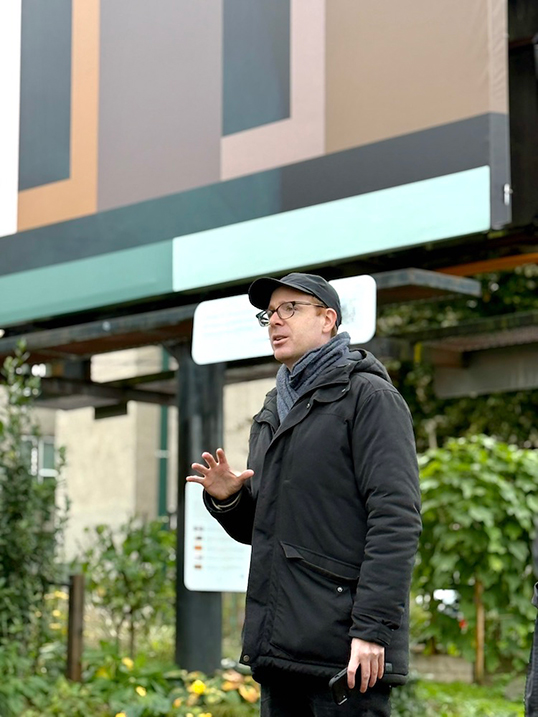
Sydney Hart in front of a Ripples billboard on walking tour. | Photo by Global Reporting Centre.
For Hart, the work reflects his artistic practice of using data visualizations to highlight invisible, capitalist processes.
“What was more important to me was to explore gaps between seeing and reading, information and abstraction, and to examine emotional or affective relations to information statistics,” he shares.
The project is a collaboration between the artist, the University of British Columbia’s (UBC) Global Reporting Centre, curator Christine D’Onofrio and researcher Gavin Fridell.
Hart will be joined by UBC associate professor of art history Jaleh Mansoor in a conversation about Ripples on Nov. 20 at the Emily Carr University of Art + Design’s Rennie Hall. The event will be moderated by D’Onofrio.
Interdisciplinary collaborations
Last year, UBC professor D’Onofrio contacted Hart with a collaboration request. D’Onofrio had been working with the Global Reporting Centre (GRC) on their project, “Hidden Costs of Global Supply Chains.”
A multi-year long project, “Hidden Costs” is a research cluster – including journalists, academics and artists – exploring consequences of global supply chains. Hart recalls how D’Onofrio was looking for an artist to close the project.
“The prospect of collaborating across disciplines always entails a degree of risk,” the artist says. “I think that risk paid off.”
Hart was intrigued by the opportunity to collaborate with a GRC-connected researcher. He started working with Fridell, professor of political science and global development studies at St. Mary’s University in Halifax.
“[Fridell’s] looking at supply chains and trades through a humanities lens: he’s interested in the ideological aspects of trade,” Hart explains, adding that the researcher also explores trade from a psychoanalytical framework. “A lot of his research was mind-blowing to me.”
Hart had already been studying supply chains and logistics from a humanities and arts perspective – using publicly available sources like the website “Our World in Data.” Through conversations with Fridell who supplied “more refined and obscure” resources, Ripples was created.
“I developed a pattern where I could combine that satellite imagery with abstract shape and data visualization,” the artist says of Ripples. “The project is about exploring what can be read in the artwork, like the visualization, and what escapes rationality – what escapes reading and decoding.”
Finding new ground
Hart drew on his existing artistic practice for data visualization. His practice works with images that included “three elements in different measures”: the first is photographic or satellite imagery; the second is abstract shapes; and the third is data visualization.
“I’ll have three triangles representing carbon emissions, but then I’ll have three triangles that are abstract, so I’m playing with visual echoes there,” the artist adds. “I wanted to explore the gap between what can be intuitive – light or dark, primary or secondary colours – versus what you need to read or decode.”
Even before Ripples, Hart had been curious about processes “shaping global capitalism,” particularly those concerned with maritime trade. He sees these processes are largely invisible to city dwellers.
One of Hart’s inspirations is American photographer and writer, Allan Sekula. The artist recalls learning that “9/10ths of the world’s commerce pass through the sea” from a documentary Sekula directed with fellow filmmaker Noël Burch.
Ripples draws on satellite images of the Salish sea and Pacific Northwest Coast. The artist considers the work regionally rooted, describing this connection as an “elemental aspect.”
“I was really attracted to the aesthetic dimensions of those ripples I observed: How they might have been shaped by wind, by boats,” Hart says.
The title also refers to how consumers have “ripple effects” on global trade. The artist and Fridell also considered how trade could be the solution to its own consequences.
While Hart first envisioned the billboards at the Port of Vancouver – a reflection of his interest in the seas and maritime trade – the final location allows for a different engagement with space.
“At the Arbutus Greenway, there’s an opportunity to examine a more overtly natural space,” Hart shares. “I was interested in the images of the ocean I was depicting in relation to the greenery of the space.”
The installations will be displayed until Nov. 23 as part of Vancouver’s public art program.
For more information, see www.globalreportingcentre.org/ripples


Comments will load once you reach the end of the article.