
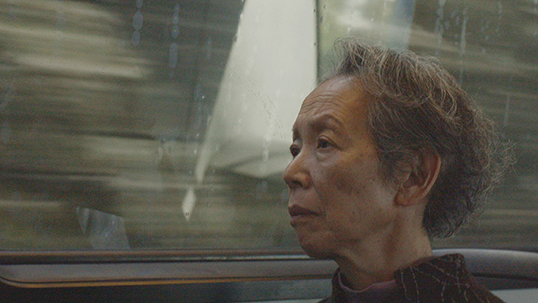
Karilynn Ming Ho, Untitled, 2026, video (still). | Photo courtesy of the artist.
“More than anything, this exhibition is about how we can access new possibilities and collaborations to exchange with one another and create something new,” says Hara.
The exhibition features works by twelve renowned Japanese and Canadian artists, including Yusuke Shibata, Shiho Kagabu, Mineki Murata, Marico Aoki, and Haruka Saito, among others. Together, this lineup features multiple disciplines, such as on-site installation, performance, sculpture and more.
Stories without borders
Born in Tokyo, Japan, Hara’s pursuit of the arts has always been founded in collaboration with other artists. Since moving to Vancouver two decades ago, she has worked with a diverse range of artists in the Metro Vancouver community, notably during her time as a Chief Curator of Centre A: Vancouver International Centre for Contemporary Asian Art. It comes as no surprise that she soon co-founded Pacific Crossings in 2019, a curatorial platform with a mission to connect artists across borders. Tokyo’s ACO, headed by Director Nozomu Ogawa, quickly became an integral partner to Pacific Crossings, allowing for the sharing of histories, experiences, and culture between members in B.C and Japan.
“For over seven years, we’ve been meeting in Tokyo, inviting artists from Ongoing to B.C, or sending artists from B.C to be hosted by Ongoing. It has been a great honour to bridge the way and work with colleagues abroad,” shares Hara.
The artists affiliated with Ongoing/Pacific Crossings bring new and thoughtful perspectives from a wide variety of experiences. From Ming Ho’s work warning of AI replacing human connection to Kagabu’s exploration of Richmond’s vibrant scenery, the exhibition promises a unique and contemplative environment for all audiences.
“The artists in Ongoing/Pacific Crossings show their spirit and uniqueness, and that is what I wanted to show audiences in Vancouver,” says Hara.
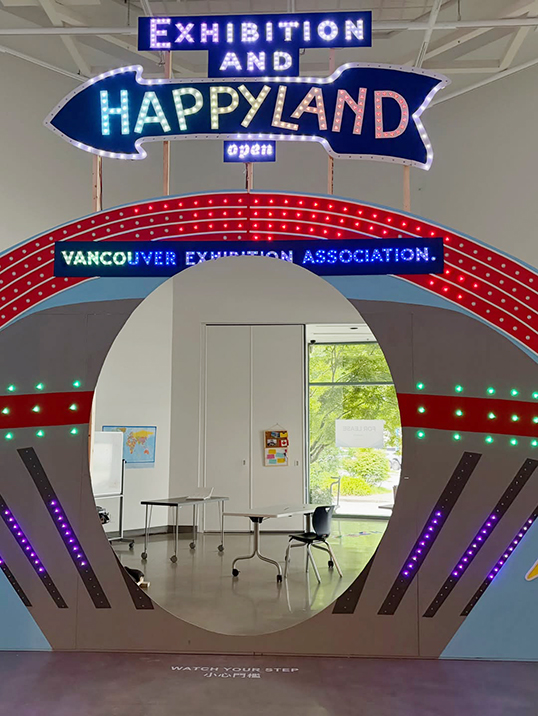
Hara notes Shibata’s newest work HAPPYLAND, a multi-media installation that reflects upon the experience of a Japanese-Canadian immigrant. It was created referencing both archival material and personal interviews with Japanese visitors, immigrants and post-war immigrants, resulting in an emotional piece about finding belonging.
“HAPPYLAND is a new world response from current immigrants living in Richmond and beyond, but also illustrates the universal dream of moving from one place to another in search of happy land, which may have unexpected, challenging and sometimes difficult results. The installation opened up a very personal experience of immigrants into a more universal state,” says Hara.
Bridging audiences
While all of the artists featured in Ongoing/Pacific Crossings draw on more emotionally rich themes, this does not restrict audiences by background or age. Hara is especially thrilled to see diverse audiences enjoying the exhibition.
“It has been really exciting to see Ongoing’s works in Richmond Art Gallery because in Tokyo, we see mostly artists and regulars of the art community. This is very opposite to Richmond where the audience is completely open,” says Hara. “Since the doors opened, we have been seeing a lot of young kids and regular people from Richmond’s community enjoying the show. I love seeing how the artwork engages new audiences across the Pacific.”
Culture in conversation
With each exhibition, Pacific Crossing’s central goal is fortified.
“We all come from different places and so we carry different cultures, which is interesting to open up, intersect and share,” says Hara. “I think contemporary art is very much about that human relationship that emerged from curiosity, travelling and exchange with one another.”
For more information, please visit: www.richmondartgallery.org/ongoing-pacific-crossings


Comments will load once you reach the end of the article.