
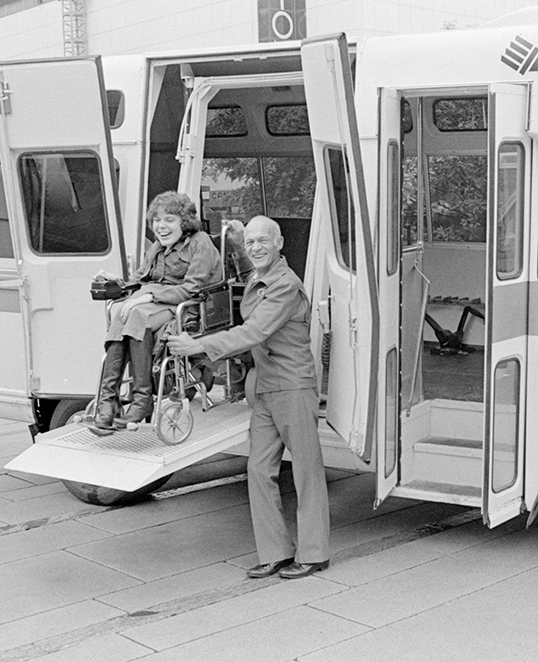
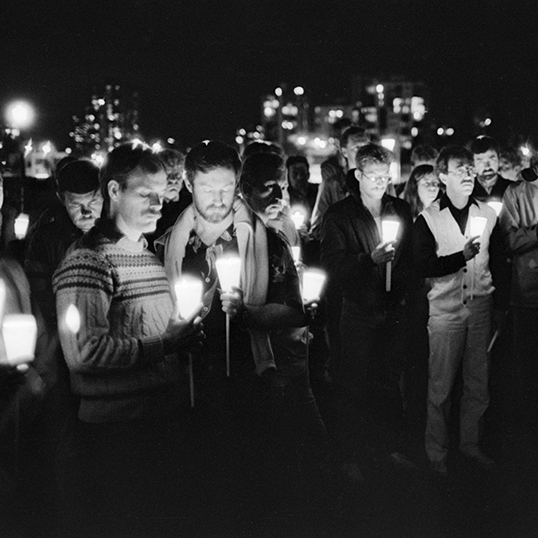
Community members founded the Vancouver AIDS Society to support people living with AIDS and those affected by the epidemic. At a time when government support was limited, organizers created networks of care, information and advocacy. Their work helped people access resources and challenged the stigma surrounding AIDS. | Photo courtesy of City of Vancouver Archives.
“There’s a lot of stigma about not being normal,” explains Gosselin.
The Museum of Vancouver explores the history of disability activism and its role in shaping a more inclusive future with the exhibit Taking Care: Disability Activism and Possible Futures (Nov. 19, 2026 to Dec. 2027).
A history of disability activism
The exhibition’s origins can be traced to the work of Carmen Papalia, one of its three co-curators. After losing his sight in his late teens, Papalia began exploring how to navigate the world as a non-visual learner, drawing on the social model of disability.
“It’s not his blindness that’s the problem. It’s how people treat him,” explains Gosselin.
Gosselin encountered Papalia’s work around 10 years ago. Her interest in his approach eventually inspired the museum’s curatorial team to explore the history of disability activism in Vancouver.
The exhibition traces history back to the 1970s, which Gosselin describes as a turning point with disabled people “feeling strongly about advocating for themselves.” While advocacy had previously often come from churches, schools, families and other allies, disabled people increasingly began organizing and advocating for themselves.
This history is presented through a 70-foot timeline – the installation size intended to make a bold statement and give disability activism greater visibility – highlighting the artists, performers and activists who helped advance disability rights.
“Too often, people with disabilities are […] asked to take less space to make themselves small,” says Gosselin.
Activism in everyday life
When more than one in four Canadians live with a disability, it begs a question: what does it really mean to be “normal”?
Beyond exploring the history, the exhibition also considers how disability culture takes shape in everyday life.
In one installation, visitors can step into a studio apartment shared by two disability activists; the space offers a glimpse into the ways disabled people adapt their surroundings to meet their needs. Gosselin describes the disabled community as “extremely resourceful” in navigating a world that has not been designed with their needs in mind.
“For that very reason, people by design become hackers,” points out Gosselin. “They’re always adapting objects, systems, to fit their needs.”
This installation challenges conventional ideas of activism, showing that advocacy can start within the home. For individuals who may not always have the energy to participate in large public demonstrations, a home can serve as a space to connect and organize communities.
“Activism also can start at home,” says Gosselin, explaining how a bedroom can be both a sanctuary and a place for meaningful advocacy.
This resourcefulness is further reflected in a collection of instruments from the Vancouver Adapted Music Society, a nonprofit supporting musicians with physical disabilities. Among the instruments featured is a guitar strummer activated by a foot pedal and modified guitar picks and drumstick grips.
Gosselin calls the instruments “a great example of activism and resourcefulness,” illustrating how creative adaptations can allow musicians to continue pursuing their passions.
As a part of this collaboration, the society has also donated objects to the museum’s permanent collection in hopes of preserving the history of disability activism in Vancouver.
Imagining a more accessible Vancouver
Looking towards the future, the exhibit features five illustrated scenarios (short two-page comics) that imagine how the values of disability activism can shape Vancouver in the years ahead.
“What if … we were to use these values to think about … a future in Vancouver, where we use these values to problem solve?” asks Gosselin.
One scenario, titled “Rewilding Our Lives,” imagines disability and climate activists restoring a stream beneath downtown Vancouver, making nature more accessible to disabled people who may face barriers to visiting forests or hiking trails.
For Gosselin, the exhibition’s message extends beyond the disability community; and she hopes visitors recognize the different needs and ways of experiencing the world.
“What if we start making more room to different kinds of learners? You know, everyone benefits,” she says.
For more information visit: www.museumofvancouver.ca/taking-care


Comments will load once you reach the end of the article.