
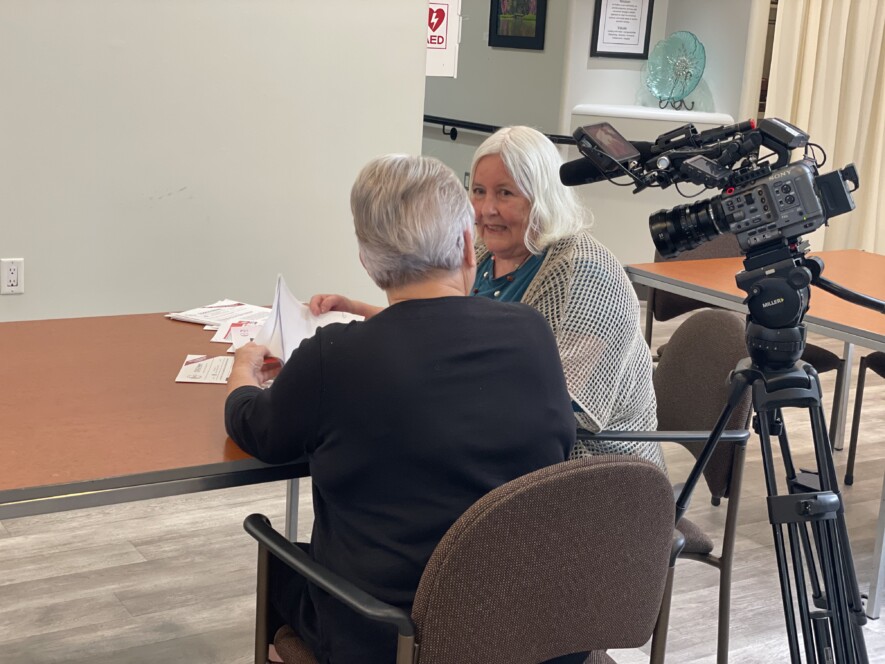

SFU researcher Mei Lan Fang | Photo courtesy of Mei Lan Fang.
Second spaces available to seniors—such as seniors’ centres, community centres or public libraries—are often overlooked and underfunded, says Mei Lan Fang, assistant professor of urban aging at Simon Fraser University (SFU). For B.C. Seniors Week (June 1 – 7), Fang will present, “Beyond Age-Friendly: Reimagining Cities, Care and Community” (June 2, Seniors’ Activity Centre in West Vancouver)—highlighting the essential role of these spaces.
“When I work with seniors, they often tell me, ‘When you hit a point in your life, it’s almost like you become invisible in some way,’” Fang says, noting seniors often lose access to common second spaces: workplaces and schools. “It’s imperative that we look for ways we can value older people more [and] engage them more.”
Part of the Seniors’ Activity Centre Speaker Series, Fang’s talk is presented by Amica Senior Lifestyles. She hopes the session encourages more reflection on age-friendly approaches and senior participation in research.
An aging population
In 2007, the World Health Organization (WHO) released Global Age-friendly Cities: A Guide. The guide—which was created in consultation with seniors, caregivers and other service providers across 22 countries—focused on eight interconnected domains of urban life: housing; outdoor spaces and buildings; social participation; transportation; respect and social inclusion; civic participation and employment; communication and information; and community support and health services.
“We’ve been looking to that [guiding framework] as the key criteria we should be looking at when it comes to making our cities more age friendly,” Fang says. “Over the years, we realized, especially from working with seniors in the community that there’s a lot of nuances associated with that.”
While age-friendly infrastructure is important, her research shows that seniors also require strong social connections.
“We have a huge number of people getting into an older age range and requiring more support, and we can [support them] by creating better infrastructure,” Fang says of the driving factor behind this global movement—now nearing its 20th year—to design age-friendly cities.
Fang advocates for adapting these global guidelines to the Canadian context—identifying local seniors’ everyday needs.
Creating social hubs
Seniors not only require affordable housing, but housing that addresses their needs as they age, says Fang. These include implementations for accessibility, such as handrails. Seniors may also require more check-ins from the building’s caretaker, particularly when it comes to repairs.
Fang adds that older homeowners—who are facing higher upkeep costs—and renters—who are susceptible to renovictions—are both at risk of being displaced.
“[It’s] also about getting people out of their homes and doing things,” she says, emphasizing the need for cultural and physical activities around senior housing.
According to Fang, another issue is transportation. Sidewalks, for example, can be made safer. The professor also advocates for more reliable transportation systems—ones that support seniors in retaining their autonomy—even when they lose the ability to drive.
“Having people in long term care is very, very expensive, and it’s not the desire and expectation of people as they age,” Fang says, adding that her talk focuses on seniors’ perspectives. “In older people’s mind, what does reimagining age friendliness look like?”
For the assistant professor, seniors’ centres are integral to these conversations. These centres—run by and for seniors—offer a range of free or low-cost programming, including physical activities, health workshops or arts and crafts. Low-cost food is often offered as well.
According to Fang, some seniors’ centres even open their programming to those 55 and above, allowing for more connections between age groups.
“You hear lots of stories where an older person’s partner passed away, and they’re just feeling really down and depressed, not knowing what to do and how to move forward,” she shares. “Then, they start going to seniors’ centres and talk about how, ‘This actually saved my life—I was really feeling like I didn’t have a purpose for living.’”
Inclusive play
Fang points out that many seniors’ centres are looking for funding to transition into bigger spaces—a reflection of growing needs across the province. Her research also explores potential connections between seniors’ centres and B.C.’s primary healthcare system.
“Can primary healthcare interventions be offered in seniors’ centres?” she asks, pointing out that such partnerships can reduce healthcare waitlists and encourage seniors to take a preventative approach to their health.
Fang sees seniors as an untapped resource. Many of them, she says, are “highly qualified individuals” with decades of professional experience.
“Involving older people in planning, researching and developing the solution is key,” she says, adding the benefit goes both ways. “As soon as you become really isolated, that’s when your health starts to decline—the best thing you can do as you age is to get out of your house and do things.”
Fang sees “play” and “fun” as essential to both the research process and seniors’ wellbeing. She has seen “multi-purpose” spaces in Asia designed to accommodate play for both younger and older people.
“Older people can also play; it’s not just a kids thing,” she says. “A swing can become an exercise equipment, and different play gyms can be used by people of different age groups.”
Fang—who sees climate adaptation and resilience as another key research domain—observes how older people’s voices have been left out of the climate change movement. In reality, climate change impacts seniors’ overall wellbeing.
“As you age, your body’s ability to regulate temperature changes,” Fang points out that climate change activism is often dominated by younger generations. “When you speak with a lot of older people, they want to help, [and] they want to be part of the movement.”
For more information on the West Vancouver talk, see https://westvancouver.ca/parks-recreation/recreation-programs-services/recreation-activities/events-trips.
For more information on Mei Lan Fang, see https://www.sfu.ca/urban/people/faculty/mei-lan-fang.html.
For more information on the WHO Age-Friendly Cities Framework, see https://extranet.who.int/agefriendlyworld/age-friendly-cities-framework/.


Comments will load once you reach the end of the article.