
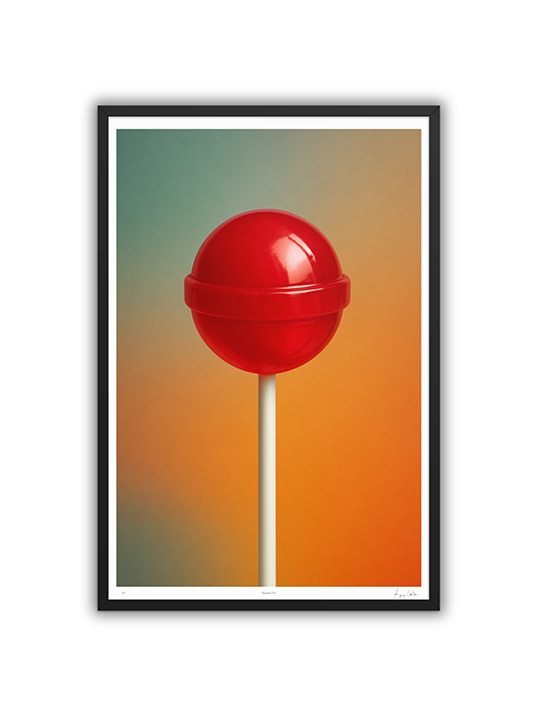
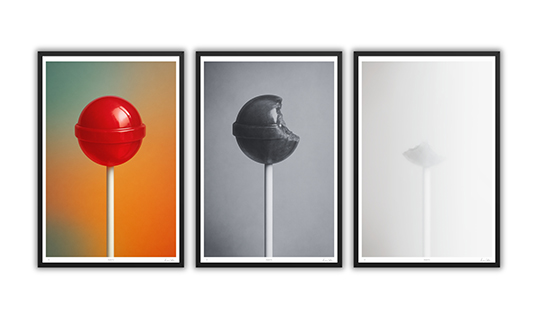
Avery Lake, Sweet Fix (triptych), mixed media installation.
“Sweet Fix is [about] being present,” Lake shares. “What does it mean to enjoy something now that we know will dissolve?”
Festive Visions features 13 local artists. An artist meet and greet will be held at the exhibition’s opening reception on Dec. 4.
A two-sided season
Alongside exploring pleasure’s ephemeral nature, Sweet Fix investigates the role of desire in consumer culture. According to Lake’s artistic statement, the work echoes Andy Warhol’s 1962 Marilyn Diptych – a silkscreen print with 50 images of the late actress.
“It’s three lollipops,” he shares of Sweet Fix. “One is very enticing [with] bright colours; one is bitten and in black and white; and the last one is totally dissolving.”
Each panel – giclée prints on Epson Cold Press Bright fine art paper – is 24 x 36 inches. They are also framed in black wood.
“I wanted to capture that moment of something that is really sweet but disappears over time,” the artist shares. “Things don’t last forever, but you want to have a taste of it, and you want to focus on the present.”
This theme of “sweetness” reflects on the meaning of festivities and celebrations. Lake adds that while people may look forward to the holidays, nothing lasts forever.
“Some viewers will probably feel delighted; others might feel the opposite: melancholic,” he shares. “And that’s the season of the holidays – there’s the sweetness of the holiday, but for a lot of people, there’s also sadness.”
For Lake, the work is incomplete until the viewer has experienced it both visually and through taste.
“I’m actually giving away some lollipops,” he adds. “As the viewers experience the enjoyment of the lollipop, they are seeing it dissolve.”
To be human
Lake is the artist name for Johann Roduit. He is also an ethicist with an academic background in theology, bioethics and philosophy. Around 10 years ago, his postdoctoral research investigated the “ethics of outsourcing our moral decision-making reasoning to AI” – a topic that received little attention at the time.
“I can see how it is very frustrating for an artist who has worked on their craft for 10, 20 years, and AI can replicate it in seconds,” Lake shares, adding that he experienced a similar situation when AI was able to replicate his doctoral work. “My question is what happens after this disruption?”
The artist sees technology’s potential to liberate artists. This liberation is rooted in the human agency to create meaning. He published a manifesto, titled “The Age of Beauty,” to encourage artistic endeavours in the age of AI.
“We need to find the freedom to create even when machines can replicate,” he shares. “They can replicate, but they cannot choose to mean something; only humans can give that meaning.”
Lake adds that while people should be critical of technology, they don’t necessarily have to refrain from using it. Rather, they should seek ethical ways to employ technology.
His other work, Becoming Andy. To chosen Singularity explores what Andy Warhol would have done with artificial intelligence. Lake’s goal was to “push [the concept] to the limits” – moving from a diptych to triptych to eventually the potential of infinite images.
“No technology is eternal; they replace one another and complement each other,” he says, noting that ethical questions should always be asked. “It’s not always black and white; it’s like a sweet fix, you can enjoy it, but it might disappear; it might be positive or negative.”
Lake encourages viewers to pause and reflect on the pieces. Placing a real candy jar, labelled “Help Yourself!” beside the three panelled art piece allows viewers to enjoy a “sweet fix.”
The ephemeral nature – taking one of the real lollipops and allowing their bodies to experience the sensations of dissolving pleasure – may also inspire people to be more present. This presentness translates to Lake’s relationship with viewers.
“A lot of my art may not be a direct, emotional response to what is shown,” the artist points out, adding that his works encourage reflection.
For the artist, this sweetness has both good and bad sides. It can be addictive. It can also signify a literal “sweet fix” – something that temporarily satisfies a need but does not actually solve the problem.
“The meaning is [actually] co-created from the artist and the viewer – it goes beyond the mere images,” Lake says. “It requires a choice to be made, and ultimately, the capacity to care about something – which machines cannot do.”
For more information on Avery Lake, see www.averylakeofficial.com
For more information on The Gallery George’s Festive Visions, see www.thegallerygeorge.com/upcoming-exhibitions


Comments will load once you reach the end of the article.