
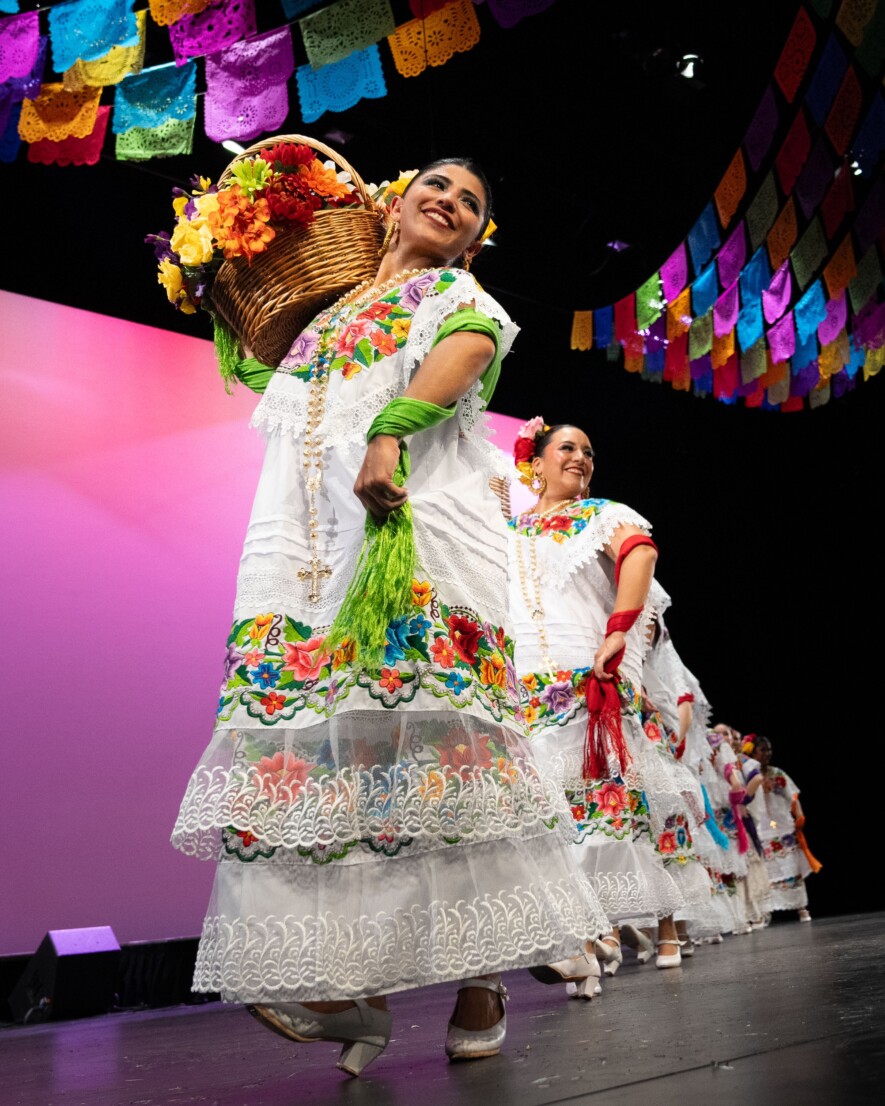
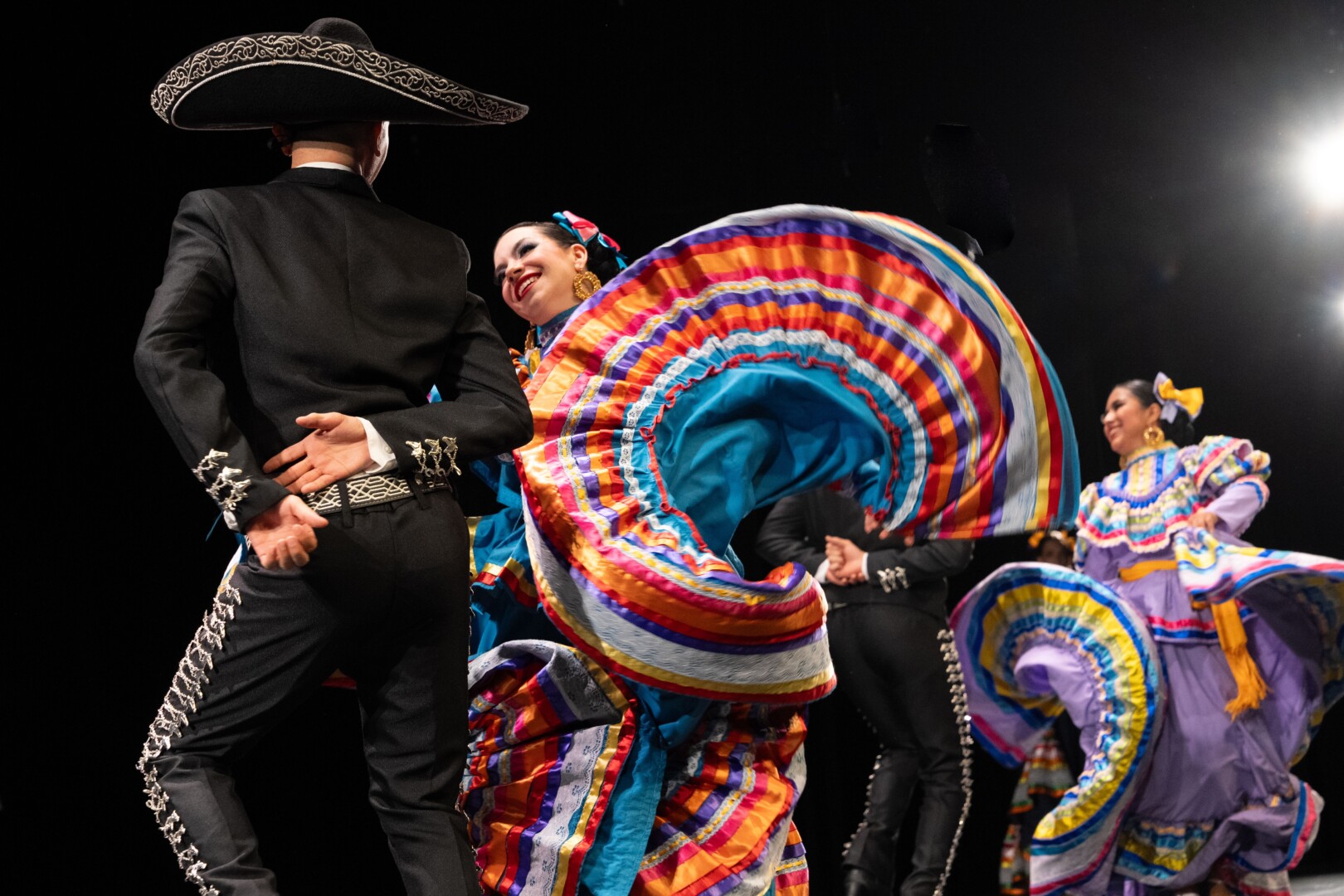
MEXICAN DANCE ENSEMBLE – Jalisco 2025 | Photo by Tom Gould
“I want [the audience] to see these people who are going from regular activities to being on stage, performing dances that they never thought they would be performing, doing something that they never thought they would be doing outside of Mexico,” Ruiz shares. “We need that sense of community—of sharing and helping everyone.”
Embracing challenges
Ruiz choreographed the dances around the theme of challenges. This third edition of Viva La Danza will feature 30 dancers. Out of the 20 choreographies, 15 will solely focus on the dancers; the other five will include live musicians.
Some choreographies are fast paced; others are slow and more intimate, invoking what Ruiz refers to as a Day of the Dead feeling with dancers balancing candles on their heads.
“We go from the North to the South then back to the centre, then we go again to the South and again to the North,” Ruiz says of Viva La Danza’s program. “We try to have a little bit of something from everywhere.”
One of these represented regions is Veracruz in Eastern Mexico. According to Ruiz, the dance style is heavily influenced by the state’s Afro-Indigenous and Afro-Caribbean heritage, including “syncopated rhythms,” “call-and-response structures” and “percussive footwork” from the son jarocho tradition.
The founder adds that each region has a different cultural influence. In Northern Mexico, such as the Nuevo León region, one can find European-influenced dances. According to MDE’s program notes, this style contains “upbeat tempos,” “energetic partner work,” and “a celebratory communal spirit.”
“Then, of course, you have Jalisco which is in the centre: we have the mariachi [and] big, colourful dresses,” Ruiz adds.
The costumes are made in Mexico. Ruiz begins the design process early each year. Using the traditional designs as the “base,” she adds unique touches to each piece—including its accessories and shoes.
“That’s part of my creative process of trying to bring something to life,” she says. “I love to share [my dance] in a way that is colourful; there is something different about it.”
Ruiz is also inspired by the visuality of movements. She choregraphs the pieces to feature different geometrical shapes, such as lines, squares and triangles.
“It’s not just the dance itself; it’s the movement,” she explains. “I’m hoping that everyone can see and be amazed at how so many people can move at the same time and be in the same synchronicity.”
Building a community
This year’s performance will also feature choreography from Ruiz’s students—a sign of MDE’s growing community. Ruiz recalls how only two dancers were able to balance a bottle with water on their heads last year. In this year’s performance, MDE will have twenty dancers performing the Yucatán-based ceremonial dance.
“I do love seeing that evolution of people who are very new to dance,” Ruiz shares. “I walk them through the whole process…getting them into that mindset of ‘I really love it and I think I can do it.’”
Ruiz was a dancer back in Mexico. After relocating to Vancouver at the age of 22, she sought opportunities to continue performing.
“I had a job, I had a family—but something was missing,” she recalls joining a local dance group, performing once or twice a month. “Then, I met people and they would ask, ‘Is there somewhere I can go and learn [Mexican folkloric dance]?”
In 2013, Ruiz established MDE. After two years, the initiative grew from “just being an activity” to a community where newcomers can connect with each other and their culture.
“We would have regular classes and rehearsals, then we’d go for coffee and [food],” the founder recalls. “We celebrate everybody’s accomplishments—we welcome everybody.”
Some members from MDE’s early days are still involved with the company. Ruiz now offers classes at different levels: beginners, intermediate and advanced. The upcoming performance blends all three levels.
“I try to have different dancers from different backgrounds,” she shares, adding there is diversity in age too. “I just love to see them all as a team when it comes to performances…I love seeing that friendship, there are no divisions.”
Ruiz’s company reflects a “generational blend”—featuring young dancers to those over fifty years of age. This diversity is particularly meaningful to the founder: She recalls being seen as “too old” to dance professionally in Mexico at the age of 22.
For Ruiz, beauty can be found everywhere. She adds that in Mexico, dance is a part of everyday life.
“I would love for [the audience] to see that love—that sharing,” Ruiz reflects. “I’d like to remind people that you can do it, and it is better that we do it as a community.”
For more information, see https://thedancecentre.ca/event/viva-la-danza-2025/.


Comments will load once you reach the end of the article.