
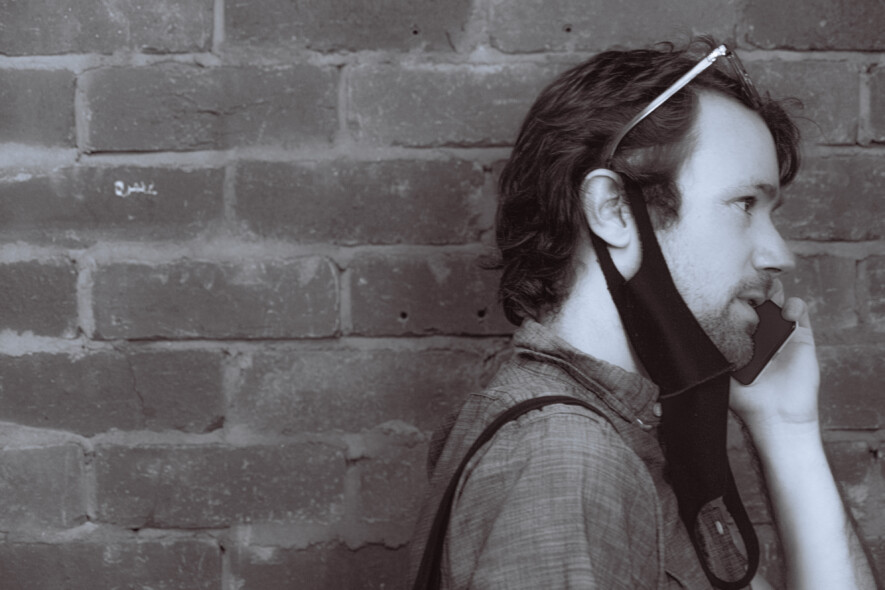
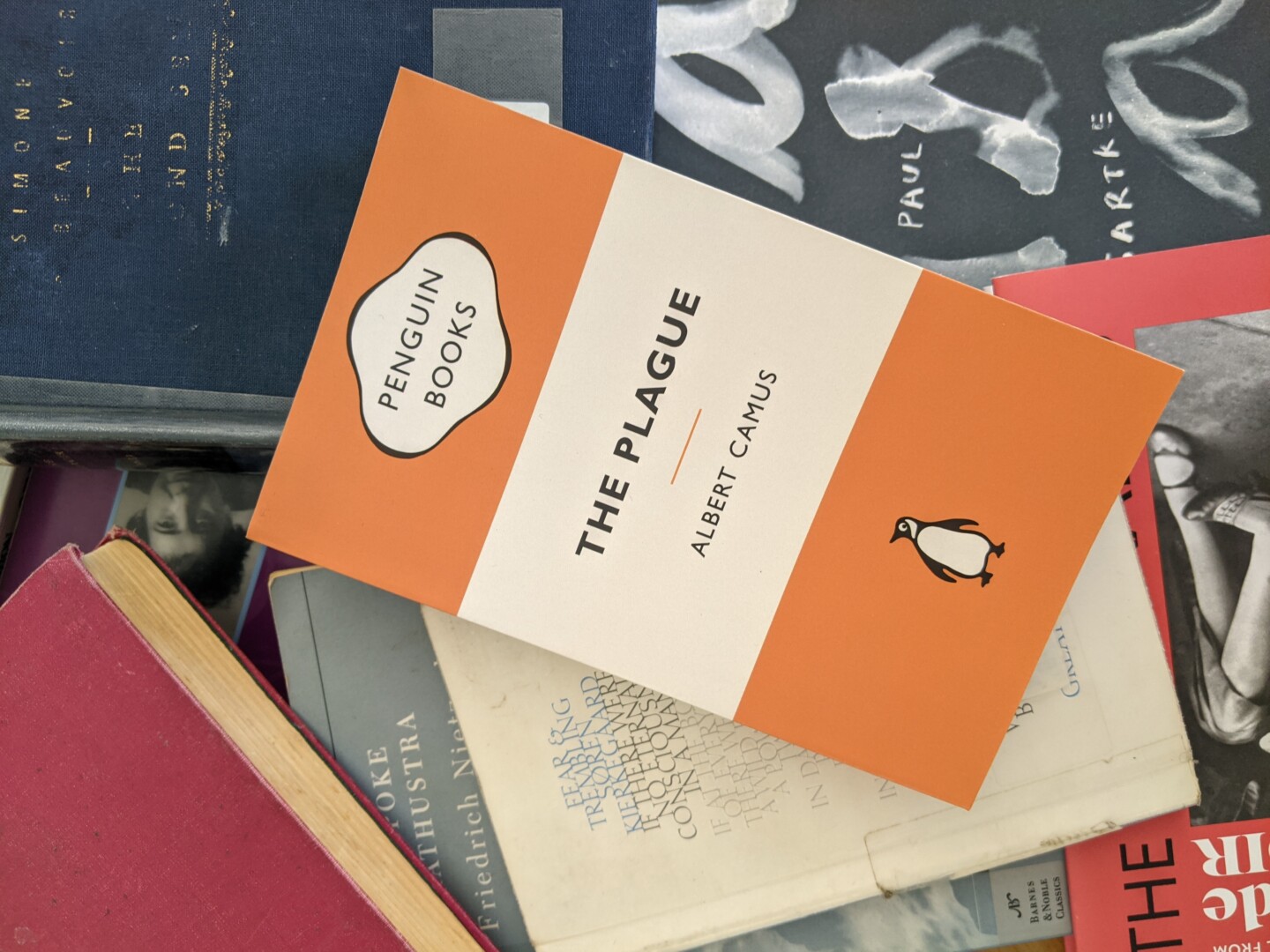
Existentialist texts for Elliot Vaughan’s Existential Hotline | Photo courtesy of Elliot Vaughan.
There’s magic in using technology—it allows artists to morph reality in ways that are not always physically possible, says director of interplay_ Caroline Chien-MacCaull. Now in its 13th season, interplay_ returns Jan. 8-11 with six live, online works pushing the boundaries of digital experimentation.
“[We looked] for people that were using technology beyond just an extra thing or an add on,” Chien-MacCaull shares of the curatorial vision which positions technology as a fellow collaborator. “It felt like the technology was emerging as part of their practice, and it was necessary.”
interplay_2026 is presented by Vancouver-based interdisciplinary art collective, Chimerik. In partnership with New Works XR, three workshops will follow the festival, including an online artist talk and technical workshop on Jan. 17 with intermedia artist Freya Björg Olafson.
Curating an online space
“[Olafson’s] just an incredible dance technology artist,” says Chien-MacCaull. “She’s going to be morphing the real with the pre-recorded, what’s live with what’s being manipulated—she’s someone I really, really admire.”
Olafson will perform excerpts of CPA [Consistent Partial Attention] on Jan. 8 and 10. The work explores the embodied experience during the internet age.
The line-up also includes Niloufar Samadi and Avideh Saadatpajouh’s Glitch Under the Skin. With layered projections, live cameras and analog as well as digital puppetry, the artists will investigate temporality and displacement’s bodily effects on Jan. 9 and 11.
“arya will be doing a spoken ritual, reflecting on memories and cultural symbols, while putting spices into water that will transform into smoke throughout [the performance] to create a digital ritual,” shares Chien-MacCaull of multimedia artist and filmmaker arya’s Ghorboonit (Sacrifice).
Based in Vancouver, arya (Arya Hawker) is a multimedia artist and filmmaker of mixed Iranian Canadian heritage. A close English translation of Ghorboonit Beram is “I would die for you.” It is meant to be a term of endearment in Persian.
His performances—which feed webcam footage in real time into the creation tool Unreal Engine—will be held on Jan. 8 and 10. The artist will also hold a technical workshop on particle simulation using Unreal Engine on Jan. 25 at New Works (77 E 7th Ave).
“Chantal & Choo are doing this really interesting work where they’re using poetry, movement, new media technology, and growing this tree throughout the work,” shares Chien-MacCaull of Chantal & Choo’s Seed Sanctuary.
Seed Sanctuary (Jan. 8 and 10) is an interactive performance—featuring meditative chants and visual communication—that reflects on dreams, cycles and transformation. Chantal Dobles Gering and Choo-Kien Kua of Chantal & Choo will hold a workshop on Jan. 18 at New Works, sharing their artistic process and philosophy.
Continuing a legacy
interplay_’s first iteration took place in 2012—the initiative was led by award-winning choreographer and dancer Vanessa Goodman. Goodman then passed the festival to fellow dance artist Deanna Peters in 2016.
“I was really honoured when Deanna reached out and invited me to take over interplay_,” adds Chien-MacCaull. “You’re able to blur boundaries [with technology] in such different ways you’re not always able to do, especially if you’re interested in state-based work.”
This year’s festival was co-curated by five individuals—bonded through the shared vision of highlighting “experimentation.” The experimentation involves considering how performances can exist in a “site-specific, online” container. For its 2026 edition, that online container is Zoom.
“[An online festival] is also a lot more accessible to rural communities,” Chien-MacCaull shares. “It allows us to connect with these different places that we already have relationships with and curate artists who are not based in Vancouver.”
She looks forward to expanding these partnerships. For Chien-MacCaull, another key part of interplay_ is its interdisciplinary focus.
“One of the artists, Vincent Isabel, is using [objects] through his room…modifying them into sound-making objects and creating music with them in real-time but also activating the body and using performance in this really interesting way,” she shares. “It’s mixing visual art, performance art and sound art.”
The Québec-based Isabel will perform Empathie infonctionnelle [sound observations] on Jan. 9 and 11. After the live, online performances, interplay_2026 will premiere Vancouver-based filmmaker Ying Wang’s new documentary The Border (Jan. 24, The Cinematheque).
The film explores the liminal spaces—that of closure and openness—surrounding the local U.S.-Canada border during and beyond the Covid-19 pandemic. For Chien-MacCaull, the film’s inclusion further pushes the boundaries of interplay_.
“It’s a nice to connect and cross-pollinate between the film and the live, online performances,” she shares. “This idea of borders and of the interdisciplinary is a symbol for what I feel interplay_ has always been [about]: What are these in-between spaces?”
Rolling the dice
New Zealand-based artist Elliot Vaughan will perform Existential Hotline on Jan. 9 and 11—a work investigating chance, anonymity and intimacy. Vaughan is inviting the public to call his hotline (778-652-9759) prior to the performance.
The hotline will be opened from 6:00 p.m. to midnight starting on Jan. 3. The artist will then flip, “non-linearly,” to a page of existentialist philosophy. The concept was developed by both Vaughan and theatre-maker ellis cheadle.
“I’m going to insist that it is a fairly serious question and a legit one,” Vaughan says. “It’s really fun when people ask things like…’Should I quit my day job and commit my life to art for the next 18 months?’ ‘Or how much should I put into fixing my relationship with my mother?’”
“[Vaughan] is using low tech—he really challenged me, too, in this way,” adds Chien-MacCaull. “When we were curating [interplay_], we thought this is such a different thing from what other people are doing.”
Vaughan has previously performed this work for an in-person festival. He recalls how questions of whether to move or stay in a city were common.
“You could answer, ‘yes,’ you could answer, ‘no’; it almost doesn’t matter what you choose as long as you sort of choose,” he reflects. “In my life, I often take the advice—I turn to the book, and that’s how I make the decision.”
Vaughan’s decision to leave Vancouver and move back to New Zealand came about through a similar exercise. His catalogue of existentialist literature was also compiled with a degree of randomness—borrowing whatever was available at the library.
He expects to draw from Søren Kierkegaard, Albert Camus, Simone de Beauvoir, Jean-Paul Sartre and Friedrich Nietzsche. A self-described “non-linear person,” Vaughan has only ever approached these texts through this artistic practice of randomness.
“I don’t come to it from a literary point of view or a study of philosophy—I come to it from artistic engagement,” he says. “It’s most delightful when what the philosopher says speaks to the question and that happens quite often…the question contextualizes the answer.”
A key part of the work, for Vaughan, is the connection between anonymity and intimacy. He sees existentialist philosophy’s investigation of “disembodied experiences” as engaging with similar questions. The telephone was popularized around the same time.
“How is your voice at your end of the call my voice?” he shares. “The technological aspect to this performance is quite different from other tech-driven performances, and it offers something quite fun to the conversation on technology and performance.”
For more information on interplay_2026 Festival, see https://interplay-arts.com/.


Comments will load once you reach the end of the article.