
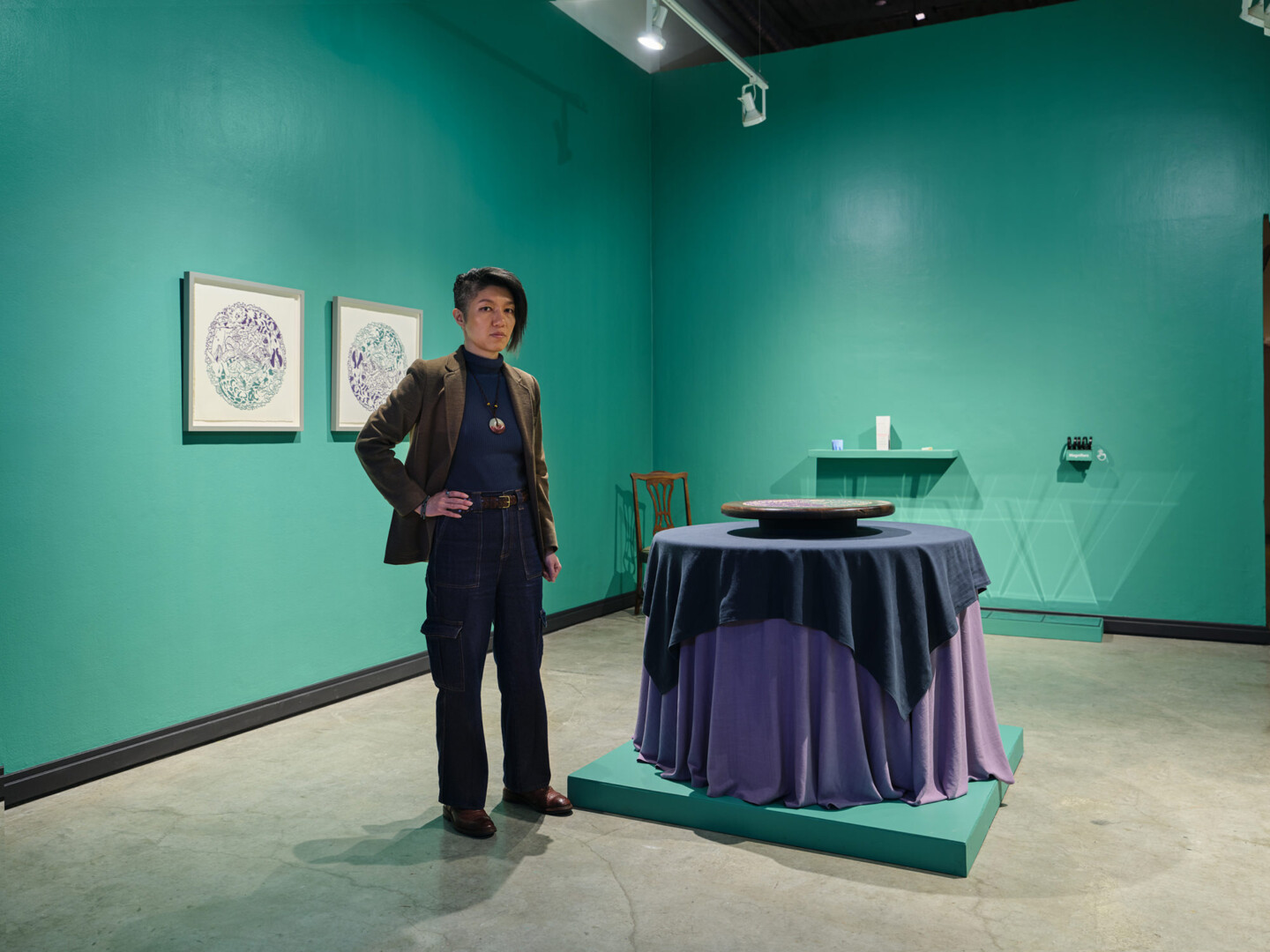
Artist Jenie Gao at Where Mountain Cats Live | Credit: Dennis Ha
Artist Jenie Gao hopes viewers to their grunt gallery exhibition Where Mountain Cats Live reflect on how their own stories are contextualized in social and political systems. Running until Jan. 17, the exhibition features table-based installation, prints and artist’s books—offering an opportunity to reflect on cultural resilience.
“If we come to recognize that our personal stories are always existing in adjacency with these larger, social political systems, then we can begin to see storytelling as a means for us to be both accountable towards and compassionate for one another,” Gao says.
As part of the exhibit’s closing events, Gao will host, “An Independent Artist’s Survival Guide: Business Basics & Art Ethics” on Jan. 14. In this free event, participants will learn how to build a financially viable and ethical art business.
A behind-the-scenes tour will also take place Jan. 17 with Kay Slater, the exhibitions manager at grunt gallery. Gagan Saran will also lead blind tours of Where Mountain Cats Live on Jan. 9 and 16.
Questioning exclusivity
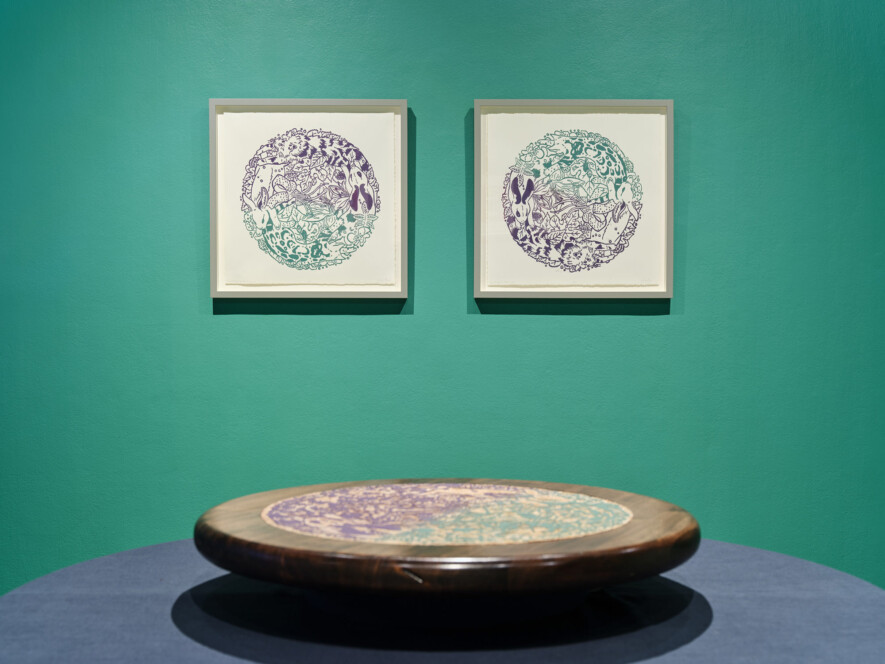
The exhibition’s centerpiece is a ‘lazy Susan’ table from Gao’s larger series, The Negotiation Table, which challenges conventional practices of printmaking. The series transforms their hand-carved woodblocks—which are used for printmaking—into centerpieces.
For Gao, this transformation is a statement on the labour of printmaking. The artist points out how the art form was historically a communication tool “to democratize information,” allowing people to print books and newspapers.
“The traditional printmaking tools, like woodcarving, became [a part of] the fine arts,” Gao explains of the rise in digital technology. “In the western world, fine arts prizes exclusivity and rarity, and it became a problem in printmaking that you could make multiples—How can you prove that something is rare, and therefore, valuable if you could make many of [it]?”
They add that, to preserve artworks’ rarity, the common practice is to destroy woodblocks and printing plates. Gao has always felt uncomfortable with this practice—a discomfort rooted in their family’s immigration history from Taiwan to the U.S.
“To participate in the act of destruction to prove that something is rare because it is minoritized is not something I like in my practice,” they explain, noting how the Chinese Exclusion Act of 1882 forcibly created “limited” editions of people. “When I finish making the woodblock prints of the artworks hanging on the walls and frames, the end of the edition comes not from the destruction of the hand carved blocks, but its transformation into a purpose beyond its productivity.”
Their discomfort also stems from a deep respect for labour. For Gao, the process is an artwork worthy of celebration.
Resilient imagination
A piece currently on display at the grunt gallery was inspired by their mother’s lived experience. As a child, Gao’s mother lived in an old Taiwanese building on the mountainside.
There wasn’t enough room in the family’s small apartment, so they rented a bedroom on the building’s third floor for Gao’s mother.
“She’d have to ascend into the mountains, under the watchful eyes of the mountain lions,” Gao recalls of their mother’s story. “She’s telling me this story in the present-day context, and it’s her way of telling me she’s brave and she can do things alone.”
Gao has been working to document their family’s stories—a task that has inspired further reflections on accuracy in historical documentation. Through research, the artist discovered that mountain lions did not exist in Taiwan. Their mother most likely saw feral cats.
“Perhaps, in reality, the cats of my mother’s story were just outdoor cats,” Gao adds. “There’s also the wonder, the fact that, yes, through the eyes of the child and in the preservation of the story, there really were mountain lions.”
The artist adds that imagination is a powerful tool for cultural resilience. Themes of homebuilding in precarious spaces and property dispossession also run throughout the exhibition.
Gao’s maternal grandparents’ farmlands were seized by Chinese nationalists following the Communist Revolution. When they immigrated to the U.S., Gao’s family purchased a home. This property, too, was repossessed by the government to build a freeway.
“It’s a classic story of what happens to marginalized people in the U.S. and in Canada,” the artist says. “While art always has the ability to challenge and critique existing systems, the institutional systems around us have also been built in such a way that they individually co-opt and weaponize people’s stories.”
For more information, on the grunt gallery exhibit see https://grunt.ca/.
For more information on Jenie Gao, see https://jenie.org/index.html.


Comments will load once you reach the end of the article.