

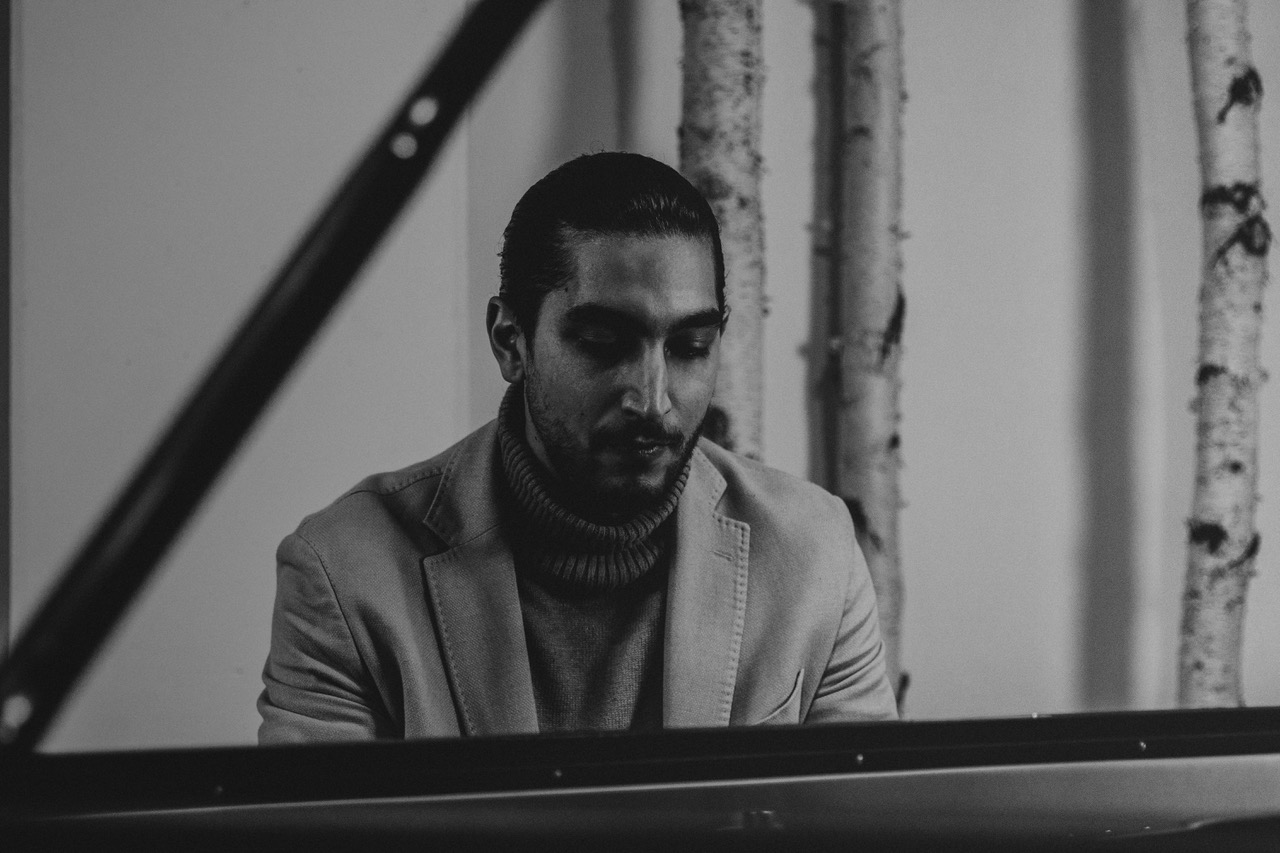
Spartak Margaryan | Credit: Kateryna Hussing
Interpretation doesn’t just exist in music performance—it is also how you approach everything in life, says pianist Spartak Margaryan. Making his Vancouver debut on Jan. 18 at the ANNEX (823 Seymour Street), Margaryan sees musical interpretation as an everchanging process—negotiating between space, vibration and his own inner world.
“How much space do you want to give the sound to resonate?” he asks. “Sometimes, even if your heartbeat goes a bit too fast, your feeling of the space is also shrinking and becoming smaller, [and] you have to reflect on your condition and [this] feeling.”
The opposite happens on other days: the pianist recalls feeling the need, at times, to give the note “a bigger breath.”
At the ANNEX, Margaryan expects to feature pieces from Beethoven, Brahms and Schubert. The official program will be announced at the concert.
Flowing with changes
Interpreting compositions places performers in “an unstable position,” says Margaryan. In 2021, he released Sonus Eterna, an interpretation of Beethoven’s Diabelli Variations.
“Beethoven’s music is created in a deeply architectural and structural way, meaning that if played simply with intuition, the music can easily overpower and dominate the performer, leading to misinterpretation,” says Margaryan.
For the past six years, the pianist has been fascinated with Beethoven’s musical structure—which he describes as “architectonic.”
“To perform Beethoven convincingly, one must engage deeply with the architecture and structure, rather than focusing [on] the first layers our intuition initially gives us,” he reflects.
Margaryan now hears the music differently, making it “difficult to listen” to his recording. For him, musical performance—unlike other art forms—is a never-ending process.
“[My] mother is an artist, [and] the moment when she says, ‘It’s done,’ and she’s not touching it anymore, it is a finished work,” the pianist explains. “In our case, it’s never coming to this finished point: Everyday, I’m sitting practicing for hours, but tomorrow, it will sound different.”
For Margaryan, the key is to “flow” with these emerging differences—adjusting the music to each condition. Just as the music changes, so does the performer.
“On a daily basis, if you are working on something, and if you are sensitive enough, you will realize that firstly, you are changing every day,” he says. “When you are changing, whatever you do will also change.”
Feeling vibrations
How sound vibrates through the performance space—both the venue and instrument—is also important for Margaryan. He prefers a modern approach to interpretation, recognizing the grand piano’s ability to elongate sound.
“In Germany, there’s a big wave of historical approach to [interpreting] baroque music,” he shares. “This is important to understand—the feeling of that era, of that century—but I believe we need a performer to stay up to date because we have a grand piano now.”
Margaryan was born in Hamburg, Germany to Armenian parents. His family lived there for five years before immigrating to Sweden, where he taught himself how to play the piano.
“This was my decision: I chose the instrument,” Margaryan recalls. “There are musicians who say, ‘Music has chosen me,’ but in my case, it was the reverse.”
Upon his family’s return to Armenia, the musician studied at the Alexander Spendiaryan Music School in the country’s capital, Yerevan. He finished the program in six years.
Margaryan then moved to Siberia and returned to self-studying music. Soon after, he studied at institutions in Berlin and Lübeck—eventually completing his formal education at the University of Music and Theatre in Hamburg.
“I was always curious about the question ‘how’ rather than ‘what,’” says Margaryan of his approach to learning. “Maybe there are some truths [to the techniques], but unless you understand how it works and why you should do [it that way], it will never be a part of you.”
The musician recently moved to B.C. with his Canadian wife, Maia Siradze. Siradze is a classically trained violinist. Together, they established Big Ear Music Society with the goal of bringing European artists to Vancouver.
“I’m new to this town, so I want to learn my audience,” he says of the upcoming performance. “If there is concentration, you can feel it—this is also very dependent on me, the artist, and how I play.”
For more information on the upcoming concert, see https://vancouvercivictheatres.com/events/spartak-margaryan-a-vancouver-debut-jan-18-2026/.
For more information on Spartak Margaryan, see https://www.spartakmargaryan.de/.


Comments will load once you reach the end of the article.