
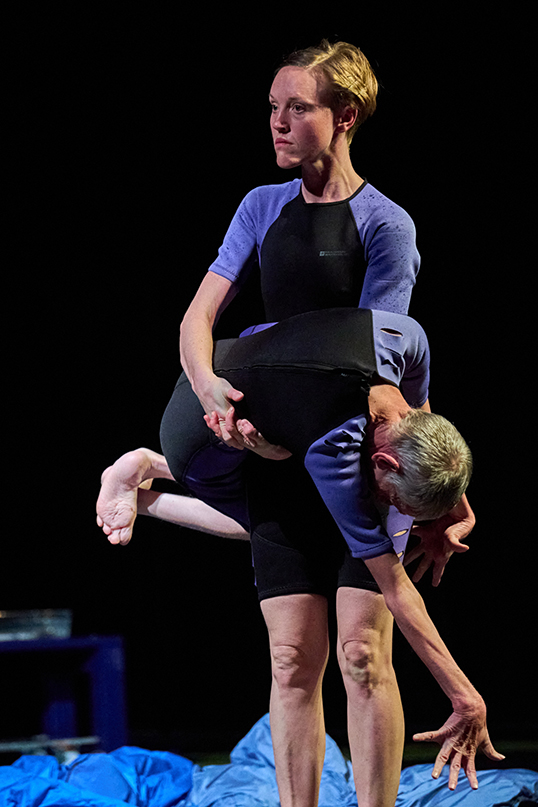
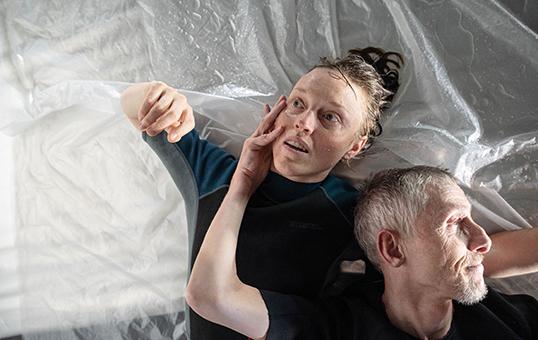
Renae Shadler and Roland Walter in Skin. | Photo by Beat-pix with Heart.
“This idea of excess is a celebration of us both—in a way that Roland doesn’t need to copy me, and I also don’t need to copy Roland,” Shadler shares, adding her collaborator experiences full-body spastic paralysis.
A post-show talkback will take place Feb. 4; a filmed version of Skin will also be available online Feb. 4-8.
Spaces of co-existence
How can we be together and celebrate these two bodies, Shadler questions, without labeling one as more or less abled?
“We made the work about the art, rather than the therapeutic process,” Shadler says. “The real diamond here is the art: [It] becomes a personal journey for the two of us and our friendship.”
The two met following Shadler’s 2018 solo performance of Restore in Berlin. Roland waited after the show, introducing himself with an offer to collaborate. The upcoming PuSh performance combines Walter’s idea of skin—how bodies meet, sense and communicate through touch—with Shadler’s focus on environmental conversations through “worlding.”
“[Worlding] is how I think about choreography: It’s looking at how the environment changes the body, and how the body is influencing the environment,” she explains. “This conversation is very present, especially now in the Anthropocene, as humans have created these enormous changes.”
Shadler points to Australian bushfires and Indonesian volcanic eruptions as examples of these changes. The duo searched for an environment where their bodies can co-exist on stage—that space emerged through water.
“In warm water, [Walter’s] muscle spasms relax, so his body becomes more sinuous, and closer to mine,” Shadler shares. “He’s also over 60, and in warm water, my skin wrinkles, so I begin to age—through this idea of aging and wrinkles.”
The duo initially performed with an inflatable pool. They then adapted to bringing water on stage through a plastic water bottle and shallow tray—allowing this natural element to become what Shadler calls “an active presence.”
“You get this metaphor of the human body and the environmental body,” she explains. “Water opens up imagination toward expanded movement possibilities.”
Shadler adds that water directly shapes their movements. As the dancers pour water on themselves or make the floor slippery, their movements through water are also being moved by water itself.
The performance also draws inspiration from Shadler’s life-long curiosity towards sea anemones—one sparked by Ursula K. Le Guin’s sci-fi writing. The dancers were inspired by the creatures’ physical nature, translating their underwater movements into Skin.
“Conceptually, we were interested in their way of sharing genetic material and used this as a metaphor for freely sharing movement vocabularies with one another,” Shadler adds, noting the sea anemones added play into their process—paving way for “a shared movement language” belonging to both.
Taking risks
Skin champions the idea that every voice is valid, says Shadler. She draws on the “social model of disability,” shifting attention away from the human body to question limiting societal structures.
“How is society itself disabling a body— rather than a medical model in which the body itself is not functioning in the way that society needs it to?” Shadler asks. “I wasn’t interested in Roland accessing my body.”
The choreographer recalls their rehearsals prioritizing “meeting in silence,” “making eye contact,” and “mirroring one another”—all done through “very little language.”
“We would always begin a rehearsal meeting each other with eye contact and very little language,” Shadler recalls. “[Mirroring] is in a way copying, but it’s also understanding and inviting each other into the other person’s tempo.”
The two dancers would often surprise each other, creating what Shadler refers to as an “excess of tempos, movement and possibilities.” The first 30-minutes of Skin sees Shadler and Walter in unison, done through a lead-and-follow method where one person sets the pace.
“Within it, time stretched in sections, and you lose your breath as a dancer: the sound, the lights—how are we going to pull it back together?” Shadler recalls of a previous performance where eye contact between the dancers was crucial. “I think that’s possible because of excess, because there isn’t a forceful perspective that’s saying, ‘I’m right.’”
Shadler sees Skin as celebrating difference and coexistence without hierarchy. Skin does not follow an “obvious” narrative. Instead, Shadler describes the show as “lots of images”—including “very detailed, small” movements.
“If there are people coming to see the work for the first time, I’d invite them to look at this play between the different scales,” she says. “Emese Csornai worked a lot with lights throughout the piece—there’s always this transformation of vision that happens during the work.”
Skin’s lighting designer Csornai plays with scale by strongly lighting a small area, then expanding outwards. Shadler sees risk-taking as embedded in Skin, both in the performers’ movements and communication. They must “listen” and “adjust to one another” on stage.
“I think this moves audiences: this idea of risk, of trust, of wanting to show yourself on stage,” she says. “There is this idea of courage that we want to create in the work, not necessarily to go out and fight, but just the courage to have difficult conversations.”
The PuSh International Performing Arts Festival 2026 takes place Jan. 22 – Feb. 8, featuring productions from Czech Republic, Argentina, France and other countries.
For more information on Skin, see https://pushfestival.ca/shows/skin/.
For more information on Renae Shadler, see https://renaeshadler.com/.


Comments will load once you reach the end of the article.