
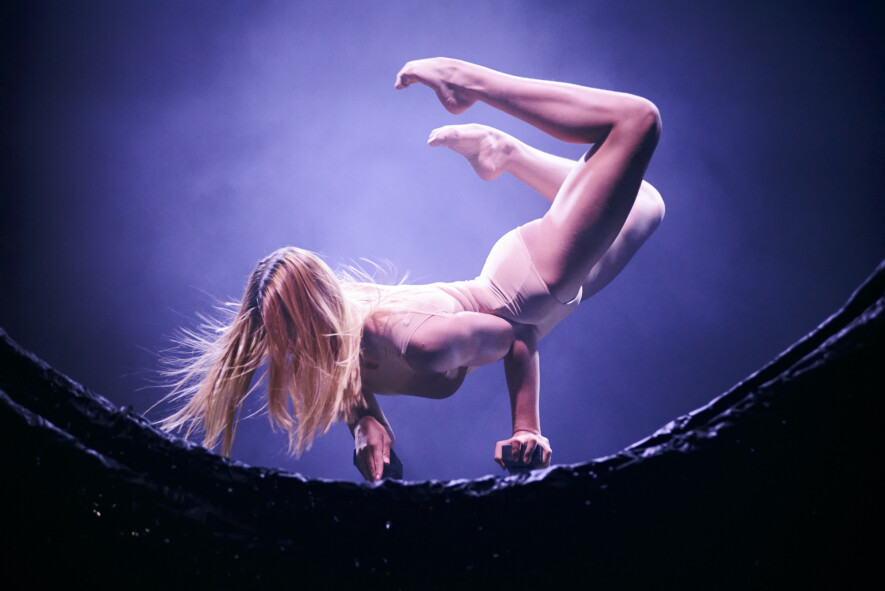
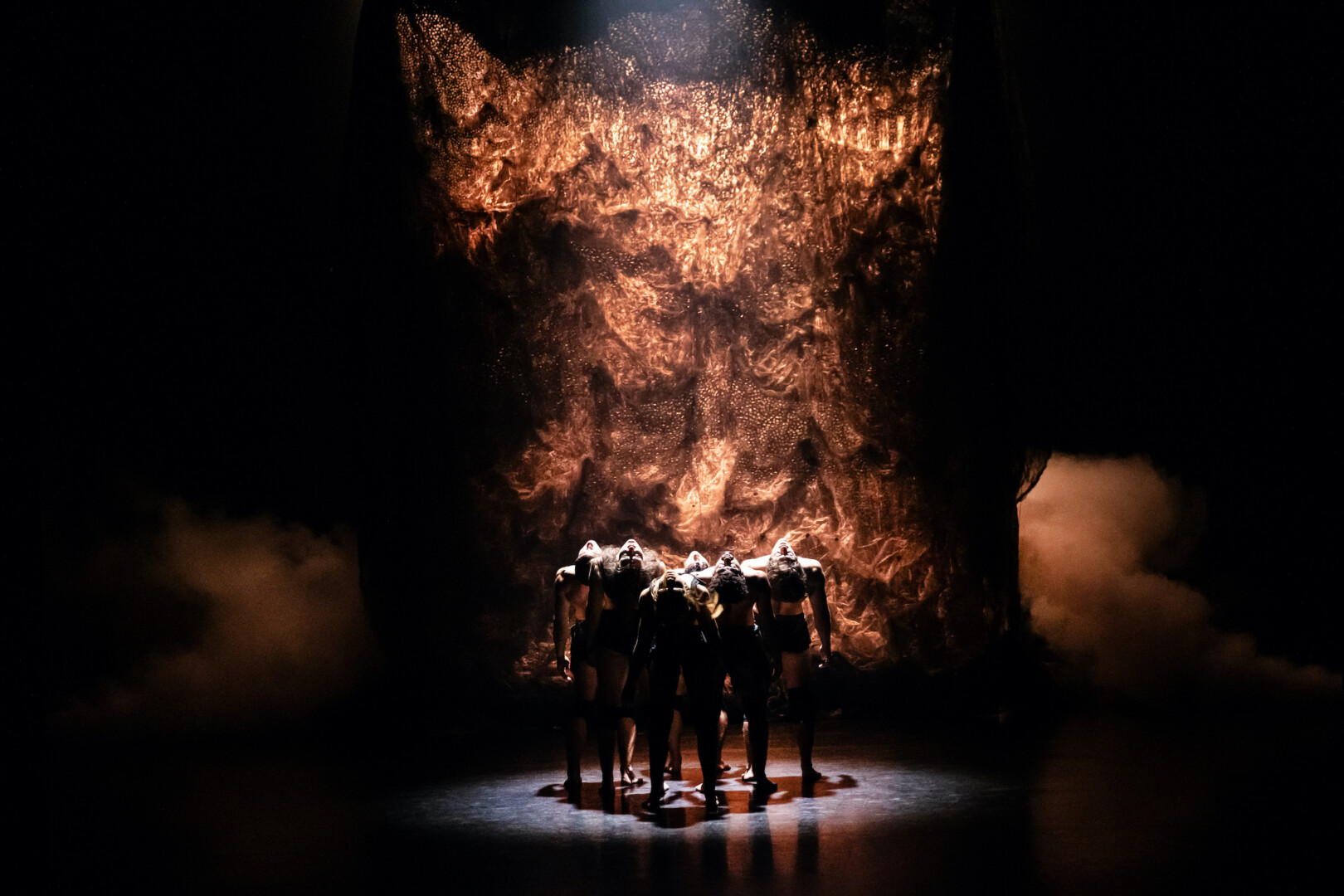
Recirquel, Paradisum, 2024. Photo by Bálint Hirling
Hungary cirque-dance company Recirquel brings Paradisum—a blend of contemporary circus, theatre and dance—Jan 21-24 to the Vancouver Playhouse. For the company’s producer Natália Fábics, Paradisum is an intense, thought-provoking confronting humanity’s response to a post-apocalyptic world.
“It asks what happens if humanity is given another chance?” she notes, adding the performance has philosophical depth. “The post-apocalyptic world is not about destruction, but about renewal—about whether a renewed human being can confront fear, anxiety and possibility—and imagine a different future.”
Bence Vági founded the Budapest-based company in 2012. He is their artistic director and choreographer. For Fábics, the upcoming Vancouver performances showcase the company’s signature style—a blend of circus’s “expressive possibilities” combined with “dance’s depths and theatrical thought.”
A dance-circus-theatre triad
My interest in Recirquel wasn’t in using tricks for tricks’ sake, says Fábics. The production director has always seen theatre, dance and circus as an integrated triad.
Through Recirquel, these movements have evolved into what she describes as “cirque danse”— “a shared artistic language” combining the three traditions.
“Dance trained how I think about bodies and space; circus taught me the power of astonishment; theatre gave narrative depth,” Fábics says. “Integrating them meant rethinking how acrobatic skill, choreographic intent and emotional storytelling can live in the same gesture, the same moment.”
Paradisum includes aerial and groundwork; it also features stagecraft, including a black drape, ladder and hoop. Fábics sees Paradisum as “a refined example” of the cirque danse genre.
“Circus apparatuses are fully integrated into the choreographic and dramaturgical structure,” she says. “Acrobatics functions as an expressive tool, on the same level as movement or gesture, blurring the boundaries between dance and circus.”
For Fábics, the show extends Recirquel’s artistic trajectory. She notes that, their 2020 production of Solus Amor explored “love as a force capable of holding the world together.” In 2023, the company produced IMA—an immersive unraveling of reflection and prayer.
“Paradisum extends this line of thinking into a broader, collective dimension,” she says. “The iconographic imagery helps create a symbolic, timeless space where these questions can be experienced rather than explained.”
Openness to storytelling
Light is a prominent fixture of the show—playing what Fábics refers to as a “dramaturgical role.” She adds that, instead of illustrating action, light is an active participant in the storytelling.
“It shapes perception, sculpts space and carries emotional meaning,” Fábics describes.
Fábics herself came from a dance background, with training in both modern and classical styles. Recirquel has provided her opportunity to continue exploring the body and space.
“What keeps me coming back is this ongoing exploration of expression: discovering new languages between bodies, props, and imagery, and letting the work evolve with the company,” she reflects.
Their performers come from different backgrounds: contemporary dance, acrobatics, circus and other movement traditions. Fábics notes that through Recirquel’s training and “shared creation,” performers develop in different disciplines—“integrating movement, acrobatics and theatrical presence.”
“What matters most is openness—to storytelling, to transformation and to becoming a hybrid performer,” she says.
Paradisum dancers experiment with collaborative, ensemble-driven performances and solitary, intimate productions as their shows operate on different scales. A recent production, Walk My World, sees performers unfolding across 6, 000 square metres.
“It is populated by many performers simultaneously, with multiple parallel scenes and interactions, allowing audiences to move freely through a vast, living world shaped by movement, imagery and collective presence,” Fábics says of Walk My World—which premiered in Budapest.
After their Vancouver stop, the company will take Paradisum to Quebec. For Fábics, each place has its own conversations and energy.
“Performing in different cultures and contexts challenges the work and enriches it, reminding us that expression isn’t the same everywhere,” she adds. “Geography doesn’t dictate the art, but it shapes how it’s received and how we think about it.”
This North American premiere is co-presented by DanceHouse and The Cultch.
For more information on the upcoming performance, see https://dancehouse.ca/recirquel/.
For more information on Recirquel, see https://recirquel.com/


Comments will load once you reach the end of the article.