
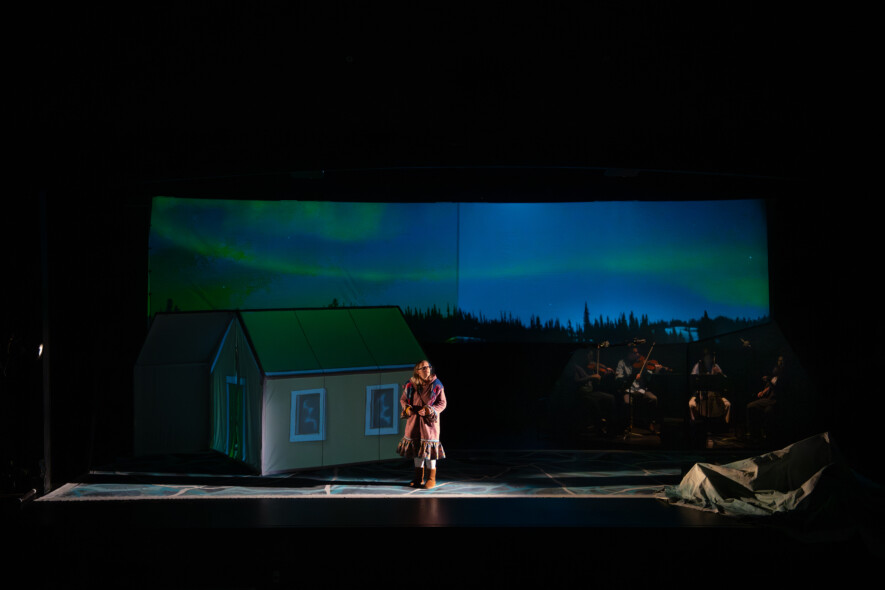
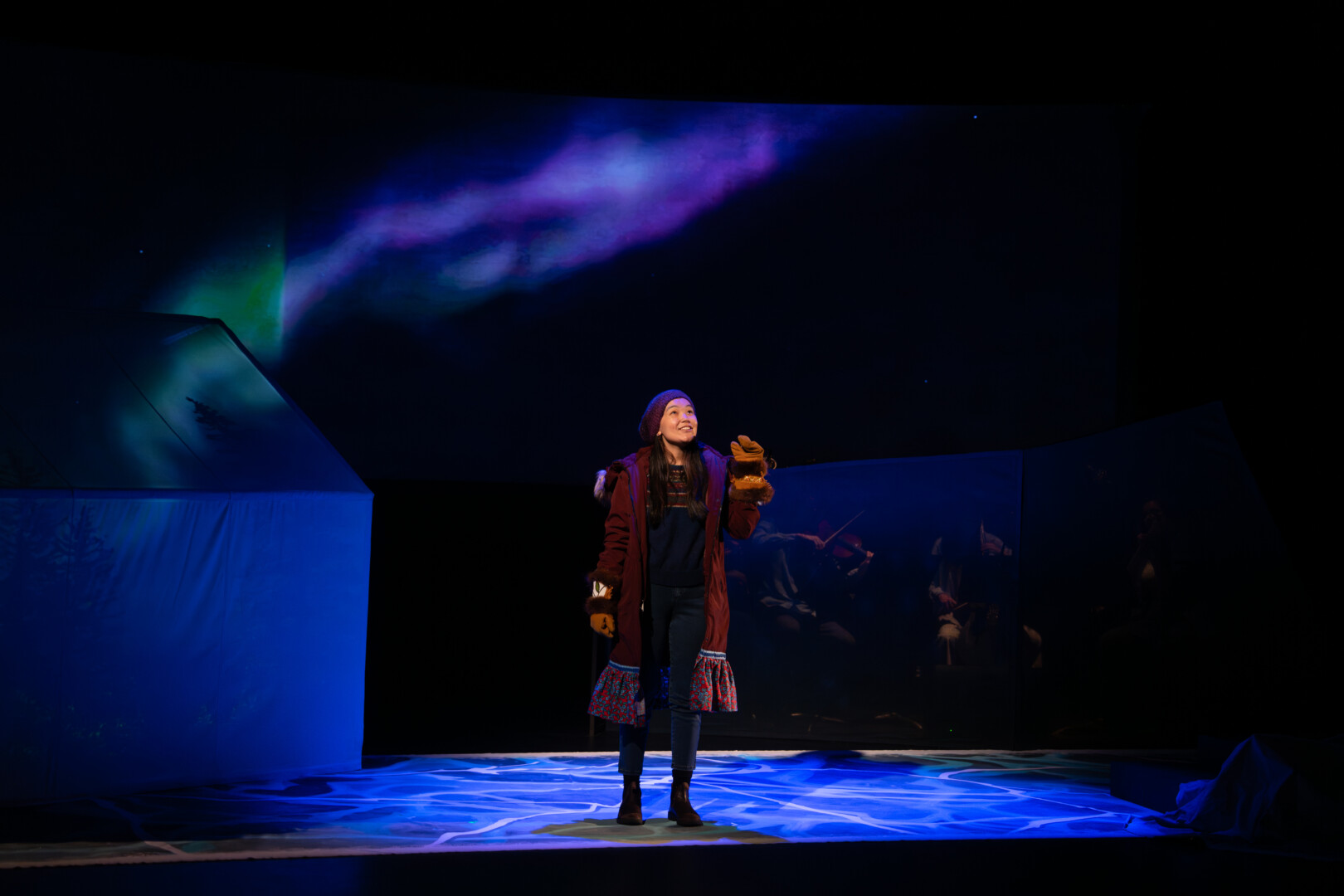
Julia Ulayok Davis in Kiuryaq | Photo credit: Shay Markowitz.
The Northern Lights are such a fertile way to connect the circumpolar region, says director and writer Alon Nashman of a key discovery while creating Kiuryaq. PuSh International Performing Arts Festival presents Kiuryaq—a collaboration between Indigenous and non-Indigenous artists from Canada, Kalaallit Nunaat (Greenland), and Sápmi (Norway)—at the Chan Centre for the Performing Arts on Jan. 28.
“It’s been about finding a way for us to work together in a decolonized manner, giving lots of time and respect to the Indigenous storytellers,” Nashman shares of the development process. “The first conversation that felt really important is between people in the circumpolar region, and they get a chance to see themselves and each other on stage.”
Alongside Nashman, Kiuryaq’s two other writers are Reneltta Arluk (Inuvialuk / Denesuline / Gwich’in / Cree) and Rawdna Carita Eira (Sami / Norwegian). Nashman brought what he calls “more of a Southerner’s perspective”—the lens of those who grew up outside the region without the “wisdom of the Northern perspective.”
“All of us [in the circumpolar North] have been told to not whistle at the Northern Lights, to have respect for the Northern Lights and that the Northern Lights would come down and get you if you tease them,” shares Eira. “It’s important that we tell our stories about it, as Indigenous peoples.”
Rooted in these stories, Kiuryaq explores ancestry, displacement and reconnection through the journey of two siblings: one in search of the Northern Lights, and the other who has grown up underneath them.
Recreating ancestral connections
For Eira, the Northern Lights are “very complex” but also “very simple.” They are a source of comfort, a connection that crosses geographical distance and a bond shared between generations.
“[They’ve] always been there to comfort me when I have been in trouble,” Eira says of her experience as a reindeer herder. “I never get tired of watching them, I can go out on my porch and watch them every night—it’s really fascinating, it’s that kind of humbleness towards nature and these amazing powers that are within nature.”
“The Northern Lights are a massive presence in the play,” adds Nashman. “They really infuse the spirit and the longings of the characters.”
One of the siblings is a “Southerner.” Having grown up in Northern Ontario, this character lost touch with what Nashman refers to as his “place on the landscape.” In contrast, his sister is immersed in the Indigenous worldview of her grandparents.
Kiuryaq’s origins trace back to Nashman’s questioning of Hans Christian Andersen’s The Snow Queen—a play that he has performed and directed.
“I realized a lot of stories that Hans Christian Andersen was using within The Snow Queen were from Indigenous sources,” Nashman recalls. He then reached out to Arluk, inquiring about these stories. “I wondered if I could even perform it knowing that these stories had been taken.”
According to Nashman, Kiuryaq also addresses how the Northern Lights have been fetishized as a bucket list item.
“It’s becoming more and more popular,” adds Eira of Northern Lights tourism. “The third thing we found that [is similar between communities] is children being taken away from community and adopted down South—that has happened in Canada, Greenland and Sápmi.”
Staging the North
In Kiuryaq, the Northern Lights go beyond mere physical beauty. It serves as a powerful force bringing characters together—while actively shaping the story.
To recreate the North on stage, the team focused on an iconic object: the prospector’s tent. Made of thick canvas, the tent was commonly used during the Gold Rush.
“It does function like a tent, but it’s also a projection surface,” Nashman says, adding the production team filmed the North’s landscapes. “That iconic object really helped us to ground the play into what Reneltta calls ‘the home’ or ‘the heart of the show’ in that tent.”
Projections transform the tent into a home or a cottage, a restaurant and even the sky. Kiuryaq’s soundscape is also crucial for staging the North—creating what Nashman sees as a “cosmic space” for performers.
Music director Carmen Braden worked with a string quartet, creating three to four songs as well as an ongoing soundscape.
“The string quartet are living and breathing with the Northern Lights and actors,” says Nashman, adding the quartet will perform live. “There’s a lot of gripping sounds, not necessarily musical in that traditional sense, but it’s using the qualities of these instruments to take you into those deep, dark and dangerous places.”
For Nashman, this “musical feast” mirrors the North’s nature: it is both full of beauty and terror.
“The Northern Light is not a backdrop,” adds Eira who personifies the Lights as a ‘She.’ “She’s very personal…[She] also strengthens feelings of connection to the land, to nature and to time—the stories have been passed down for generations”
Humour is also woven throughout the play, bringing lightness to its heavy subject matter.
“Humour in the North is the way of surviving,” Eira says. “It’s something that has helped people through the years and through time to cope with the harsh conditions of nature and all those forced assimilation problems.”
“You can’t really open the heart to feel the immensity of the situation unless you are able to laugh as well,” Nashman adds.
Taking a community-centered approach, Kiuryaq has been on tour around the circumpolar—one that emphasized connections through shared meals after performances. The upcoming Chan Centre performance will be the first staging of Kiuryaq for a “Southern” audience.
“I’m just very excited…What is going to be funny to them? Who will they identify with?” says Nashman. “I hope that they enter into a relationship with the people at the core of this play that is full of wonder and amazement at this glorious mystery called the Northern Lights.”
At its core, the play is about honoring and respecting the circumpolar peoples.
“Our northern stories, the stories of our culture is important and shows how to work with environmental issues,” says Eira. “If [we were to] listen more to Indigenous people’s knowledge, especially in the northern parts of the world, then maybe it would be possible for the world to go in a different direction—it’s all about respect.”
Arluk and Eira will engage in a pre-show artist talk. There will also be a reception co-hosted by the Royal Norwegian Embassy.
For more information on Kiuryaq at PuSh 2026, see https://pushfestival.ca/shows/kiuryaq/.


Comments will load once you reach the end of the article.