

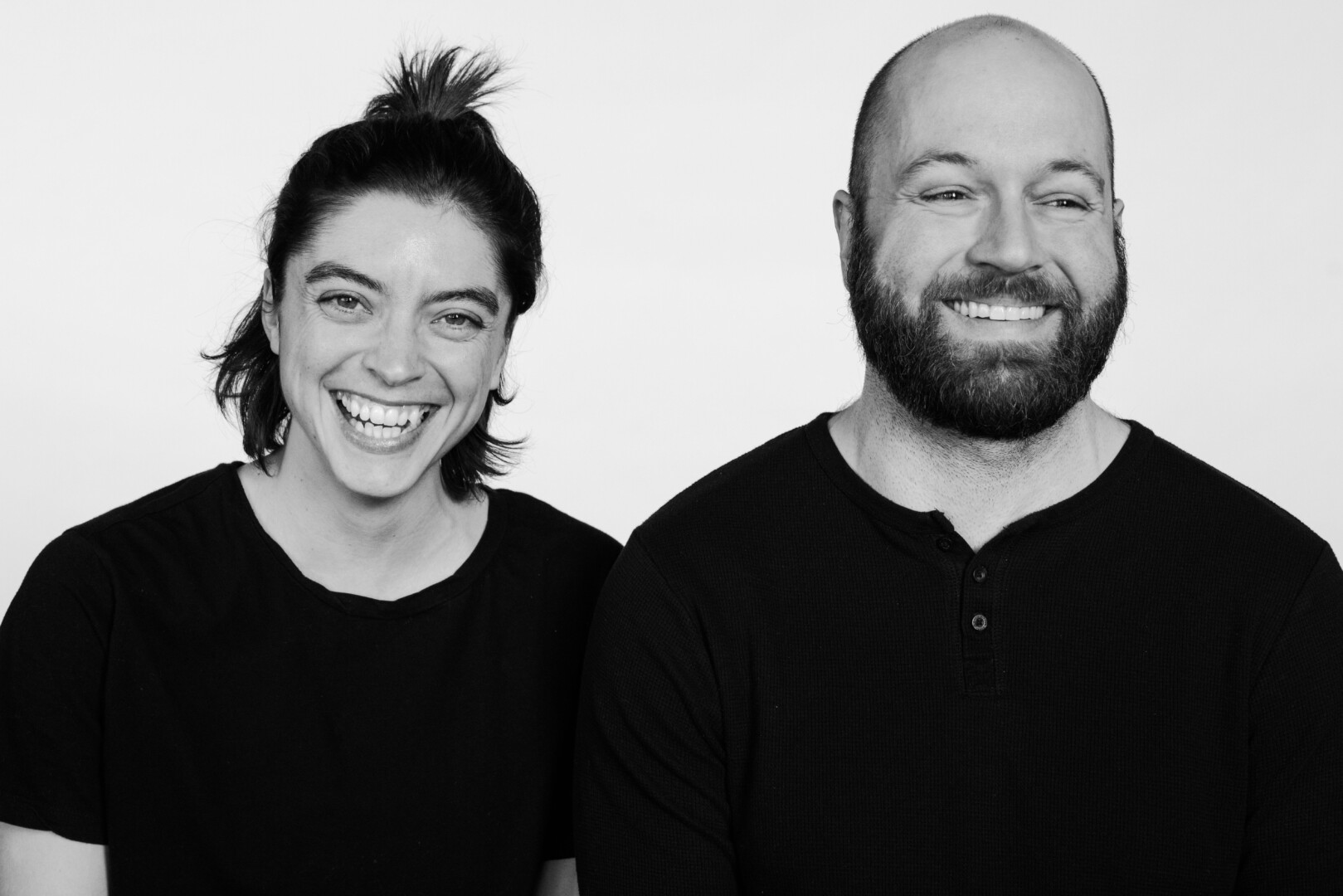
Bianca Richard and Gabriel Robichaud from Parler Mal | Credit: Annie France Noël
“When someone attacks the way you speak your mother tongue, it’s very upsetting because they’re attacking a part of you, and a part of your family and a part of your heritage,” says Bianca Richard, co-author and performer of Parler mal. “Language isn’t just about communication; it’s also about culture and who you are.”
Feeling insecure or uncomfortable about one’s mother tongue inspired Richard and Gabriel Robichaud’s Parler mal—which explores their experiences being stigmatized as “bad” French speakers. The scenes are drawn from the creators’ personal experiences.
Both are Acadians—descendants of the Maritimes’ early French settlers. Richard hopes the show encourages people’s curiosity about language and identity. Presented by Théâtre la Seizième, Parler mal will take the stage at Alliance Française Vancouver on Feb. 6-7.
Performances are in French with English surtitles. A bilingual Meet the Artists event will occur on Feb. 6 in partnership with Radio-Canada.
More than accents
What does one have if they don’t speak their mother tongue correctly, Richard asks. She has felt insecure about her mother tongue since a young age—a feeling caused by being a minority within a minority.
Even my parents say they don’t speak good French—it’s a sentiment that has been going on for generations, notes Richard, adding that Parler mal is a commonly used expression among southeast New Brunswick’s Acadians whose French, known as “Chiac,” blends old French with English and even conjugates English verbs into French.
“The discomfort comes from very early conditioning,” Richard recalls, adding it was intensified when studying with the Université de Moncton’s different Francophone communities. “That’s when I really started to feel like, ‘Oh, my French is inadequate,’ ‘I’m not legitimate, I don’t feel like a real French person even if it’s my mother tongue.”
The idea for Parler mal dates to 2016—where she and Robichaud were attending artist workshops in Banff. Richard was intimidated at the thought of performing for other Canadian theatre makers.
She created a song with lyrics inspired by what others have said about her French, such as “I don’t understand you when you speak” and “you don’t speak good French.”
“My wish that night was that people danced on my insecurity,” she recalls.
Revisiting the idea three years later, she and Robichaud wrote “linguistic bibliographies”— documenting moments of linguistic discomfort in their lives. As part of their process, they interviewed people from different backgrounds.
“It’s all wrapped up in a very nostalgic, 90s vibe,” Richard says of Parler mal. “We both grew up in the 90s, and that’s probably the peak of our development—where we developed a relationship with the language.”
An absurd situation
Richard now recognizes this discomfort as “linguistic insecurity”—a term popularized by American linguist William Labov who studied the phenomenon in English speakers.
“If you are in front of someone whom you judge is better in French, you’ll start overcorrecting yourself,” Richard says. Such hypercorrection is a symptom of linguistic insecurity.
“Even if you master French, there’s this hyperawareness of ‘I’m not adequate,’ ‘I’m not legitimate,’ so I am going to try harder to impress and fit in,” the playwright adds.
Or one does the opposite. A ‘hypocorrecting’ Chiac speaker might exaggerate their accent or use more English words than usual. The third symptom—silence—is what drove the co-creators to finish Parler mal.
“How do we as a French community start accepting varieties of French and how do we teach that in school?” Richard reflects. “It’s a subject that gets really heated, very quickly.”
Richard sees laughter—particularly “tongue in cheek” humour—as a way into Parler mal. She calls for a new perspective that recognizes how linguistic preservation is no longer a Francophone versus Anglophone issue.
“We’re losing Francophones now [not from] assimilation through the English side, but assimilation in the French side when we don’t accept varieties [of French],” Richard laments. “The whole concept is absurd—not being accepted in your mother tongue: How does that happen?”
In partnership with Alliance Française Vancouver, Théâtre la Seizième will also present “Ah, Your Accent is Cute!’: A Conference on Linguistic Insecurity” on Feb. 6. Hosted by Marie-Eve Bouchard, sociolinguist and associate professor at the University of British Columbia, the conference will discuss linguistic insecurity. This French-only event draws from Bouchard’s research of B.C.’s Francophones.
For more information on Parler mal, see https://seizieme.ca/en/spectacles/parler-mal/.
For more information on the conference, see https://seizieme.ca/en/cultural-outreach/.


Comments will load once you reach the end of the article.