
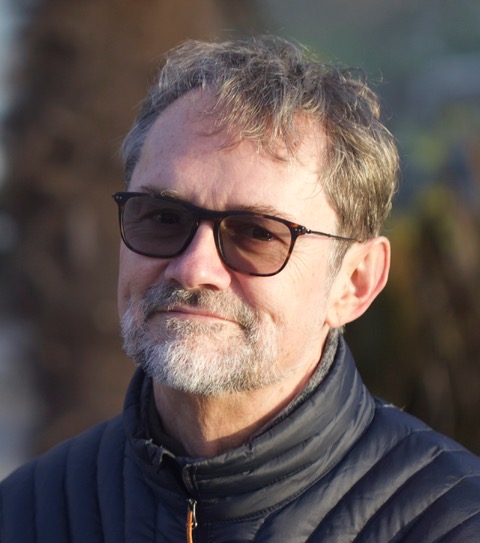
Philip Holden | Credit: Ng Yun Sian
How does one represent a multilingual environment—say a room where four to five languages are being spoken—in a literary work, asks writer Philip Holden. Such spaces are common in Singapore where its four official languages—English, Malay, Tamil and Mandarin—as well as other dialects can be heard.
“What I like to do is use Chinese characters with the full knowledge that non-Chinese readers will not understand the characters, but you don’t need to understand the character to fully understand the work,” Holden says of his writing.
He adds that the answer lies in welcoming that incomprehensibility—through word play, mistakes and jokes—rather than pretending communication is fully transparent.
“If you’re in that inter-linguistic space, nobody has access to all those four languages, so what’s interesting is getting the experience of not fully understanding every language,” Holden says
He adds that Singaporean playwright Kuo Pao Kun refuses to use surtitles, preferring to keep people in a “space of incomprehension.”
Spaces of incomprehension
Born in the U.K., Holden completed his doctoral studies at the University of British Columbia before spending nearly two decades teaching at the National University of Singapore—developing their program in Singaporean literature.
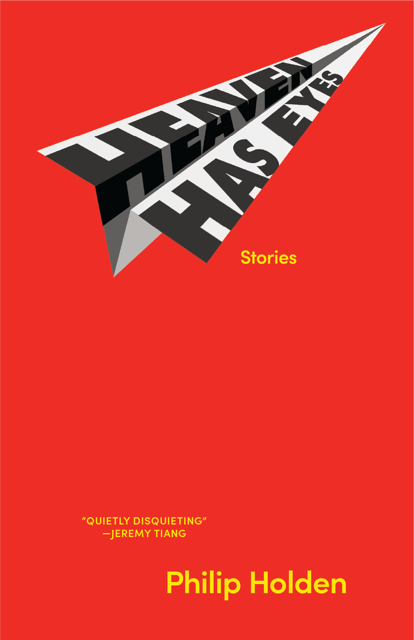
Holden is launching a North American edition of his short story collection, Heaven Has Eyes, at UBC’s Green College on Feb. 10. Green College writer in residence Theresa Muñoz will facilitate the event.
Some stories in Heaven Has Eyes were published around 10 years ago for a Singaporean audience. Others were written specifically for this North American edition.
“I’d imagine some of these issues about not belonging—living between worlds—are quite universal,” he reflects. “There are about three to four stories that have a Vancouver connection.”
A historical event that Holden witnessed first-hand inspired the title. At a rally, the former leader of Singapore’s opposition party, Low Thia Khiang, was about to give a speech when it started raining.
The leader remarked in Chinese, “heaven has eyes.” The phrase references an old Chinese idiom about fate.
“Even if things are bad, heaven has eyes and heaven will notice what is going on,” Holden says. “That image stayed with me, and I wove it into a story—the story is fictional, but the moment was real.”
One story reimagines Singapore’s first prime minister Lee Kuan Yew’s 1968 visit here. While at UBC, Lee’s hope to rest was disrupted by a student occupation of the former Faculty Club. American social activist Jerry Rubin led the sit-in to protest authoritarianism.
“He spent about a week in Vancouver…[Lee] wasn’t impressed by the students because he’d seen worse,” Holden says. “The archive stops at a certain time, and you try to fill it to the best of your ability.”
Holden positions these historical figures as minor characters. He focuses, instead, on the perspective of a fictional character—an “unknown person”—who encounters these grand figures. His reimagining of Lee’s 1968 visit sees a Canadian student casually encountering a Chinese man while having breakfast at the former Bus Stop Café. That man is Holden’s fictionalized version of Lee.
“In the newer [stories], I followed that line a bit longer, starting to look away from Lee Kuan Yew and [towards] other first-generation, anti-colonial activists in Singapore who made this transition to power,” the writer adds. “They’re widely celebrated as heroes in Singapore, and that’s not wrong, but there’s another side to Singapore as well—that side is they engaged in certain forms of political repression when they got to be in charge.”
Stories of complexity
Holden wanted to tell complex stories about these leaders without fully endorsing or opposing their politics. Another story engages with Singapore’s first minister for culture, Sinnathamby Rajaratnam—a figure Holden sees as “paradoxical.”
“What he believed Singaporeans had to do is forget the past,” Holden explains. “Paradoxically, in the 90s, later in life, Rajaratnam started suffering from dementia.”
The writer sees Rajaratnam as advocating an Asian modernity that wasn’t rooted in a single culture. In his story, the statesman is writing letters—sharing his dreams filled with political and racial concerns—to an old friend in London who happens to be a psychologist.
Unusually, Rajaratnam’s personal documents, including annotations on books, became available after his death. Drawing on this historical archive, Holden portrays Rajaratnam as embodying a complicated inner world.
“He was trying to think, how do we live together in a society where we acknowledge our differences, and yet, we have a sense of being together,” the writer adds, noting the statesman was highly aware of unfolding racial violence around the world. “If you go down into these deeper kinds of histories, you see people grappling with very similar problems to what you face in Vancouver.”
For more information on the Green College event, see https://greencollege.ubc.ca/events/heaven-has-eyes-canadian-book-launch.
For more information on Philip Holden, see https://www.pulauujong.org/me/.


Comments will load once you reach the end of the article.