
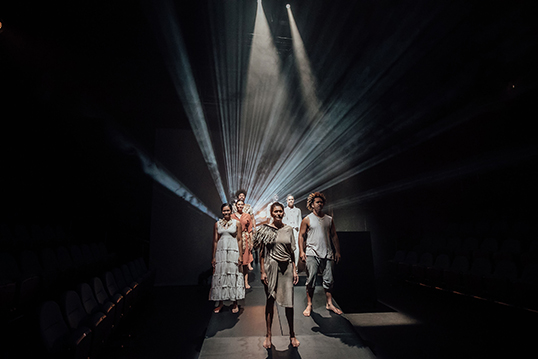
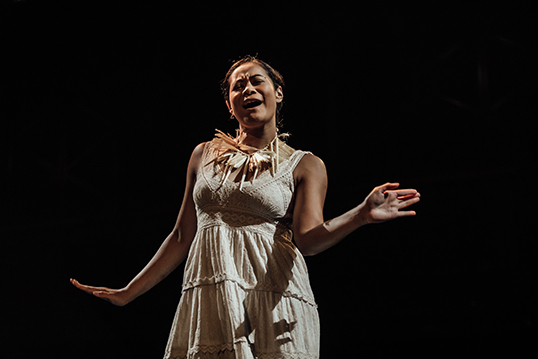
Performer in UPU. | Photo by Andi Crown.
“[UPU] speaks to heart, spirit and soul through the movement of the ocean, and the lyricism of the ocean,” says performer Jarod Rāwiri, drawing on a castmate’s description. “You find yourself almost riding the waves of the ocean, stopping off at different Pacific island nations…and learning the histories of those places – contemporary and traditional.”
The Upu Collective (Aotearoa/New Zealand) brings the show to York Theatre from Feb. 17–21.
From page to performance
For the show’s director Fasitua Amosa, UPU emerged from a moment of discovery rather than a grand plan. His early collaboration with poet Iwashita-Taylor revealed not only the power of poetry, but a structural gap between literary and theatrical worlds.
“Poets trend towards the university [and] academic route, and all the theatre kids are in theatre, and the worlds never really came together,” Amosa says.
What struck him most was how Pacific poetry often lived quietly on bookshelves despite its emotional potency. He saw an opportunity to shift poetry from a private reading experience into a shared, embodied one – something actors were uniquely equipped to do.
“Poetry is so lean in its use of language, it’s very efficient in its use of language,” he says. “A lot of poetry can put these words together and just unlock imagery and emotion.”
That efficiency, he explains, gave poetry a visceral immediacy that traditional theatre structures sometimes avoided.
“[Theatre] builds towards a thing, whereas poetry can just cut straight through to the heart of something,” he adds. “It’s the closest thing to sorcery you can get to.”
Actors, rather than poets themselves, became the conduit for that magic. Amosa believes performance was not about reinterpretation, but amplification. To truly capture the essence of the poetry on stage, performers followed a careful process in rehearsal.
“[Grace] would act like a librarian and say, ‘Here, you need to read this so you can understand the context,’” Rāwiri says. “The first pass, you’re just reading the words; the second time you’re trying to understand what the themes are; and the third time, you’re trying to get onto the nuances.”
Those nuances included examining the shapes and placement of words.
Mapping the Pacific
Rather than following a single storyline, UPU moves across islands, histories and emotional registers – inviting audiences to forge their own connections and engage with the diverse experiences of Pacific peoples. The final poetry selection spanned the region – from Hawai‘i to Tuvalu, Guam to Aotearoa – grouped thematically rather than chronologically.
That openness extended to audience reception, creating a distinct experience for each viewer.
“The poems have a different relevance to your life depending on what’s happened in your life,” Amosa says, adding cast members – some of whom have performed the show “hundreds of times” – feel similarly. “For every audience member, something’s going to zing for them, and with poetry, you never know when that moment’s coming.”
Visually, the production resisted spectacle for its own sake. Design elements were carefully restrained, meant to deepen rather than distract. For the director, the poetry or the upu (meaning ‘words’) comes first.
“We could perform this show with no lights in the living room, and it would still hit because the poetry is so good,” he shares. “All the elements of the show are there to deepen the experience in the way the words can’t, but they have to support the experience and not get in the way of the experience.”
Amosa hopes audiences leave the performance feeling less alone, recognizing shared experiences across cultures and oceans. He sees poetry as a way of preserving emotion, resistance and memory – capturing moments that history alone cannot.
He hopes the show encourages audiences to seek out the poetic voices of their own communities.
“I feel like the poets are able to capture, whatever they are trying to capture – whether it’s a moment in time, a feeling, a response to something – better than anyone else,” he shares.
For more information, see: https://thecultch.com/event/upu


Comments will load once you reach the end of the article.