
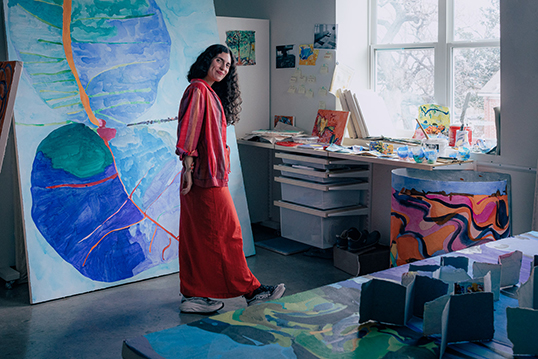
Maru Aponte in her studio. | Photo by Francisco Ramos.
“Historically, colors have had so many meanings that it’s extremely difficult to trace each one,” says participating artist Yaimel López Zaldívar. “This highlights the inherent flexibility of color as an expressive resource; and demonstrates the wide range of interpretations of everything that incorporates color.”
“Colour reflects the many forms and possibilities of existence, shaped by location, environment and atmosphere,” adds fellow artist Maru Aponte. “Colour shifts the concept of time – each moment working with it becomes a sliver of time, never fully repeatable.”
Amongst the other artists featured are Osvaldo Ramirez Castillo, Diyan Achjadi, Moozhan Ahmadzadegan and Sandeep Johal.
Invoking memories
For Aponte, colours are intimately associated with memories of home, childhood landscapes and passing time. What she enjoys most about colour is its ability “to always exist differently” – even when taken from the same source.
“I grew up surrounded by blue, pink, orange and purple skies – morning and afternoon skies filled with colour,” she shares of her Puerto Rican background.
The artist adds that colour was also a source of light during the island’s power shortages.
“Even at night, colour was present: Persian blue and ultramarine, violet skies, stories of cucubanos – the island’s fireflies – and swimming at night in bioluminescent waters,” Aponte adds.
Aponte refuses to drain all colours from her life and work, and her watercolours celebrate the emotions and meaning that colours can bring to different people. She sees the “liquid state” of her materials as allowing colour to remain “responsive, unstable and alive” – a metaphor for life itself.
Aponte is presenting five pieces for the exhibition: four small, framed watercolours created by “painting directly in the landscape” – a practice also known as painting en plein air.
The fifth, titled Sanctuary of Lavender Sand, also started in the same fashion. The artist was compelled to experiment with how changing a painting’s format could create “an entirely new body of work.”
“I call this my ‘island painting,’ a work that no longer requires a wall to exist,” she says of the 21-feet long watercolour work. “It breaks the traditional parameters of painting, standing on its own as an immersive experience.”
She hopes audiences will feel inspired to “perceive colour differently and more diversely” – seeing beyond its visuality. For Aponte, colour also carries atmosphere, emotions and memories.
Colourful experimentations
For Zaldívar, colour is associated with experimentation. His attention to colour is influenced by Cuban graphic art and poster design.
“Being Cuban and having been trained in Cuba as a designer – in a Caribbean country where intense colours are an important part of everyday life and the strong impact of sunlight shapes the way I respond to color, sometimes exaggeratedly – influences me,” the artist shares.
Zaldívar wasn’t familiar with Batchelor’s work prior to the exhibit. Yet, he has noticed contemporary society’s changing approach to colour.
“A few days ago I saw a meme that I found really interesting; it said something like, ‘In the 1980s cars came in lots of colours,’ and showed a photo of a very colourful parking lot, adding that for some reason in recent years the colours have been reduced to just a few,” Zaldívar shares.
He will be presenting an artist’s book. Created last year, the work reflects a desire to experiment with sculptural or three-dimensional forms. A wall-mounted structure accompanies the book.
“I don’t impose any limitations on myself in terms of colour, and I really enjoy combining colours without fear of the result,” Zaldívar shares. “When I draw or paint, I don’t even think about the colours, I use them as I feel them.”
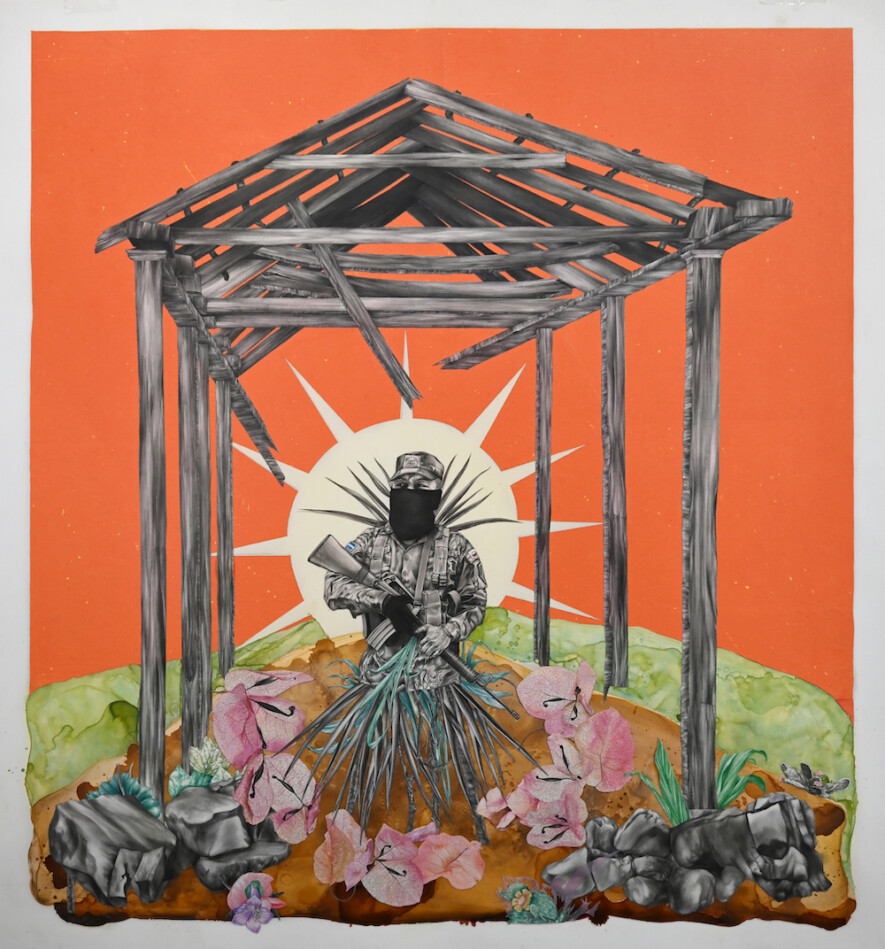
Another featured artist Castillo’s colour palette is heavily influenced by the “hot tropical landscape” of his childhood in El Salvador. His work combines painting, printmaking and collage – allowing for what he sees as “an intuitive approach to colour.”
For him, this approach conveys an “earthly or elemental aesthetic” rooted to both “place and an imaginary space.”
“Cultural expressions like Roman Catholic iconography, indigenous storytelling and the syncretic manifestations of popular folklore also informed my palette in the way of contrasting colour fields ranging in high tints and bright tones,” Castillo adds.
For more information on the exhibit, see: www.richmondartgallery.org/thechromophiliacs


Comments will load once you reach the end of the article.