
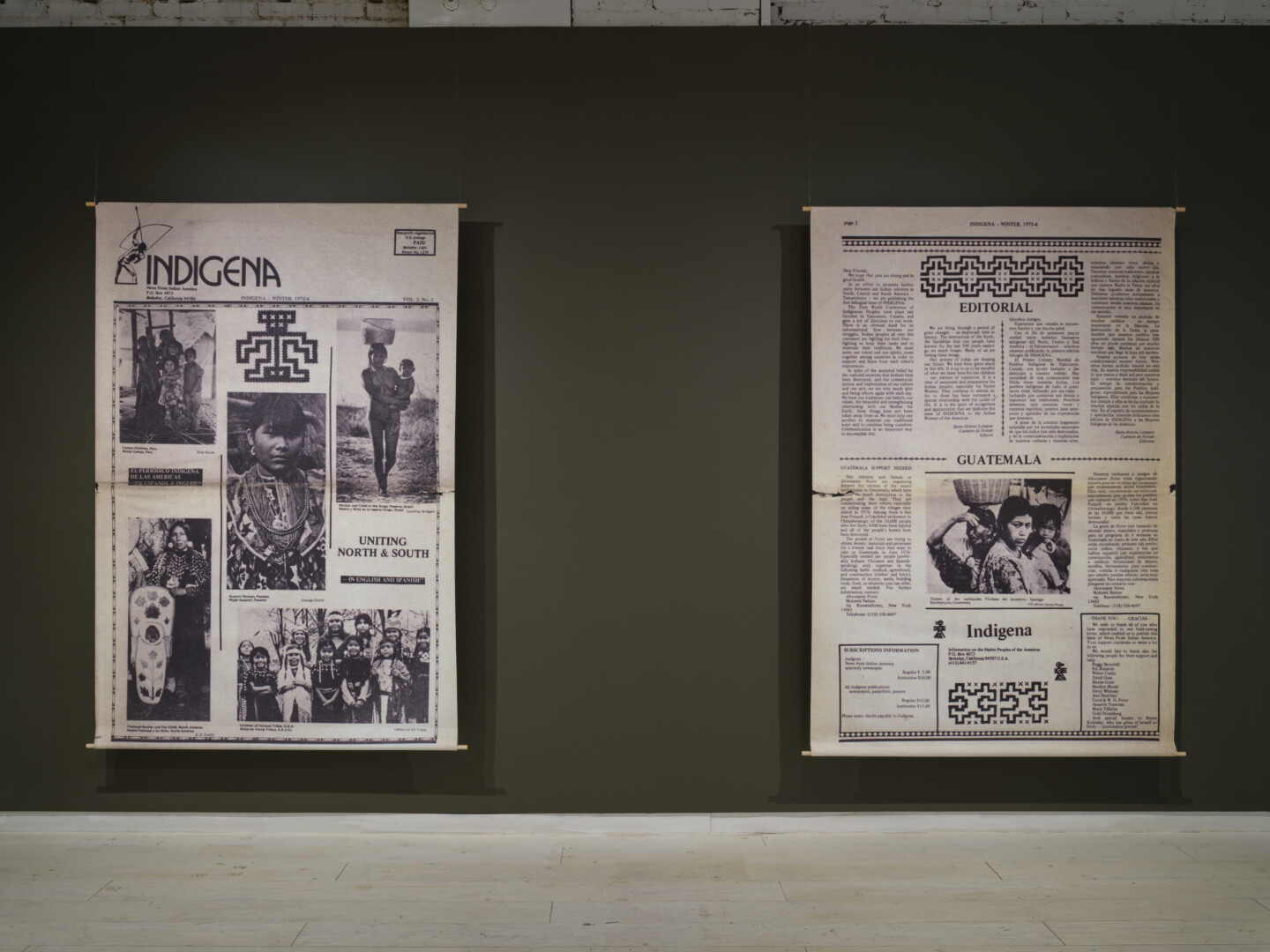
Indígena (newspaper enlargements), 2022, Siku Allooloo. | Credit: Rachel Topham Photography
The idea is reaching backwards and forwards across maternal lines, entwining a lineage of relentless fortitude, self-determination and grace on both Taíno and Inuit sides, says artist Siku Allooloo about her exhibit Singing Water Stone. Access Gallery presents Allooloo’s multidisciplinary exhibit (until Mar. 5) honouring the work of the artist’s late mother.
The artist also sees the exhibition as a way of “represencing”—a declaration that Indigenous peoples “have always been here” on their stolen homelands.
“Each generation holds a piece of the ‘we,’ each generation holds a piece of the ‘always,’” Allooloo shares. “I feel like my job is to hold the ‘always’ for a while so that we can continue to be here.”
Curated by Kitt Peacock, the exhibit features Allooloo’s original works, alongside selections of her late mother’s historic Indigenous newspaper, Indígena: News from Indian America.
An archival rebirth
Allooloo’s mother, Marie-Hélène Laraque, originally from Haiti, was a prominent Taíno journalist and activist during the 1960s-70s Red Power Movement. She founded the newspaper Indígena—which extensively covered Indigenous news across North, Central and South America. During its circulation from 1973 to 1978, Indígena had a global audience.
“Indígena was groundbreaking —it was a lightning rod for Indigenous struggles across the entire Western Hemisphere,” adds Allooloo.
The artist sees Singing Water Stone as a preamble to an overarching project expanding upon her mother’s legacy. The project includes a feature documentary, a group art exhibition and a book that republishes all issues of Indígena.
“As Indigenous women, we hold our stories and pass them on to our children and we are also living archives,” she says. “Even when we’re omitted from the historical record—as we are simultaneously erased and disappeared within our own homelands—our acts of re-presencing come from deep love and giving more life.”
For Singing Water Stone, Allooloo chose to display her favourite edition—one dedicated to Indigenous women of the Americas.
Allooloo shares that, at the time, Indígena was under intense pressure from male leaders within the American Indian Movement to keep the focus on them and within the United States.
“My mother and her co-editor Carmen de Novais Guerrero had the vision and the boldness to say, ‘No, this is a global movement. We have Indigenous brothers and sisters throughout the entire hemisphere, and we’re going to light up a communication highway,’” the artist says.
She adds that the duo started publishing in both Spanish and English. Their first bilingual issue was focused on Indigenous women of the Americas.
For Allooloo, this vision reflected their awareness of how Indigenous women “bear the brunt of colonialism” while also playing a significant role in “holding families together and passing on the culture.”
The artist has been working on her feature documentary, also titled Indígena, for the past five years.
“It follows my journey of unearthing my mom’s legacy as this groundbreaking Indigenous activist and journalist during the Red Power movement, who was also an early generator of the Taíno movement and helped spark our reawakening,” she shares. “I’m picking up this story at the same time I became a mother myself—so it’s a story of reclamation and rebirth.”
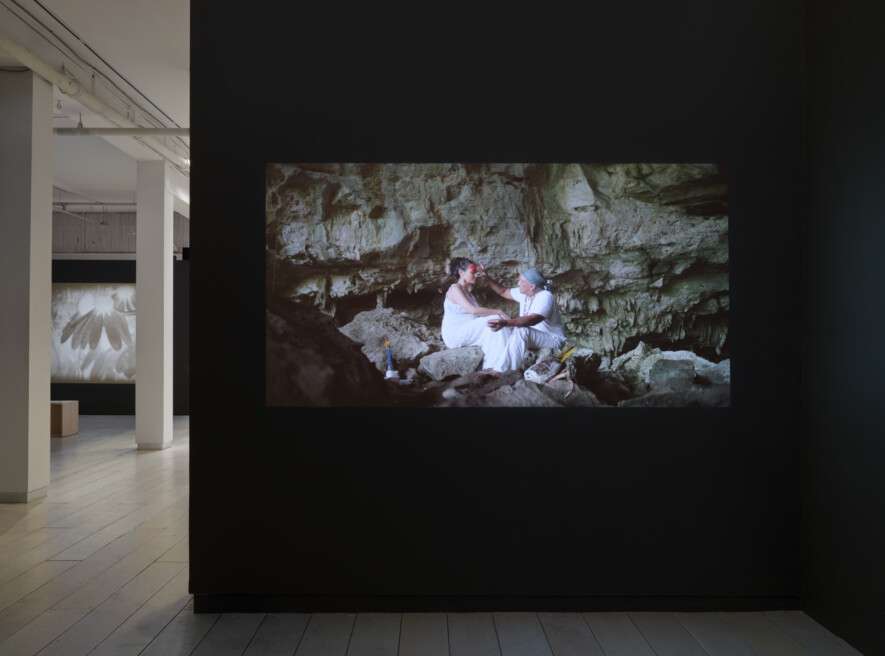
The artist sees Spirit Emulsion—an experimental short film shot on a Super 8—as the exhibition’s linchpin. Allooloo developed the film using plant medicines, learning the technique from a local, eco-processing expert.
“We made a developer’s brew with botanicals, including Douglas Fir needles,” the artist recalls, noting Haiti’s national flower, Hibiscus, was also added. “My mom passed away when I was young, and I feel that her spirit is very much part of this work, in a similar way that my ancestors are part of this overall, intergenerational work.”
Allooloo sees the film as “an offering to the spirit world, an opening prayer” for the feature film currently in production. Hand-picked cedar, sweetgrass and sage were also added to the “beautiful smelling brew”—drawing on the artist’s connection to the land in her current residence of Vancouver Island and childhood home in the Northwest Territories.
Honouring multiple lineages
Singing Water Stone also presents “Interface,” a poem printed on silk. Allooloo’s intention was to honour her Inuk grandmother—who survived the Inuit High Arctic Relocations as a child, as part of Canada’s original Arctic Sovereignty effort.
She later experienced having her children forcibly removed by the Canadian RCMP and sent to Indian Residential Schools.
“I never got to meet her, but she is one of my namesakes in the Inuit naming tradition,” Allooloo says. “She was this incredibly resilient-beyond-comprehension woman who was not defined by these horrific things that she survived.”
For the artist, this strength is one of “represencing,” a response to ongoing colonial genocide. Allooloo’s artworks—a form of activism—reaffirms the presence of Indigenous peoples and challenges the myth of the “vanishing Indian.”
“My mother’s people—the Taíno—were the first Indigenous people to be colonized in 1492; my dad’s Inuit people were amongst the very last,” says the artist. “I wanted to show how these legacies of survival and reaffirming our place in the world filter down through personal lineages, and really, through these mothers and grandmothers who transcend colonial violence and create more life.”
This transformation, for Allooloo, reinforces indigenous worldviews and families “in a very beautiful way.” She hopes the exhibit will speak to viewers emotionally—communicating at the “level of the human spirit.”
The artist shares that people have held onto copies of Indígena for over 50 years—a testament to the newspaper’s power.
“People have been sharing copies with me since I was 20 years old,” she adds. Allooloo invites those with copies of the Indígena newspaper to contact her.
For more information on the exhibit, see https://accessgallery.ca/programming/singing-water-stone.
For more information on the artist, see https://www.sikuallooloo.com/.


Comments will load once you reach the end of the article.