
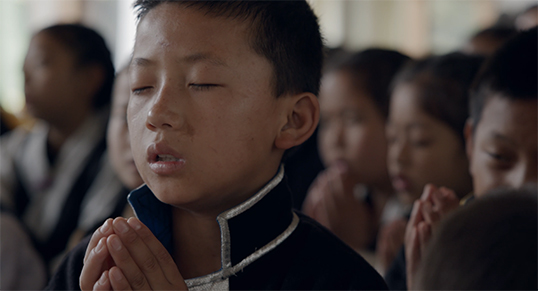
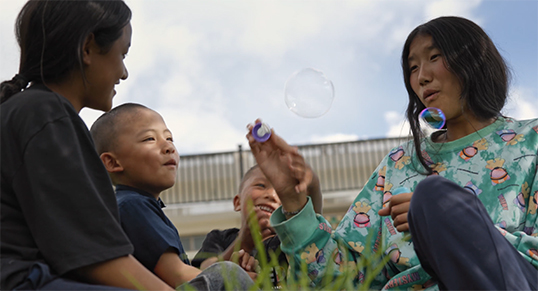
Still from Loving Karma. | Photo courtesy of Andrew Hinton.
“I’m very committed, as a filmmaker, to telling hopeful stories,” Hinton shares. “We’re bombarded with negativity [and] problems, and we get overwhelmed – I feel it is so important to be reminded of all the good that is happening in the world and all the good of people.”
Co-directed with Johnny Burke, the documentary features former monk Lobsang Phuntsok’s Jhamtse Gatsal – a community for abandoned and neglected children in a remote Himalayan village. The film explores what it means to educate not only the mind, but also the heart.
Bringing hope
Much like naming a child, it is incredibly challenging to title a film, says Hinton. Named after two of the featured children, Loving Karma is a title that holds both spiritual and cultural weight.
“In the West, we think we know what karma is,” Hinton explains. “But these two boys are called Karma, and it allowed us to explore that idea in a more human, lived way.”
Hinton adds that Phuntsok, the film’s central figure, was drawn immediately to the title.
“He felt he could use that title to talk more deeply about this concept of karma, the challenges we carry, the journey we take in life, [and] the opportunities presented to us,” Hinton adds.
The film stems from a previous project more than a decade ago. Hinton and Burke directed Tashi and the Monk, an Emmy-award winning short featuring Phuntsok and one of his community’s children, Tashi.
In Loving Karma, the directors return to this Himalayan community – learning more about Phuntsok and Tashi as well as featuring a new generation of children.
The film includes a powerful on-screen moment where the words “12 years later” appear – allowing audiences to see how Tashi and the community have overcome trauma and evolved.
“We were interested in exploring how this environment [at Jhamtse Gatsal] works,” Hinton shares. “Can it transform even the most damaged children? Can it help them grow into kind, loving people?”
An important story
Hinton sees Loving Karma as opening conversations about human potential – particularly in the context of education and healing. In this Himalayan community, education extends beyond academics.
“It’s not just intellectual,” Hinton says. “It’s an education of the whole human being. It’s an education of the heart as much as the mind.”
Jhamtse Gatsal is a community where love, solidarity and emotional care are foundational to education. In many Western systems, Hinton notes, success is measured by grades and performance – losing sight of what is truly valuable to human beings.
“We get very smart in our heads, but we haven’t educated our hearts,” he says. “We lack empathy; we lack compassion.”
For him, the film is a reminder of the good in humanity. It also draws attention to the possibility of healing, and the responsibility to care for one another.
“As we are social [beings], relationship with others is important,” Hinton shares. “Our daily actions have an impact on those around us – our family, our neighborhood, our workplace – it all ripples out.”
At Jhamtse Gatsal, Hinton witnessed how everyone benefits from kindness. He recognizes this kindness as anchored to an individual’s “own evolution, happiness and joy.”
“When I experienced the joy, happiness and love, I was very inspired and there was a lot for us to learn,” Hinton shares of his time in the community.
He believes film festivals are more than cultural events – they are communal spaces (allowing for a similar connection). For the director, films like Loving Karma do not simply tell stories – they invite audiences to carry them forward.
“When people come together in a room to watch a story, there’s a shared experience,” he adds. “It opens the door for conversation.”
The director hopes the film inspires others to “start with love and let the karma follow.”
VIMFF returns Feb. 27–March 11 with in-person screenings and live guest appearances. The festival will continue online from March 14 to Apr. 11.
For more information on VIMFF, see www.vimff.org
For more information on Andrew Hinton, see www.andrewhinton.film


Comments will load once you reach the end of the article.