
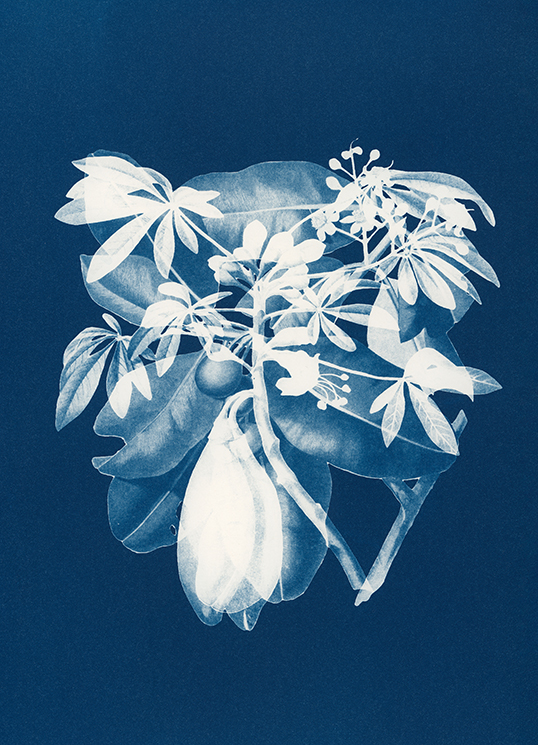
Karen Zalamea, Herbarium (after Flora de Filipinas), 2024–25, cyanotype on watercolour paper, 30.5 x 23 cm. | Photo courtesy of the artist.
Presented at Coquitlam’s Evergreen Art Gallery from March 7 to May 24, this photo-based showcase highlights the artist’s reimagining of photography as a medium.
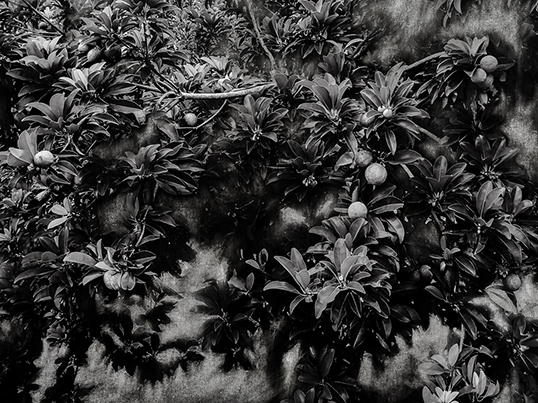
“The exhibition draws connections between personally linked items: the chico tree, a nineteenth-century botanical text, family photographs and my ancestral house in Quezon City, Philippines,” Zalamea says.
“She then weaves, engraves, enlarges and reprints her images of these objects and places,” adds curator Katherine Dennis.
Part of Capture Photography Festival 2026, Every Surface Is a Shrine is a selection of Zalamea’s repertoire over the past five years. It includes pieces from Sunken Garden, an ongoing work of photography, sculpture and installation; Herbarium (after Flora de Filipinas), a series of cyanotypes; and Correspondence, a video work.
Reflecting on time and place
The pieces are all thematically interconnected through reflections on time, distance, place and memory, says the artist. Zalamea was born and raised in Vancouver – the daughter of immigrant parents from the Philippines. She now resides in Burnaby.
Every Surface is a Shrine explores Zalamea’s connections to her ancestral home through distance and time, examining how the diasporic experience affects one’s identity and expression.
“Living in the diaspora is an aspect of my positionality that informs not only this exhibition and my entire creative practice, but also how I move in the world, how I remember, how I imagine,” the artist says.
“Zalamea’s exhibition is rooted in her personal diasporic identity but isn’t bound only to her experience or to her Filipino heritage,” shares Dennis, adding the artist draws on the notion of a ‘trans-Pacific kinwork.’ “Her work will resonate for others in the diaspora, especially people separated from their ancestral homelands by a vast distance.”
The exhibition’s title originates directly from one of Zalamea’s new works in Sunken Garden: a hand-engraved marble slab that travelled from the Philippines to Canada. The phrase “Every Surface is a Shrine” is painted on it.
For Dennis, the title emphasizes how the “everyday surfaces of our lives” are meaningful. She sees the exhibit as encouraging viewers to examine not just Zalamea’s works, but their own lived experiences.
“Certainly, there are monumental moments and places, but a meaningful life comes equally in the tiny moments, the ordinary places and the unremarkable sites, sounds and textures that make up a messy human life,” the curator adds.
Dennis shares that, Herbarium (after Flora de Filipinas) is a digital collage composed of “cyanotypes of illustrations” from a 19th century botanical text.
“Zalamea investigates how such images, taken during research surveys, are considered ‘unbiased’ and ‘scientific,’ yet are in fact linked to colonial practices of knowledge extraction, and as such, [are] not ‘neutral’ at all,” the curator shares.
Enshrining cumulative actions
Every Surface is a Shrine considers the artist’s ancestral house as what she calls “archive and site of memory.” Zalamea adds that both “the intimate scale of the familial” and a larger scale – such as the origin of building materials – are examined.
“Touch is central to the exhibition, from the material handling of braiding photographic ropes, to inscribing text on the marble sculpture, to distressing the photographic surface of a large-scale photograph of chico trees,” the artist adds.
Zalamea drew on geologists’ understanding of “trace fossils” – footprints, tracks and other marks left behind on rocks. She considered how her process could echo this “repetitive mark-making.”
“The works present surfaces of accumulated gestures and think through the possibilities of unearthing the memory of material and of how surfaces remember or enshrine our cumulative actions,” Zalamea adds.
Zalamea’s Correspondence directly explores themes of memory and place, playing with layered meanings embodied by the chico tree. According to Dennis, the fruit-bearing chico tree – native to southern Mexico and Central America – was brought to the Philippines during Spanish colonization.
“Chico is also the name of the street Zalamea’s mother grew up on, and as a child, ‘chico’ became shorthand for the place her mother was from,” Dennis explains. “Zalamea considers ‘chico as place.’ This work is about how the idea of something – in this case the chico tree – also becomes a stand in for a place or person of significance.”
According to Dennis, the exhibition showcases how a photograph is “not constrained by paper or wall.” She sees the different mediums of Zalamea’s work – sculpture, installation and video – as in conversation with one another, demonstrating the “versatility of the photograph as a starting point.”
Every Surface is a Shrine invites viewers to look closely at one’s own history and the layers of foundation on which one’s home and identity are built. It is an exhibit that, in Dennis’ words, rewards “close looking.”
Launched in 2013, Capture Photography Festival returns April 1–30. It is the largest lens-based art festival in Western Canada.
For more information
on the exhibit, see www.capturephotofest.com/exhibitions/karen-zalamea-every-surface-is-a-shrine


Comments will load once you reach the end of the article.