
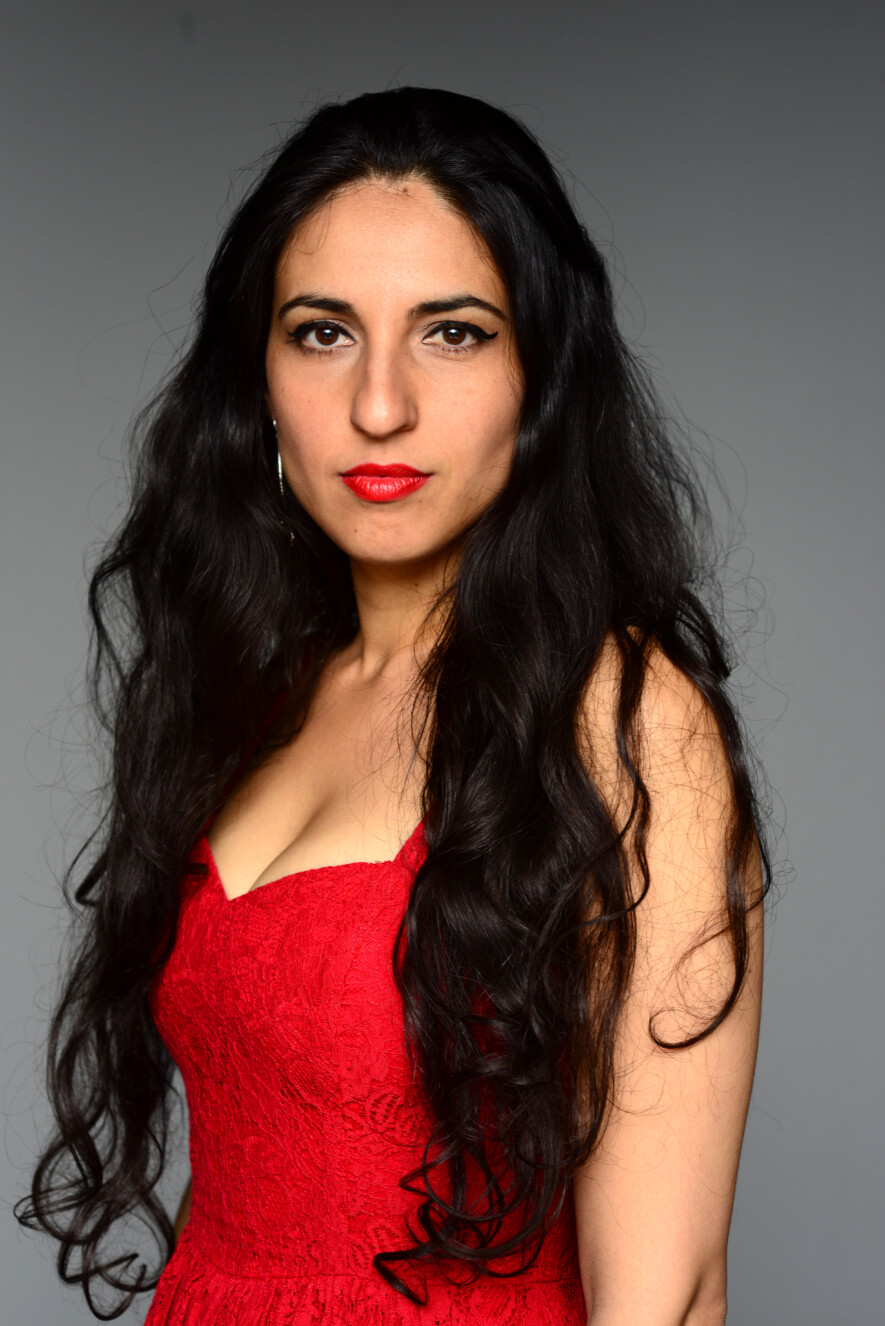
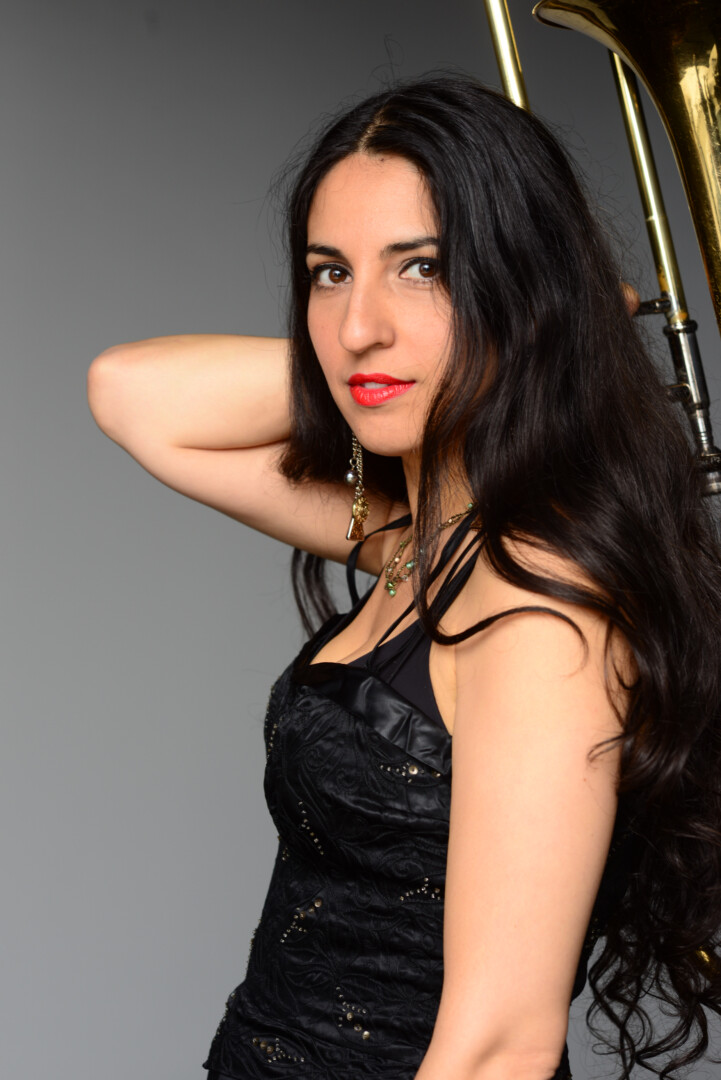
Nani Vazana | Photo by Victor Lacken.
Audience connection is not just through sharing a similar background—it’s more about inspiring people to dig into their roots, says musician Nani Vazana, who writes songs in the endangered Ladino language. Vazana will bring (Mar. 7) her original compositions and interpretations of traditional Ladino—recognized as the language of Sephardic Jews—music to Evergreen Cultural Centre.
“We’re going to tell a lot of stories—that’s the main thing in my performances: storytelling and connecting with the audience,” Vazana says, adding most of her audience is often not Jewish. “If people can feel inspired to find their own roots, that makes me happy.”
Ladino, also known as Judeo-Español, mixes Castilian Spanish with Greek, Turkish, Hebrew, Arabic, French and other Balkan languages.
Modernizing traditions
Vazana’s connection to Ladino is rooted in her Moroccan grandmother. It was “a secret language” shared between the two. The singer’s father—whose family moved from Morocco to Israel—only allowed Hebrew in the household.
“Other languages were not allowed either,” Vazana says. “He didn’t want us to speak Arabic or French—my mother spoke both these languages.”
Later in life, Vazana took Ladino lessons to reconnect with the language. At the time, it was difficult to find Ladino dictionaries and teachers. She eventually met a native Ladino speaker who agreed to teach her the language.
Rather than emphasizing on the “beauty of the singer’s voice”—as was tradition in Ladino music—Vazana focuses on the song’s storytelling aspect.
“When I started doing interpretation of old songs, what stood out most to other people is that I was singing them just as they are,” she shares.
One of her favourite songs to interpret is “Morenika.” It features a young bride going down to the beach on the morning of her wedding day.
According to Vazana, this was not unusual: it was common for brides to bathe in the sea in preparation for their wedding. What struck Vazana is the repeated mentioning of a sailor’s name—repetition that she interprets as the bride’s desire to marry someone else.
“Everyone thinks it’s a wedding song, and I think it’s about a bride that wants to run away,” Vazana shares. “I love this song because it’s so delicate, there’s no rebellion, there’s just hope.”
Sourcing material
In 2024, Vazana, representing the Netherlands, won the Eurovision Song Contest for Minority Languages. Her winning song, “Una Segunda Piel (A Second Skin),” is about a traditional Sephardic ritual—where family and friends sit around a person “at retirement age” wrapped in a shroud.
“The idea is that you need to meditate, while you’re in this cocoon state, and think about all the things you want to leave behind,” the singer explains. “And that’s an opportunity for you to start your life in a better way.”
Vazana learned about the ceremony while researching ideas for her album. It is the first song she wrote—both music and text—in Ladino. The lyrics include expressions and proverbs.
Her musical themes—and even the melodies—are inspired by very old culture. Vazana’s song, “El Gacela (The Gazelle),” is often mistaken for a melody from the 15th century. It was inspired by an 11th century homoerotic poem written by a Jewish saint.
“It was made with that intention—I composed that music to be in the spirit of the text,” shares Vazana. “It was hard to find these kinds of texts: I was looking for millennial topics for my record.”
The singer is also drawn to fairytales and magical realist stories. Another song, “Fada de mi Korazon (Fairy of My Heart),” features the mother blessing her child.
Tradition goes that parents will invite family and friends to stand in a circle, passing a baby girl from one hand to the other. Each individual—embodying the spirit of a good fairy—blesses the baby, protecting her from the underworld’s evil fairies.
“This Sephardic tradition started as orthodox, but there are some glimpses where they believe in magic,” Vazana shares. “And that’s super inspiring.”
Vazana adds that there are around 20 dialects of Ladino. While academics have tried to identify the main versions, the singer cautions against erasing the culture and heritage embodied by different dialects.
For more information on Nani Vazana, see https://nanimusic.com/.


Comments will load once you reach the end of the article.