
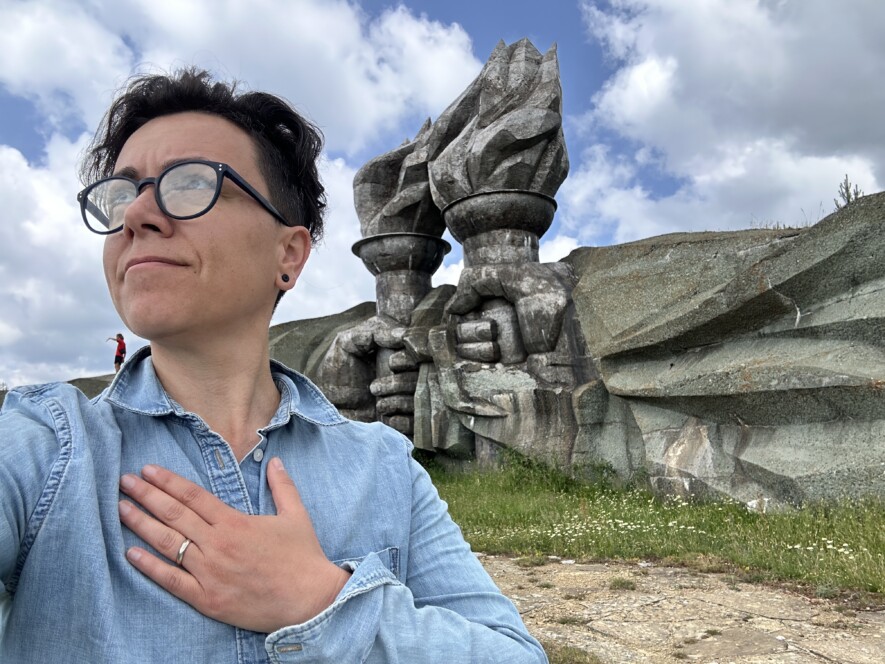
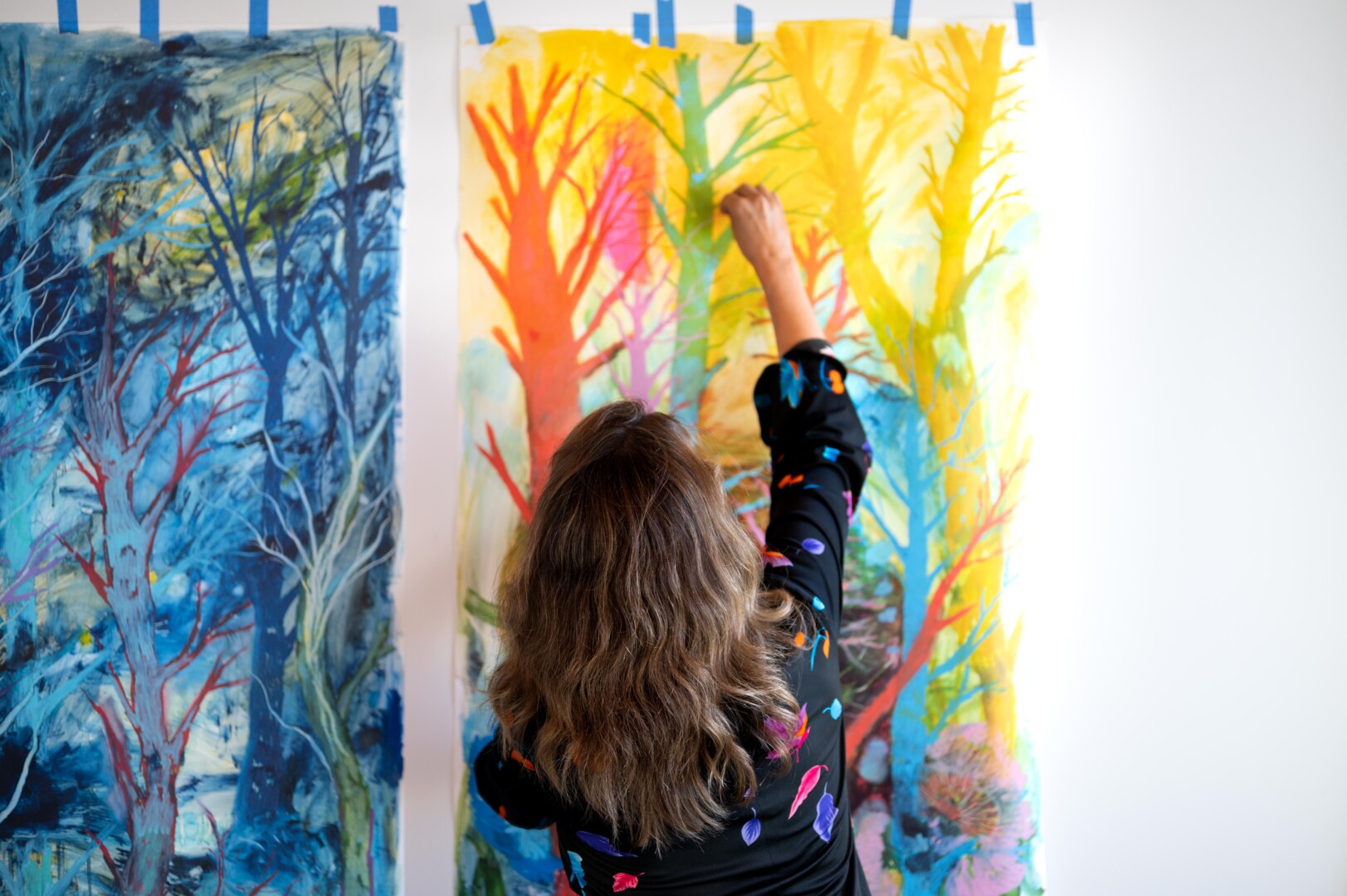
Biliana Velkova | Photo by Estelle Henric-Magin
The Bulgarian word ‘tuga’ means ‘melancholic nostalgia,’ a longing for something that could have happened but never will, says visual artist Biliana Velkova. Along with Simon Fraser University associate professor Milena Droumeva, she will explore tuga at “Time, Memory, Nostalgia: An Evening of Bulgarian Literature & Visual Art” (March 3, Upstart & Crow Studio).
“We came of age during the communist era, and we still remember it…there’s a certain nostalgia about what could have been [and] why it happened,” Velkova says. “We always talk about time before the fall of communism and after. It’s a very defining moment.”
Part of Upstart & Crow Studio’s Translation Spotlight Series, the event is a post-dinner literary salon focussing on English-translated, contemporary Bulgarian works. It will also feature visual art from Velkova’s Bulgarian folktale-inspired series, Balkan Weather Tales.
“During communism, some of these stories were put aside,” Velkova says, and intends to revive these folktales. “These creatures were held closely in people’s everyday life in order to explain how life works.”
Based in magic realism, creatures—such as the Hala (a bull-like figure with horns who may also resemble a grass-snake) or Lamia (a snake-like figure with a dog’s head and wings)—connect to the land and explain ecological changes. Velkova’s works are also inspired by the Bulgarian creature Kukeri—men dressed in costumes performing traditional rituals to scare evil spirits away.
Exploring nostalgia
The word tuga—which Velkova sees as “steeped” into Bulgarian culture—escapes English translation. But, for the co-hosts, the concept is relevant to the present moment, even beyond Bulgaria’s borders.
“Talking about nostalgia is really interesting, especially in the age of so much fragmentation,” says Droumeva. “It’s a really big transition: You’re nostalgic not just for a different time, but a different life and a different stage of that life you experienced.”
“I’m interested in the way [time] is fragmented in people’s experience and mind, depending on where they live and how they’re connected to the past,” Velkova adds.
Their curated reading list includes writers well-known to English-speaking audiences, such as Georgi Gospodinov whose Time Shelter – winner of the 2023 International Booker Prize – explores tuga. Other works include those who haven’t quite reached a North American audience. All will be available for purchase at the event.
“There’s some wonderful new voices coming out of Bulgaria,” Velkova says. “We’re really hoping that more people learn about contemporary Bulgarian and Balkan fiction.”
Some writers on the list were born in the 1950s and 60s, having lived most of their lives under communism while others were born after it fell.
“Their ideas and writing about nostalgia are very, very different,” Velkova says. “I was interested in looking at those two different perspectives.”
Russian writer Svetlana Boym’s theorization of selective and restorative nostalgia also inspired Velkova and Droumeva. Selective nostalgia leaves the past in the past such as when people think fondly about their childhood but don’t wish for a return to it.
“Restorative nostalgia is [when] you want to recreate the past because it was better—for political, social and economic reasons,” Velkova adds. “We’re seeing that today in the context of America and [other countries], that is of interest to me because we can never reclaim the past.”
Finding futurity
The co-hosts have been thinking about nostalgia for a long time, reflecting on a post-communist Bulgarian identity. Both are now based in Vancouver, B.C.
“We exist between two cultures, but we live in one,” Velkova says. “When I go back [to Bulgaria], time is almost frozen.”
“It’s not talked about enough,” adds Droumeva of post-communist nostalgia. “Everybody moved on right away, and we all want to pretend that it never happened.”
Droumeva is writing a memoir that tries to “make sense” of these complex feelings, including fondness about their childhood under communism. The associate professor recalls “nice memories” of rituals and celebrations—fostering cooperation amongst the community.
“I want to recapture that in my memoir, and I want to find in it some kind of futurity,” Droumeva says. “What can be constructive parts of this nostalgia—if you explore and follow it—that can be taken into the future?”
Their memoir will examine Bulgaria during the 1990s which Droumeva describes as a “painful transition” with rampant inflation and the loss of a value system.
“I think this present moment of planetary destruction, climate change, ‘extractivism,’ inequality, poverty, war, conflict is a call for thinking about alternatives,” Droumeva says, referring to the goal of redeeming communism. “The alternatives don’t always have to be fantastical, science fictional alternatives: Let’s look to the past and see what’s been done and not throw out everything just because it didn’t work perfectly.”
Droumeva will read from the fourth chapter of their memoir titled “Nostalgia.” It examines the history of tuga and Bulgarian life just before the fall of communism, imagining what society would look like today had communism persisted.
“I finish the section with a creative work: it’s an excerpt/poem called, ‘Don’t Join a Cult,’” says Droumeva, noting Bulgarian parents were very concerned of their children joining cults during the ‘90s. “I want all of us to be more connected and reverberating with understanding, or at least flashes of understanding of each other’s experiences.”
For more information, see https://upstartandcrow.com/event/time-memory-nostalgia-an-evening-of-bulgarian-literature-visual-art/.


Comments will load once you reach the end of the article.