
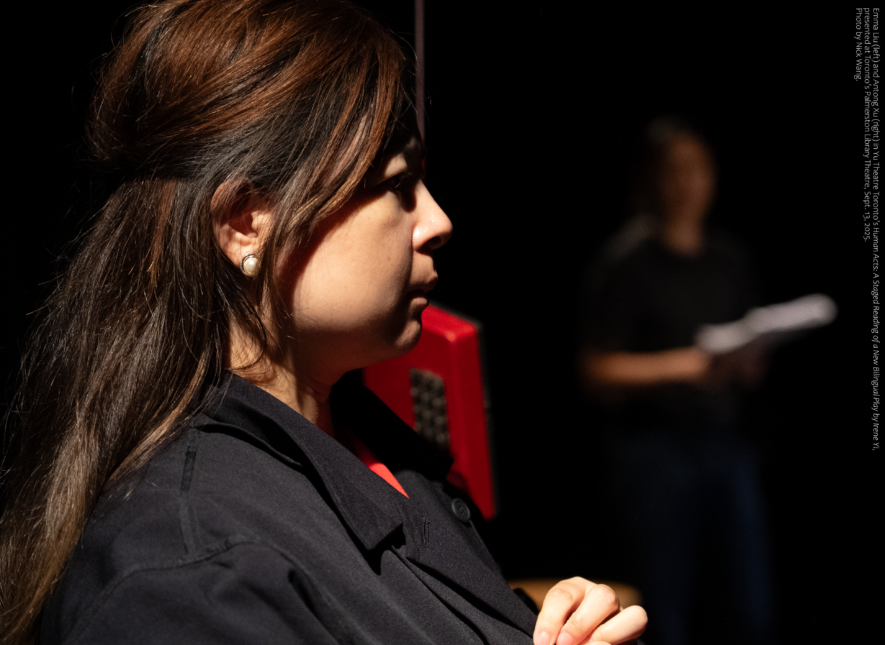
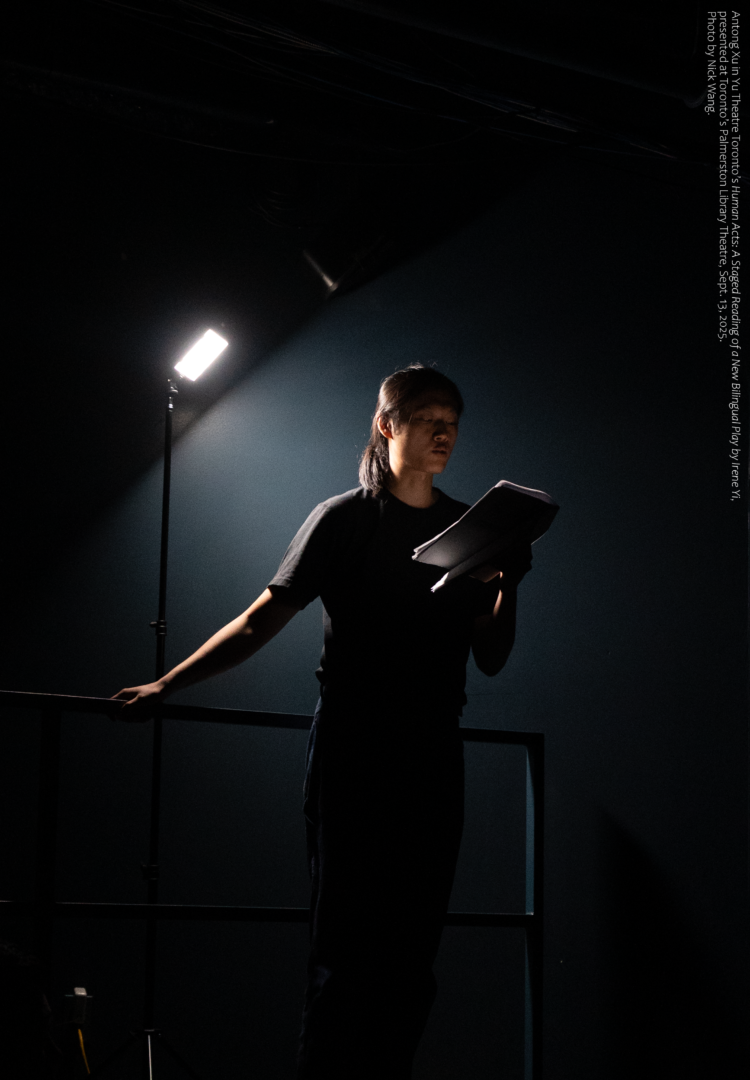
Previous reading of Human Acts in Toronto | Photo by Nick Wang.
“What remains when history is officially declared over?” asks playwright Irene (Fan) Yi. This question drove Yi to write Human Acts—one of two projects chosen for rice & beans theatre’s 2026 Polyphonic Multilingual Creation Program. Yi’s work revisits Wuhan during the Covid-19 pandemic, exploring systemic violence and collective trauma.
“The body remembers the trauma,” Yi says. “One important thing I wanted to explore is how violence or collective violence influences the human body and movement.”
As part of the program, Yi, along with her main collaborator Nick Fangzheng Wang, will undertake a 12-day residency in Vancouver. The program provides opportunity to collaborate with other artists.
A mid-program reading, followed by a questions and answers session, will occur March 14 at the Vancouver Public Library’s Montalbano Family Theatre. A final program presentation, which shares excerpts from Human Acts, will take place on March 21 at Progress Lab 1422. Surtitles will translate spoken English into simplified Chinese and Mandarin into English.
Different perspectives
Yi explores different levels of violence in Human Acts. The first addresses a “collective” violence. Another explores the common people’s survival responses.
“I tried to make it terrifying, but also ridiculous,” Yi shares.
“Theatre is such a fragile art form, because when people come to theatre, they say, ‘Everything on stage is not real,’” adds director Wang, who works with lighting, puppetry and sound to portray this violence. “I want to subvert this pre-assumption; I want to create some moments that will provoke their senses.”
Yi conceptualized Human Acts as a multilingual play from the very beginning. She wanted to make the work accessible to a broad, diverse audience. Her research into foreigners trapped by Wuhan’s lockdowns further cemented this choice.
“There was a foreign couple living upstairs, and they were ready to fly off the day before the lockdown, but after they sent off all their luggage, they were locked in the city,” Yi recalls of reading a writer’s blog post about this couple’s experience. “They were sitting in an empty room, looking at each other, and [the blog writer] started to imagine what the situation is like for the foreign couple.”
The couple was stuck in a country with a language that wasn’t their mother tongue—an experience that mirrors Yi’s own. They are featured as one of Human Acts’ stories.
Originally from Wuhan, the playwright was studying in the U.S. during Covid-19’s onset. She recalls reading Chinese accounts of the pandemic while navigating a largely English dominated environment.
“The play is set in a lockdown apartment, so it’s about different units and the way they intertwined because of the lockdown,” Yi shares.
Human Acts contains six perspectives, including a middle-aged woman in search of medication for her dying father, an advocate of “positive energy” and a starving dog.
“It’s a very fragmented [work], but structurally, it represents how we remember the history that we’re living in,” Wang adds. “It’s a collage of memories, news [and] the shared vulnerability.”
Violent repetition
Aside from fragmentation, Human Acts also explores repetition. For Yi, the pandemic challenged people’s sense of time. Days felt repetitive, leading to a loss of time. Time also sped up as policies rapidly changed from one day to the next.
“I also wanted to touch on the human connections happening in the play—which is both precious and controversial,” the playwright says, drawing attention to limited resources during the lockdown. “Under that type of circumstance, human connections are very, very rare.”
Human Acts was chosen as Toronto-based Yú Theatre’s first project in their Writing for the Next Golden Age initiative. At a Sept. 2025 staged reading in Toronto, the audience came from different backgrounds, reflecting the diversity of the city’s Chinese-speaking population.
“I always had a feeling that theatre should be more responsible for dealing with social urgency,” says Wang. “Theatre has the capability, the capacity, to talk about very controversial stories on stage.”
Both creators see Human Acts as a universally applicable story.
“[The play] is not only targeted to Chinese-speaking audiences or immigrants from China; it’s a shared memory for people all over the world,” Yi says. “The pandemic represents a shared global trauma that continues to shape how we grieve, remember and process collective loss.”
For more information on the upcoming readings, see https://www.riceandbeanstheatre.com/polyphonic.
For more information on Yú Theatre Toronto, see https://www.yutheatre.com/about-us.


Comments will load once you reach the end of the article.