
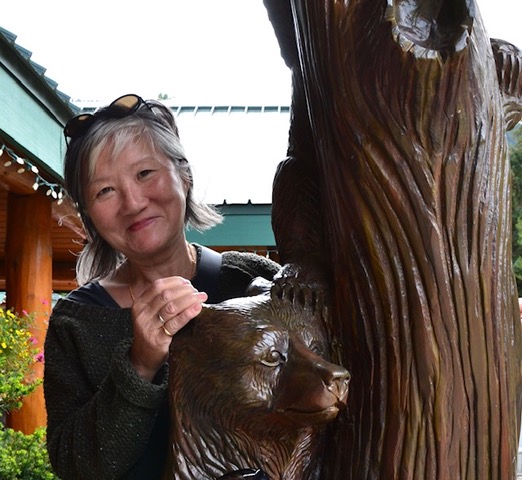
Sharyn Yuen | Courtesy of Sharyn Yuen.
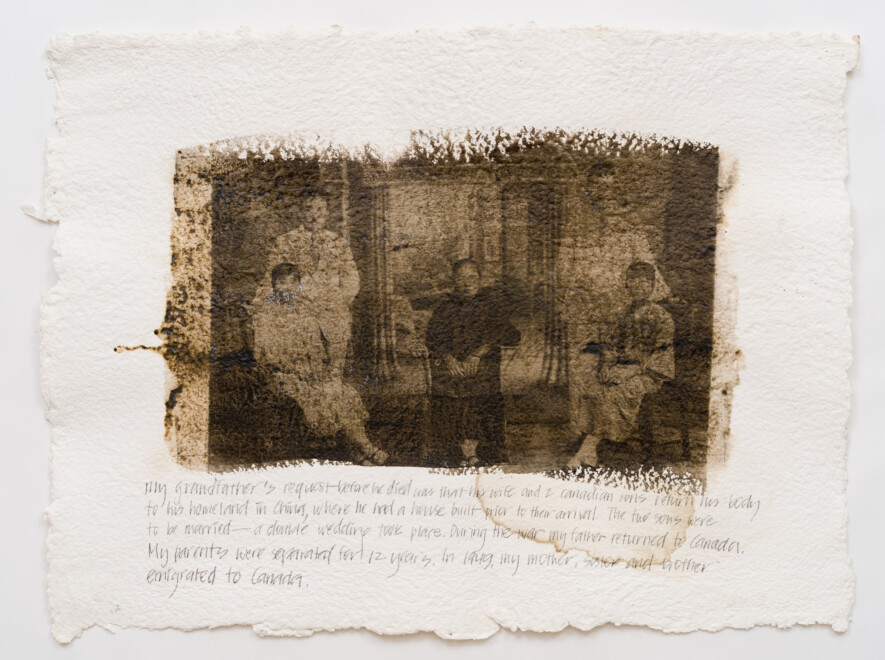
Burnaby Art Gallery (BAG) presents Sharyn Yuen: Suspended in Time until July 7 at McGill Library (4595 Albert St.). This Offsite exhibition is part of Capture Photography Festival 2026 and features five panels from Yuen’s Jook Kaak series—paper-based artworks reflecting the artist’s 1986 trip to her mother’s ancestral village in Namcheng, China.
“Prior to going to China in 1986, I was living in Montreal and hanging out in the Chinatown there, and they would all call me ‘Jook Kaak,’ meaning bamboo knot,” Yuen says of the series’ title which refers to her being Canadian of Chinese descent. “Not one or the other but stuck in the middle.”
Tracing familial roots
Yuen, her mother, brother, older sister and a friend, visited Namcheng in 1986. It was the artist’s first and only trip to China; she had no intention then to create an art series.
Yuen only wanted to learn about her mother’s ancestral village and how her parents met. The family followed a relative’s sketch—a 3 by 4-inch map—with names of villages without demarcations of distance. She recalls having to stop to get directions at different villages, resulting in a 6-hour trip.
“We gave that [map] to the taxi driver,” she says. “I was just taking pictures [with my analogue camera] as we were going through the countryside, then we arrived at the village, and this lone figure comes out and asks us who we were.”
She recalls all the villagers being “Yuens.” As more people came out to see them, Yuen realized that some of these women were friends of her mother.
“When my grandfather died, it was traditional for his wife to take the bones back to China,” Yuen recalls of her grandmother taking her father and uncle to China in search of wives. “They got married; my dad stayed there for three years; my older sister was born, and when my mother was just pregnant with my brother, the second world war broke out.”
The war meant that Yuen’s grandmother, father and uncle—who were Canadian citizens—had to leave. As was common during that time, the war caused a 12-year separation between Yuen’s father and her mother who stayed in China with her siblings.
Paper-made art
After Yuen returned from that 1986 trip, she kept notes documenting that “emotional” experience. Some of these notes made their way into the series—reflecting her desire to create artwork that resembled “pages of a book.”
“The paper is made by my hand, the writing is written by my hand,” she says. “I made the paper fairly quickly, so it’s quite textural, [and] the images aren’t as clear as the first edition I have.”
For Yuen, the works are not just photographic: they are handmade paper art. BAG purchased the second edition in the 1990s.
“I was there [in the village] for only about 45-minutes,” Yuen recalls. “I clicked, clicked, clicked, and I didn’t realize but I had put the same roll of film back in, and when I came back to Victoria, I thought, ‘Oh my god, they’re double exposed.’”
Yuen says curator Cameron McLellan didn’t mind the blurry aspect and found it fitting to indicate the time passed. The artist sees Jook Kaak as her starting point of exploring diasporas and researching family as well as community. It has previously been shown in group exhibitions curated by Paul Wong: Yellow Peril: New World Asians (1988) and Yellow Peril: Reconsidered (1991).
When McLellan approached Yuen with the idea of submitting it to this year’s Capture Photography Festival, the artist was initially hesitant.
“I said, ‘The piece is 40 years old, I’m way past that now’—that experience I’ll always keep in my memory and cherish, but it’s not where I’m at now, and it’s not where China is at now,’” Yuen says. “[Cameron] feels it’s still relevant with all the immigration still continuing and all the separation still happening, with Ukrainian, Iranian families and the astronaut families.” Astronaut family refers to the social phenomenon of fathers leaving their families in Canada to work overseas.
Yuen recalls how China was only just opening to the international world during her trip.
“I wonder if the village is still there with China [developing over] the last 40 years.” She’s been told that there’s now a high-speed rail leading to a city close to the village. “The young people probably all left and went to the city—with how advanced China is now, they’re not going to stay there and grow rice and be farmers.”
For more information, see https://www.burnaby.ca/recreation-and-arts/events/sharyn-yuen-suspended-time.


Comments will load once you reach the end of the article.