
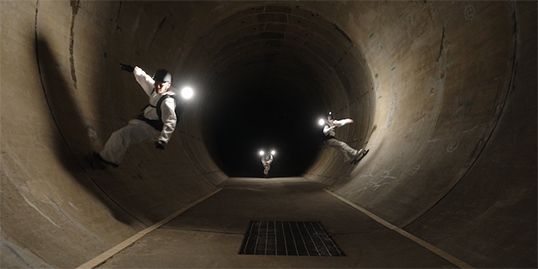
Photo courtesy of the artists | SIDE CORE, rode work ver. under city, 2023, video (still)
“They are using the urban space as a canvas to create their art,” says the exhibit’s curator and RAG director Shaun Dacey. “When you see the piece, they seem like these urban explorers, and you’re not sure what time period [it is] – it has this sci-fi vibe.”
Based in Tokyo, the SIDE CORE collective – which consists of artists Takasu Sakie, Matsushita Tohru and Nishihiro Taishi with video director Harimoto Kazunori – will speak about this piece and their other works at “Lulu Series: Rode Work/Under City” (Richmond Cultural Centre, April 16). The conversation will feature a live translator in what Dacey calls an “intimate setting” where participants can engage directly with the Collective.
Reflecting on gentrification
In 2024, the Japan Foundation invited Dacey for a curatorial exchange in Japan. The intensive 10-day stay allowed Dacey to learn about their contemporary arts scene through museum, gallery and artist studio visits.
“I came across this solo exhibition of this artist collective SIDE CORE at one of the museums,” he says.
Dacey recalls being drawn to the “cinematic,” “mysterious” nature of the work – a five-channel video installation featuring skaters exploring subterranean Tokyo.
“This video installation is an immersive experience of these skateboarders,” he says. “It has this sci-fi vibe because they’re dressed in hazmat suits and have lights attached to them, and they’re skating through this network of tunnels.”
The video’s use of these tunnels – along with stormwater basins and maintenance corridors – reflects SIDE CORE’s interest in urban infrastructure.
“I found out after that their project came out of the gentrification that had been happening in Tokyo as a lead up to the Olympics,” Dacey points out, drawing a parallel to Richmond’s development. “Richmond has been forever changed by the 2010 Olympics – we had the Canada Line put in, and you see massive condo development along the Canada Line since then.”
He adds that SIDE CORE positions skateboarding as “an alternative culture” – one that contrasts ideas of “cleaning the streets” prior to the Olympics. Another layer to this discussion, Dacey points out, is how skateboarding itself became an official Olympic sport, debuting in Tokyo in 2021.
“For [SIDE CORE], the core and soul of skateboarding is this radical, alternative culture that links together not just skateboarding, but music and art and graffiti,” he adds. The group is interested in counterculture, resistance and political agency. “They’re thinking about where do the artists and the real skateboarders go now? Do they become subterranean, hiding under the streets as the city becomes gentrified?”
Curating the international artists
RAG director for over nine years, Dacey’s work considers the role of art galleries in suburbs like Richmond which reminds him of his hometown of Mississauga, Ontario.
“Richmond reminds me a lot of where I grew up – a very intercultural, diverse [and] global place,” Dacey reflects. “I could bring artists from Japan, China and other places to show in Richmond, and the community there would understand the context and the specifics because of how globally connected to Asia Richmond is.”
He sees this exhibit as a culmination of that work, drawing relations between Tokyo and Richmond, connecting artists with the public and sparking intercultural conversations.
“Before development, [Richmond] was tidal marsh land,” Dacey points out. “When we discussed it, [SIDE CORE] was interested in those similar geographies and building of infrastructure – and these long-standing connections between Japan and Richmond.”
An example is Steveston, Richmond’s historic Japanese fishing village. The curator’s trip to Japan highlighted the importance of site-specific works – connecting art to its locality.
“I’m always interested in these sorts of artworks that stop you in your tracks; they’re not literal, they don’t hit you over the head with a statement,” Dacey explains. “But the imagery they create draws you in and makes you think – ‘What is going on? What am I looking at?’”
Next door, the Richmond Museum is exhibiting The Maple Road Experience (until Aug. 16), highlighting Richmond-raised Kevin Harris’ skateboarding legacy.
Seeing these exhibitions as running in parallel with each other, Dacey recognizes how SIDE CORE’s work provides “access points” allowing the public – even those without a formal arts background – to engage in conversations about art in public spaces.
“The idea of skateboard culture or cinematic documentary style video work has these entry points that anyone can walk in and have a response to – that’s what we try to do,” he says. “Long term goals for the gallery is to be more internationally looking and bring more artists in from China, Taiwan [and] Japan – the community can really connect to that.”
This exhibition is part of the 2026 Capture Photography Festival Selected Exhibition Program.
For more information on the exhibit, see www.richmondartgallery.org/side-core
For more information on the upcoming talk, see www.richmondartgallery.org/lulu-apr2026


Comments will load once you reach the end of the article.