
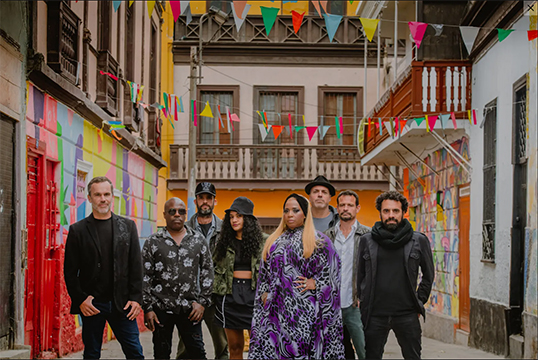
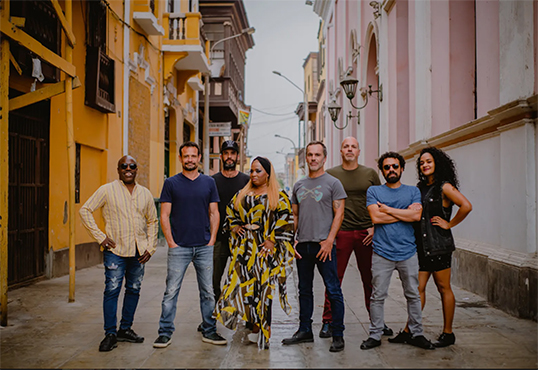
Photo by Francisco Medina | Novalima.
“Whenever we are on stage, it’s a very energetic show, and it’s hard not to see people dance,” Pérez-Prieto shares. “Our music is really rooted in traditional Afro-Peruvian beats, but we’ve managed to re-arrange this sound using very modern sounds.”
For Pérez-Prieto, the tour is an opportunity to connect with new audiences, while recognizing the band’s legacy in modernizing Peru’s traditional sounds. The concert will feature the Vancouver-based Empanadas Illegales as its opening act.
Modernizing Afro-Peruvian music
Brought together by a love of music, the four founders – Grimaldo Del Solar, Rafael Morales, Carlos Li Carrillo and Pérez-Prieto – met, in late 1980s Peru, as high school students.
“The Novalima project started because we wanted to continue making music,” Pérez-Prieto recalls the group’s decision to individually pursue more traditional paths – knowing financial difficulties involved with pursuing a music career. “The four of us started recording songs, then we decided to make a collective and get an album out.”
The musicians all studied abroad. During the band’s early years, Novalima’s members were spread through London, Barcelona, Hong Kong and Lima.
At the time, Pérez-Prieto had already returned to Lima from New York. Without access to MP3s, they shared music with each other by holding phones on speakers – eventually resulting in their long-distance recorded debut album, titled Novalima (2002).
“That’s how we got this nostalgia about our own music, our own culture,” Pérez-Prieto reflects on how their international experience was pivotal in shaping the band’s sound. “We started to get an interest in [Peruvian sounds], and we started experimenting.”
The group was also influenced by the growing electronic music scene during the 1990s.
“It sounds like a refresh of all the music we had been listening to in its traditional way when we were kids, and suddenly, we were modernizing this sound and these songs,” he recalls afrobeats also being an influence. “It gave us a lot of ideas.”
Valuing collaborations
Novalima has since produced six acclaimed albums, capturing their signature mix of Afro-Peruvian rhythms with electronic, dub, salsa, reggae and global beats. The group has also been nominated for a Latin Grammy in the Best Alternative Music Album category for Coba Coba (2009).
“We found a way to make this music more appealing for younger crowds,” Pérez-Prieto shares of their Afro-Peruvian roots. “We have been able to reach newer generations, through the electronic side.”
The musician is proud of Novalima’s reach around the world. They have performed at festivals, including Montreal Jazz Festival, Roskilde and WOMAD – “a dream come true” for Pérez-Prieto.
Novalima also works with local and international artists – an experience that Pérez-Prieto sees as having enriched their sound. The band’s newest album, La Danza, includes collaborations with Miki Gonzalez and Karolinativa.
“It has a lot of variety of different music going on,” Pérez-Prieto says the album, like all their other works, was a chance at reinvention. “We try to investigate new sounds through new vocals and artists that could put some more colour into our music.”
Their second album, Afro (2006), was released worldwide. During its recording, Novalima invited Afro-Peruvian musicians. This tour – which Pérez-Prieto sees as, in part, celebrating this first album that went international – will take Novalima to North America, Latin America and Europe.
“Touring has been one of the great blessings,” he shares. “It’s really inspiring to get in touch with other cultures – it gives us more tools to get new sounds and discover new music that we end up mixing with our new creation.”
The concert is presented by Caravan World Rhythms in collaboration with the Rickshaw Theatre, Capilano University’s Blueshore Theatre and Vancouver Latin American Cultural Centre.
For more information on the upcoming concert, see www.caravanbc.com/events/novalima-direct-from-peru-2
For more information on Novalima, see www.novalima.net/bio


Comments will load once you reach the end of the article.