
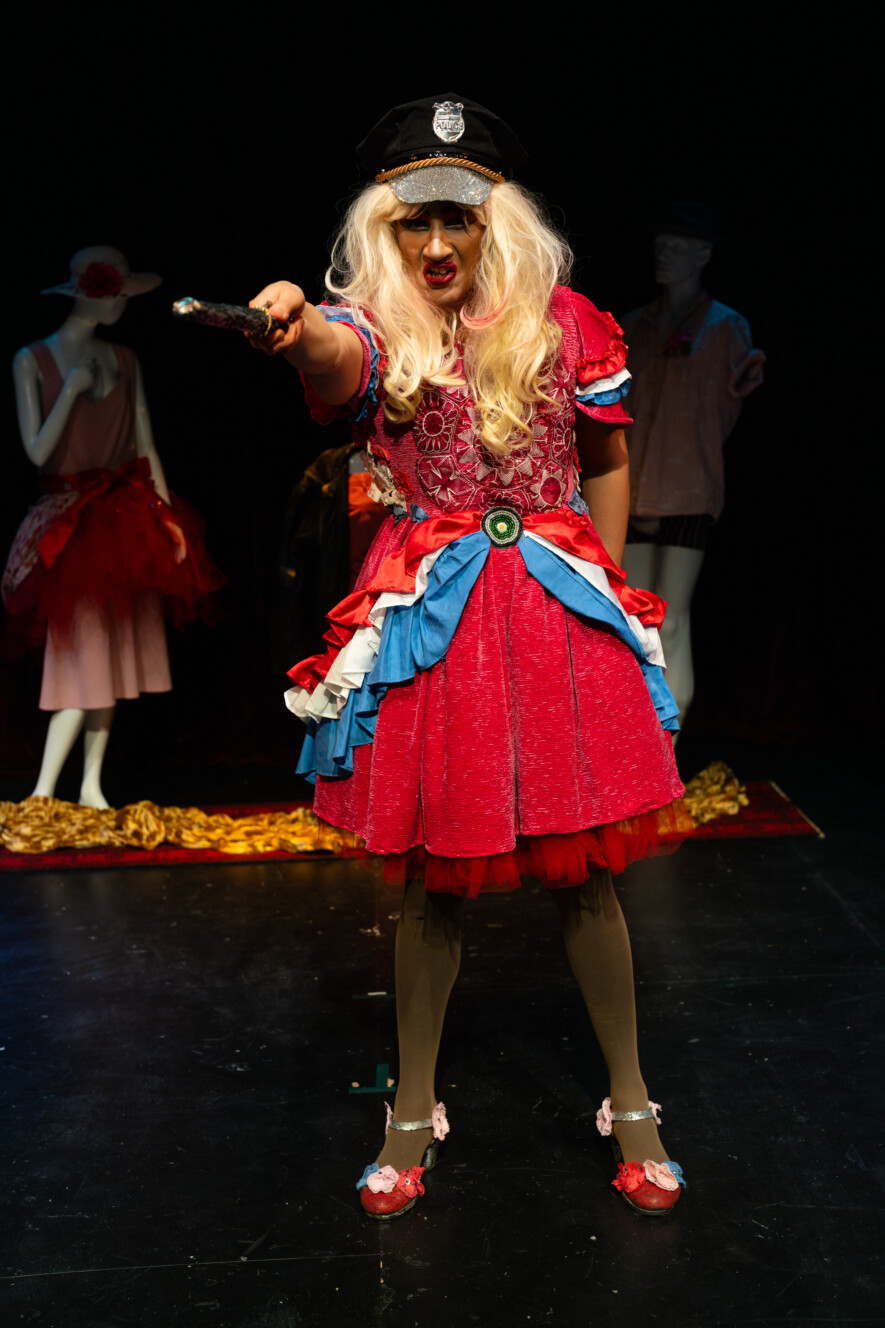
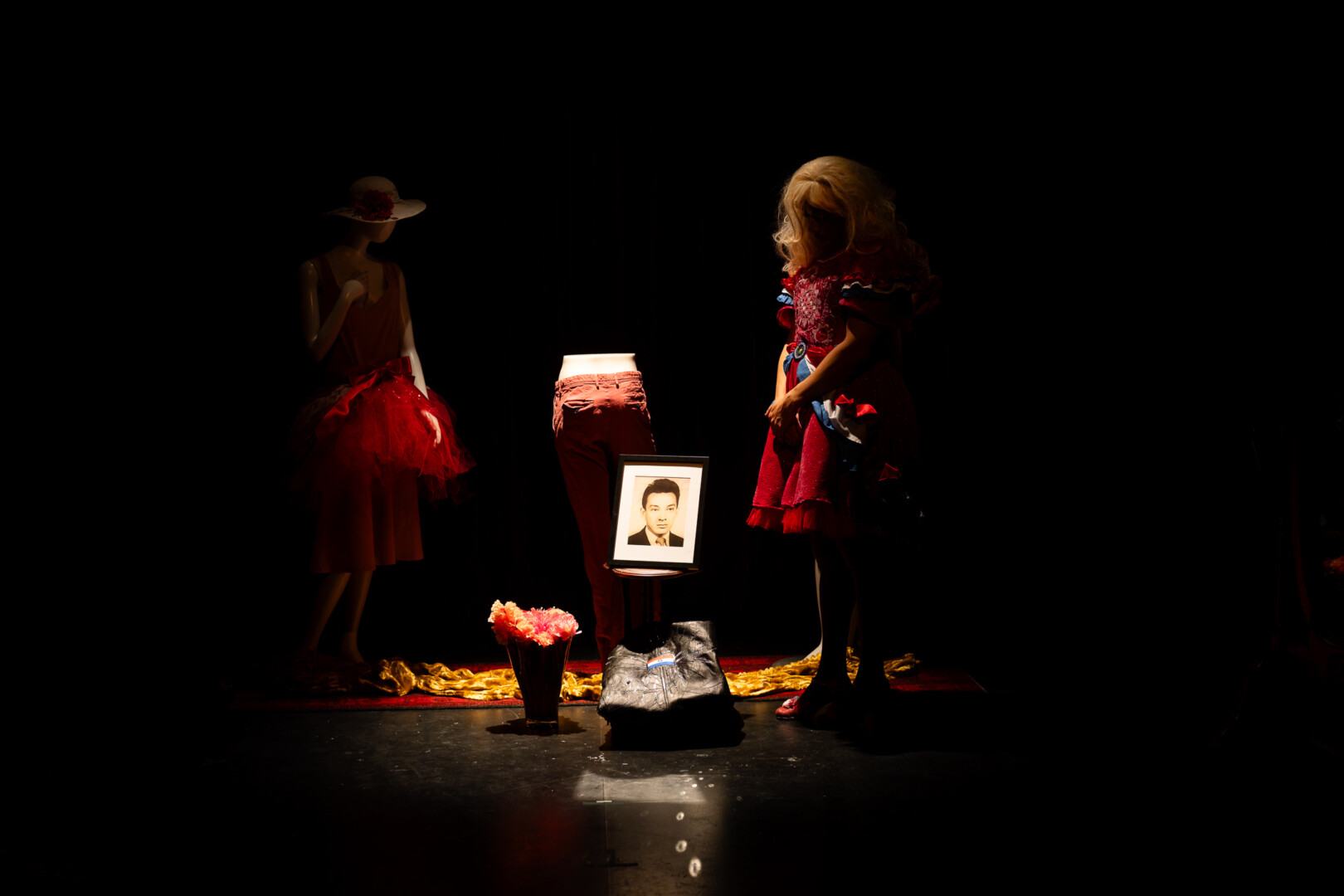
Scene from I am 108. | Photo by Javier R. Sotres.
The number 108 is stigmatized as a ‘gay’ number in Paraguay, says playwright and performer Luis Bellassai. That number, he adds, reflects Paraguay’s history of persecuting homosexual men. Bellassai will perform I am 108 (May 8, Scotiabank Dance Centre), a drag queen storytelling reclaiming this number—while asking others to confront the markers of stigma in their own cultures.
“108 is a story about homophobia in Paraguay,” Bellassai shares, while calling for more diverse representations on stage. “My number is 108—you probably know another way in your country that people shame different groups”
The show’s host is drag queen Juanita Bang Bang, who recounts the historical events of Paraguay’s Case 108.
Becoming proud
In 1959, under the leadership of military dictator Alfredo Stroessner, homosexual men were scapegoated for the murder of radio announcer Bernardo Aranda.
“It was easy to just accuse people, ‘Oh, I think this person is gay,’ and they would be detained without any kind of reason, and they would be interrogated,” Bellassai says.
Interrogation, under a military dictatorship, often resulted in torture. According to Bellassai, a journalist documented the number of men detained: 108.
“As a kid [or] teenager, you don’t really know what is going on—you just know that this number is a ‘gay’ number and you better run far from this number,” he says.
The playwright adds that, the number remains highly stigmatized in Paraguay. He recalls a Paraguayan senator asking to change the number of his chamber—coincidentally 108—because others were making fun of him. The stigma even applies to childhood card games.
“That’s the first time you hear about 108, [but] you don’t know this specific story until you start asking questions: ‘Why is this number related to [being] gay? Why is there shame?’” he says.
Over the years, Paraguay’s queer community has been reclaiming the number. They celebrate two Pride events: one in June with the international community, and the other in September to commemorate the 1959 events.
“Through our unique stories, we still find so much common ground,” adds director Luciana Silvestre Fernandes. “Our queer elders weren’t Latinos necessarily, but they were coming to us and said, ‘I’ve lived this, I feel it and I felt seen.’”
Fernandes adds that their play is heavily grounded in primary sources, including newspaper articles and interviews.
“Juanita is discovering the information about this murder as we are,” she shares. “The research [on these events] is still very new—it’s the kind of thing where we have one thesis.”
Both Fernandes and Bellassai see the show’s messages as extending beyond the Latin American queer community. Many other groups, they say, face similar stigmas in society.
“There is no more important time to be loudly Latino and loudly queer when the world as a whole is being so regressive,” adds Fernandes.
Recreating home
The duo—who met in the Master of Fine Arts program at the University of British Columbia—see I am 108 as an opportunity to showcase Latin artists. The show first previewed at Halifax Fringe before debuting at Vancouver’s Stand Festival for immigrant and refugee stories in 2024.
“We were Latin artists looking for opportunities, and we were creating an opportunity for us,” shares Bellassai, adding other Latin artists were then involved. “These were people who showed interest in the project before we actually offered them the opportunity to be part of it.”
“It’s a big passion project for everyone,” Fernandes shares their collaborators were interested even before the project received funding. “From the get-go, we always just said, ‘Yes, this is the work—this is what we do theatre for.’”
The team also received feedback from other Latino queer drag performers, particularly in the development of Juanita’s character. I am 108, the creators say, has really resonated with queer elders.
“For us, it’s partially history, but they lived through very similar things,” Fernandes adds.
Their process also involved reflecting on why Juanita had to be created. The director recalls a conversation where Bellassai recognized this drag queen character as his connection to Paraguay.
Fernandes describes the character as bubbly, fun and the “most positive, sparkling personality”—the part of Bellassai that is the “boldest, queerest and fiercest propaganda girl for Paraguay.”
“We’re immigrants, we have complicated relationships with home—we choose to leave home, but we don’t want to lose the home in us, and Juanita embodies a lot of that individual struggle,” Fernandes shares.
Despite the weight of history, the duo sees the show as fun with music and comedy.
“I’m here to embrace everything that I know as myself, with all those elements, as contradictory and conflicting as they are,” Fernandes shares the show’s intention in reclaiming identity. “It brings you a level of acceptance and reassurance of knowing the things that make you.”
The show is presented by Blackout Art Society. Bellassai and Fernandes will also host a community event exploring the play’s historical and creative foundations. Titled “From Page to Stage: Approaching Text as a Practitioner” (The Post at 750, May 5), the event is presented by Vancouver Latin American Cultural Centre. The team will also be taking I am 108 to Ireland on its first international tour.
For more information on the performance, see https://www.blackouttheater.com/nextprojects/iam108.
For more information on the community event, see https://vlacc.ca/events/from-page-to-stage-approaching-text-as-a-practitioner/.


Comments will load once you reach the end of the article.