
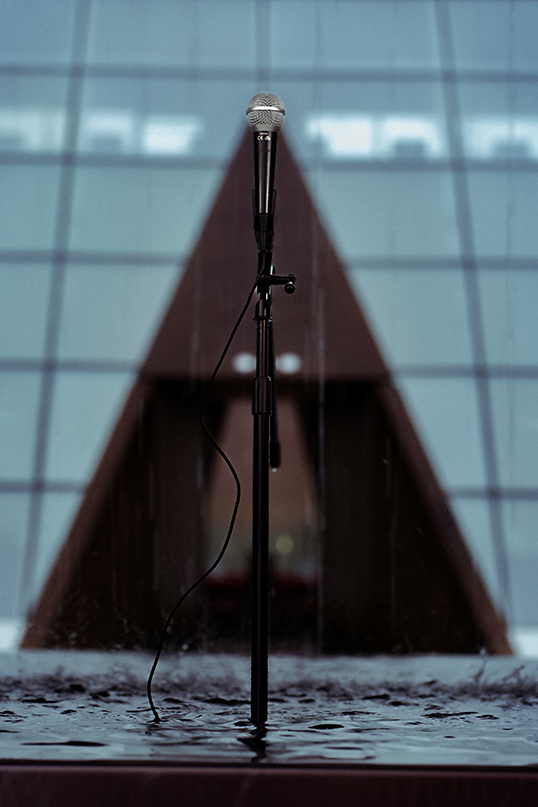
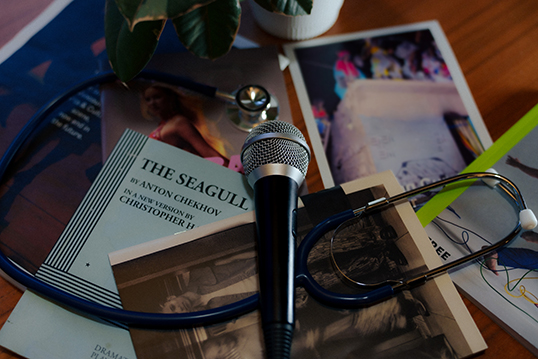
Glitch Theatre presents Arc One.
“More often than not, the work of D/disability-identified artists is put up and celebrated to whatever degree you applaud for it, and then put aside and forgotten,” Warren says. “I hope there’s something deeper that causes folks to appreciate some new perspectives or want to go look more deeply into something.”
Arc One is the company’s first community-engaged project since its rebranding. Presented in partnership with Roundhouse Community Arts & Recreation Centre, the performance is accompanied by live mixed sound and music; this soundscape, along with the audience’s response, will be recorded for release as a podcast series.
“The evening will essentially be a live studio audience recording,” Warren adds. “We have live scoring by the fantastic Mishelle Cuttler who is coming in to musically support each creator with an individual, unique soundtrack.”
The show features pieces from Sunny Daydream Chen, Elijah Curror, Kyla Dowling, Jessica Hood, Helen Jiang, Desirée Leal, Carmen Josephine Lee, Isabel Miller, Cass McKenzie and Gary Tam.
Finding different engines
Through a series of eight workshops, Warren guided participants in writing for performance. Some artists were familiar with writing for stage; others had experience writing lyrical works, short fiction or essays.
“The workshops were meant to teach the fundamentals of performing that work,” says Warren. Participants were intentionally not given a specific theme. “When you get into a room with a bunch of people who identify with D/disability, there’s an expectation of themes, expectation of stories that emerge, of approaches and stuff that people want to talk about, I didn’t want to impose that.”
After the workshops, participants continued developing their individual works – with Warren supporting each one. He sees all the pieces as having “different engines.” One action-packed story, for example, involves a hostage narrative. Another features a meaningful road trip.
“There’s an exploration of collector culture, and what collecting means to somebody looking for purpose, direction, place and community,” Warren adds. “There’s an incredible range.”
There is also a fable about a wolf and bird. The idea, says Warren, is for each performer to get their own podcast episode – allowing them to reach broader audiences. The company’s past podcasts have reached international listeners – including those in the U.K. and Bangladesh – in addition to across Canada.
“Part of the podcast is also [creating] an access point, making things accessible to folks who experience more significant barriers to coming out and seeing the work we do,” he says – adding the medium encourages audience re-engagement. “It’s the idea of the work living on and being able to be built upon.”
Beyond the first draft
Warren sees Arc One fulfilling a gap in emerging artist programming. That gap, he says, is caused by the lack of budget, time and energy given to these projects. The program moves away from what Warren sees as “applause of presence for presence’s sake” –
to supporting D/disability-identified artists beyond their work’s first iteration.
“There is a tendency to put folks up on stage, with very little budget, very little time, and applaud them for being up there and send them on their way,” says Warren. “With Arc One, the inspiration came from the idea of investment – investing in D/disability-identified artists.”
He hopes that the program will continue – with an Arc Two, Arc Three and so on – as each iteration builds off the previous one.
“It’s a body of work that people will return to and re-engage with,” Warren adds.
His team received a high number of applicants who were asked what excites them, where they find their inspiration and why they want to write. Some of his favourite moments are seeing writers develop a new or different creative eye – one that recognizes the importance of an experience that, at first glance, may seem quite insignificant.
“When a writer grabs that, and specifically in a room full of nine other writers, it’s just really magical and nourishing as a creator,” Warren says.
He advises aspiring artists to see themselves as part of an artistic community. More than just the “doing” of art, he encourages up-and-coming creators to engage in artistic conversations.
“Build your awareness of the knowledge, learning and the legacy that’s out there,” Warren says. “D/disability-identified artists don’t operate in isolation – there’s a community of makers out there.”
For more information, see www.glitchtheatre.ca/show/arc


Comments will load once you reach the end of the article.