
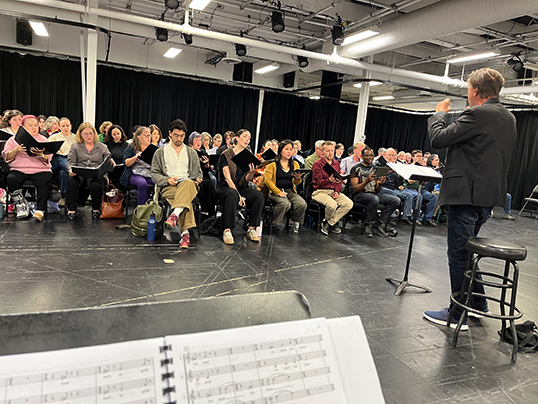
Open rehearsal, led by Leslie Dala.
“Emotional weight and beauty are powerful things, [and] music is a great vehicle to convey that,” says composer Jeffrey Ryan. “But it’s only one way that music can serve the story and the characters. What Ruth finds on her journey is not always beautiful.”
A one-act chamber opera-oratorio, Mother/Land’s libretto is written by Michael Lewis MacLennan. Leslie Dala will serve as conductor; the show features Heidi Duncan (soprano), Krisztina Szabo (mezzo soprano), Simran Claire (mezzo soprano) and Luka Kawabata (baritone).
A timeless story
Ryan sees The Book of Ruth’s story as relevant to contemporary society. In the opera, Ruth, a young widow, becomes a refugee after escaping from famine and war to her mother-in-law Naomi’s homeland. As a widow, Naomi’s resources are likewise limited.
“It’s that operatic tradition of telling a universal story from long ago but actually saying something about now,” Ryan says. “There are still people in countries suffering with war and famine, and they want something better – they come to a new country.”
Aside from forced migration, the opera also explores themes of othering by highlighting how arrival in a seemingly ‘safe’ location doesn’t necessarily guarantee acceptance. Ruth, for example, is met with suspicion and exclusion.
“She is treated as an ‘other,’ someone ‘not like us,’” Ryan notes, describing how fear – driven by scarcity – can lead communities turning inwards.
These experiences are translated into sound, encouraging audiences to feel the displacement and othering through music. Ryan points out how a scene where harvesters taunt and dehumanize Ruth is accompanied by “dissonant and jagged” music.
“In this way, we can hear how she is separate from the people around her,” the composer shares of the differences between Ruth’s music and that of the other characters. “We can feel the unease of that displacement, even if the words themselves aren’t focusing on that feeling in that moment, the music fills in that subtext.”
In an artistic genre where female characters frequently meet tragic endings, Ryan wanted Mother/Land to focus on the two women’s relationship with each other – and their resilience.
The musical impact
The opera’s music is also designed with characterization in mind. Ryan shares that Naomi and Ruth receive “completely different kinds of music.”
“Naomi’s music reflects her Jewish roots, with flowing, chant-like lines, while Ruth’s is rhythmically complex and distinct, marked by shifting time signatures and a contrasting tonal language,” he describes.
The choir, Ryan adds, plays a “huge role” as well. As the opera unfolds, these musical boundaries begin to mix, as Ruth’s music “very slowly” begins to resemble some of the styles associated with Naomi’s music.
“We also hear how Ruth’s music weaves with Naomi’s and how she finds strength and courage from that relationship – even when the outside world seems to be against her, and she has moments of doubt,” Ryan shares.
Ryan sees these musical changes as highlighting Ruth’s character development. Rather than abandoning her origins, she begins to build a new, layered identity.
“Without losing what she was, she also starts to absorb what’s around her,” Ryan adds. “She develops her own musical language, everything that she was, and everything that’s now part of her life.”
It’s a message Ryan sees as reflecting a distinctly Canadian perspective, one shaped by multiculturalism rather than uniformity. He hopes that Mother/Land will spark meaningful conversations within local communities – particularly around empathy, respect and inclusion.
“We don’t want you to give that up, we welcome that, because it makes all of us richer,” Ryan shares. “You don’t know what this new person is going to lead to in the future – those seeds get planted, and you can’t deny the opportunity for them to grow.”
He emphasizes that the point is to “treat someone who is not like you properly,” inviting audiences to see newcomers not as strangers but as part of a shared future. This acceptance, too, is reflected in the music.
“In the end, the different musical styles come together and influence each other, and everyone moves forward together as a community,” Ryan shares. “The end of the piece is very uplifting, joyous and celebratory.”
For more information on Mother/Land, see www.vancouverbachchoir.com/event/mother-land
For more information on Jeffrey Ryan, see www.jeffreyryan.com


Comments will load once you reach the end of the article.