
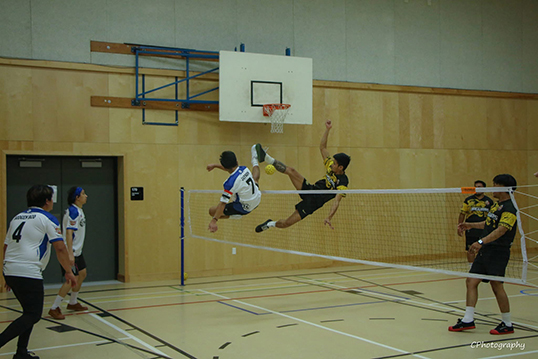
Sepak Takraw National Canadian Cup in Maple Ridge, Sept. 6, 2025. | Photo by Cedrick Perez.
“The top of the shoulder is okay, but anything below the top of the shoulder is off limits,” says Richard “Rick” Engel, president of the Sepak Takraw Association of Canada (STAC). “It would be a fault if it touched your arm or hands.”
Don’t be intimidated by people flying through the air—Sepak Takraw is an accessible and fun sport that soon may become more well known. With the support of Engel and Township of Langley Councillor Margaret Kunst, local player-organizer Irold Inso is working to form an official association for the sport in B.C.
“I had stopped playing for 10 years; I’ve never imagined that we can make it this far,” Inso reflects. “I’m really happy that we have this group, and I met these players.”
“I’m excited from the national office point of view that things are really coming together in B.C.,” Engel adds. “What started out as a club with Inso and the teams there…is now to the point of expanding to a provincial association.”
If successful, the recognition will open doors to provincial and municipal funding as well as sponsorships. In September, Inso’s club hosted the 2025 Canadian Open Men’s Sepak Takraw Championship in Maple Ridge— previewing the trio’s plans for the sport in B.C.
Developing the sport
“We’ve tried to get funding nationally, but it’s been tough,” Engel says. “We don’t have enough provincial associations under the national association to be considered for federal funding.”
Based in Regina, STAC was officially established in 1998. Engel—who had already been raising awareness of the sport in Canada for years—led the initiative. He first came across Sepak Takraw while taking a break from teaching English in China and traveling around Southeast Asia.
“We saw kids playing in a parking lot [In Thailand] with a bamboo ball over a rope,” the president recalls. “Three on three, and they were playing this crazy game; it looked like volleyball but with their feet.”
After returning to Canada, he taught mandarin and was a school’s Asia-Pacific coordinator which involved incorporating aspects of Asian culture into all the subjects. There, Engel encouraged physical education teachers to include it in their curriculums. When he founded a non-profit organization offering schools hands-on activities related to Asian studies, Sepak Takraw quickly became one of the most highly requested activities.
“When I first started, I couldn’t kick the ball twice in a row,” Engel recalls. “I learned to play through a group of Laotian players here in Regina.”
Since then, Engel as player-coach has brought the Canadian team to international competitions. One highlight was winning the silver medal at Thailand’s King’s Cup World Championships.
Changing rules
In Sepak Takraw each team’s three-on-three player arrangement includes a “feeder” on the left, a “spiker” or “killer” on the right, and a “server” in the centre. The team is called a regu.
“It’s very impressive when you see it for the first time,” adds Kunst. “[Players] are just proud to be part of the team and part of something that is their cultural background.”
Kunst first came across the sport in her work to resettle Karen refugees from Myanmar in B.C.—a project that eventually led to the introduction of the sport to Langley’s recreational programs.
“What are the barriers that some of these kids would face in Canada?” she recalls of the initiative. “The whole idea was to use sport as a tool to connect with the community: they played soccer and hockey, but Sepak Takraw was the way that they could teach Canada a new sport.”
At the international level, there have been innovations to the game. The international sports organization has introduced a quadrant (four on four) and double (two on two) style of gameplay. Engel adds that although the Canadian nationals have previously hosted doubles, they stopped doing so in recent times due to the high cost of this competition style.
Sepak Takraw’s scoring system has also undergone a recent change: Starting in 2024, teams no longer play up to 21 points. According to Engel, the change was meant to shorten the length of games during team tournaments—where three regu from one country play against three regu from another country.
“In Asia, these events at the top level are filled—there’s sponsors—it was [taking] way too long,” he says. “Now each set goes up to 15, but if the score is tied, fourteen to fourteen, then they play to 17 points.”
Finding roots
Despite its accessibility, Kunst and Engel see “lack of knowledge” about the sport as a challenge to registering an association.
“People are not that familiar…it’s going to take a little bit to get this on the programs of recreation centres,” Kunst says.
“It’s very easy to play in schools because you can use the badminton courts and the badminton poles that are already there,” Engel adds. “Lots of schools, when they begin, use the badminton nets too—it’s the same height.”
Kunst and Inso are working to bring the sport to Langley’s Global Fest in 2026. Inso—who started playing the sport in grade five back in the Philippines—now leads a club that regularly plays at Maple Ridge Christian School.
“The sport is not easy, it’s really hard.” Inso concedes. “[But] it can be modified; I have a ten- year-old son, and I’ve started training him.”
Most members in Inso’s club already knew the sport. An active B.C. club exists in Comox Valley on Vancouver Island. Led by Phill Fuller, it has been playing once a week for the past 17 years.
Kunst adds that immigrant families have already been organizing sports for their children despite the Canadian system’s different definition of “organized sports.”
“It wasn’t necessary ‘organized,’ but it was organized for them,” she says. “They come to Canada, and we want to organize everything, we want to have it certified, and we want to have things on paper—it’s just not how they roll.”
Kunst points out that these standards often exclude newcomers who may not have the financial or time resources to support their children. Sepak Takraw is a way to connect communities within and across cultures.
“That’s what we loved about Sepak Takraw: ‘hey, we’re going to play on Sunday at 2 o’clock at Douglas Park, and we’re going to set up a couple of nets,’” Kunst adds.
“The thrill was to go from not knowing anything about the sport to becoming one of the top players in Canada back in the day,” Engel reflects. “Just watching [younger players] be filled with such excitement and enthusiasm and happiness for what they were experiencing—that was even more rewarding.”
For more information, see https://sepaktakraw.ca/.


Comments will load once you reach the end of the article.