
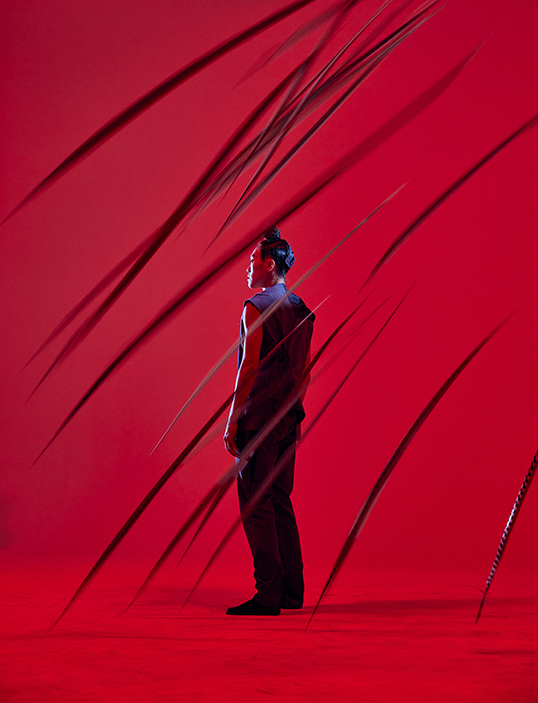
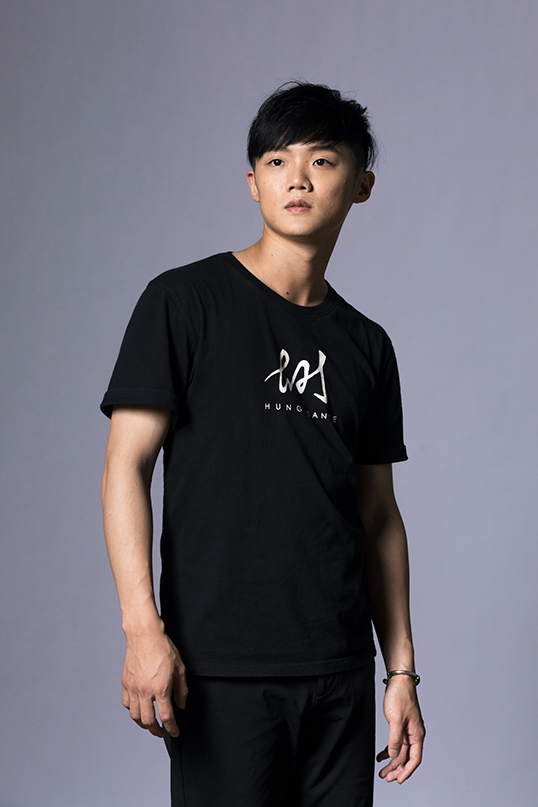
Lai Hung-Chung. | Photo by Terry Lin.
“I want to invite this kind of imagination – how these performers are going to take flight, what state and what kind of movement they are going to portray as flying,” he says.
Lai founded the Taiwanese contemporary dance company Hung Dance in 2017; he now serves as its artistic director.
A feathery innovation
For Lai, the seeds of Birdy trace back to his university days, when he began questioning Chinese folk traditions.
“We call it the Chinese folk dance because there is a strand of the Chinese culture in our own education system,” the artistic director explains. “I am very interested in the movement and the props – these are the things I want to explore in this strand of cultural and educational system.”
After graduating, Lai’s ideas deepened into a search for a more personal language of expression. He began collaborating with classmates, exploring props that could embody their own culture.
Birdy draws on the visual power of the Ling Zi – a four-foot pheasant feather headpiece from Chinese opera – to explore cultural heritage and its transformation.
“So, Ling Zi , the plume, actually came in: that sort of jump-started our creative process for Birdy,” Lai shares. “The plume itself is a feather – it also has the connotation of flight and freedom.”
He sees Ling Zi as a symbol of his creative process. It represents the “shackles” that used to limit his creative energy. Birdy’s performers use this prop in a choreography that Lai sees as a “new vernacular” being presented on stage.
“You can see a lot of traditional opera elements in [Birdy]; it’s part of our cultural strand,” Lai adds.
He was also inspired by American director Alan Parker’s 1984 film Birdy. Set during the Vietnam War, the film follows a young man who uses makeshift methods to fly – eventually injuring himself.
“It’s ironic or poetic in a way where his way of achieving flight is actually when he was in a psych ward,” the artistic director reflects. “He’s naked all the time, staring outside the window, but in his own inner world, he has been flying in that instance even though physically, he might be imprisoned.”
Honouring hybridity
Birdy also draws on tai chi – not as a stylized effect, but as a method of discipline and clarity grounding the dancers’ physical vocabulary. For Lai, tai chi is not just about “effects,” it is a “fundamental for training” of his dancers.
“When we use this technique on stage, how the body – the strands, the sinews and muscles – contort, there is a clarity to it,” he explains. “There is a linear presentation to the body through tai chi.”
Beyond the precision of movement, Lai approaches choreography as a form of storytelling – one that blends different techniques.
“I wouldn’t want audiences to say, ‘Oh, they’re using modern dance techniques,’ ‘Oh, they’re using contemporary dance techniques,’” Lai adds. “I want a blend of narrative, of drama into this kind of storytelling.”
For Lai, Birdy’s arrival in Vancouver represents more than just a tour stop – it’s a meeting point between cultures, histories and shared struggles for identity. This sense of diversity resonates personally for Lai, whose earliest impressions of the city came through his aunt’s immigration to Vancouver in the late 1990s.
“You can also see these traditional Chinese elements sprinkled around these cities – it’s kind of interesting how these simple things can be spread around Asian countries and other cultures and then see them hybridize, see them evolve into something new,” Lai recalls of his impressions of Vancouver. “By creating this kind of hybridity, they interact or connect with the locals in a different, innovative way.”
The artistic director sees this sense of cultural hybridity – including Canada’s work to decolonize – as connecting deeply to Birdy’s themes of freedom and transformation. For Lai, Birdy is part of a larger mission to encourage Taiwanese arts.
“[The name Birdy] embodies this kind of abstraction and ambiguity of what the performers are playing,” he says. “We are practicing, sort of trying to become an inspiration for more Taiwanese performers, creators to participate in dance – in this art form.”
For more information, see: www.dancehouse.ca/hung-dance
Interview conducted with translation help from Hegel Tsai.


Comments will load once you reach the end of the article.