
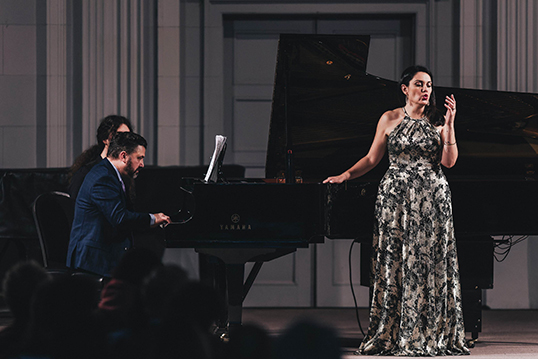
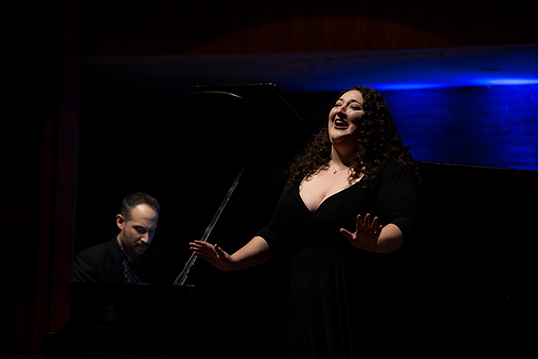
Jaclyn Grossman at Rebanks Concert. | Photo by Stuart Lowe.
“Leading from a place where you can try and be open and hear the pain that other people are going through will help you understand,” Khalil says. “There’s a lot of pain in this situation, and we can’t neglect one for the other—we also live in Canada: we’re in a place where we need to heal what’s going on.”
“It’s hard to start talking about a certain topic, but if music opens the conversation, it’s coming from this shared experience,” Grossman adds.
The repertoire features both Arab and Jewish stories—highlighting composers such as Ilse Weber (1903-1944) who wrote songs for children interned at the Terezín ghetto in German- occupied Czechoslovakia. After the performances, Marsha Lederman will host a Q&A session to encourage cross-cultural dialogue with the artists and the audience.
Strength in differences
Khalil’s and Grossman’s conversations inspired the project. Grossman sees Khalil as a mentor in the opera world; the artist often offered support.
“There was really no intention behind these conversations other than we like each other, want to support each other and understand each other’s experiences, especially as we felt this rift growing stronger between our communities,” Grossman says.
Edmonton-based Khaili was born in Syria; Grossman, based in Toronto, has spent the past six years researching Holocaust Jewish repertoires.
“We were never afraid to say our piece, and we were always very honest with one another,” Khalil adds. “I know that Jaclyn was never going to judge me; she was just going to enlighten me.”
Through these conversations, the duo soon noticed how their media algorithms were filtering different information. For Grossman, the “most helpful and important” conversations were ones where they shared different perspectives.
“I would say, ‘hey, I’m seeing this and feeling this way, is that similar to what you’re experiencing, can you help me understand what’s going on for you?’” Grossman adds. “There was no judgement, no fear, I could just genuinely say, ‘I was trying to understand something, can you help me?’”
“We all are born and raised into things that we learned, and those things evolve as you get older,” Khalil says. “But sometimes you have to challenge those things that you learned and really step out and seek answers for yourself.”
Khalil feels that through challenging these beliefs, people can recognize humanity’s “one consciousness”—including how they deal with pain in similar manners. Grossman also had these conversations with artistic advisor Idan Cohen.
She adds that many artists have “quietly” expressed wanting to have similar dialogues—illustrating a desire and need for these “nuanced, difficult” conversations.
“Stepping out from a crowd might mean that you’ll find a new community of people,” Grossman shares. “That’s been the experience of making this concert and the response so far—that there’s a new community, a space where I can make a positive impact, be helpful and learn to understand things better.”
The team sought composers from Palestinian, Israeli backgrounds, or both, and those of Jewish and Arab heritage.
“We really want to have pieces that align with our themes of home and finding home—either where we are from and where we are now,” Grossman adds.
They aimed for a “positive message,” searching for music from spaces “where all cultures peacefully co-existed,” adds Khalil. COV artistic director Gordon Gerrard will be the concert’s pianist/conductor.
“We really want to give people a place where they can come and experience the music, the languages, the composers and the relativity and the similarity of these things we have chosen,” Khalil adds. “And to create a safe space to be able to talk to people that are in that space.”
Finding hope
Grossman is part of a piano-vocal duo, Likht Ensemble, with pianist Nate Ben-Horin. The duo performs music from Holocaust Jewish artists—themes that Grossman sees as resonating in Salam-Shalom.
The sopranos will perform Eli, Eli—a World War II Hebrew poem—in Hebrew, Arabic and English verses. Grossman says the poem by Hungarian-born Hannah Szenes (1921-1944) plays a key role in Jewish culture. In 1944, Szenes left British-mandated Palestine, returned to occupied Europe and helped Jews escape the Nazis.
Recalling that she sang the poem in elementary school, Grossman says its message is sharing the “beauty of the world” and the everlasting, universal desire to “find our hopefulness.”
“That is the message of the whole concert—the beauty of the world and the beauty of our hopefulness and seeing each other has to live on for us to move forward at all,” she shares.
Salam-Shalom will feature a new arrangement of Eli, Eli from Ben-Horin with Arabic verses translated by Khalil’s parents. The duo will also perform “Ya annah emza’cha” from Argentinian composer Osvaldo Golijov’s Ayre—a work blending Hebrew and Arabic poetry. It intertwines a Hebrew prayer with Palestinian writer Mahmoud Darwish’s poetry.
“It’s about displacement and who you become when you leave somewhere and start somewhere else,” Khalil says. “The prayer is woven all the way through.”
The program also features Palestinian, Sri-Lankan, American composer Felix Jarrar. Jarrar’s contemporary piece blends mermaid folklore from the Syrian, Lebanese and Hebrew traditions. The group will also perform a song from Georgian Israeli composer Hana Ajiashvili.
“It’s this artistic gathering of people who share these values of togetherness, empathy and understanding,” Grossman says. “That’s clear in the music they write.”
For more information on the concert, see https://cityoperavancouver.com/season/salam-shalom-echoes-of-home/.
For more information on Miriam Khalil, see https://miriamkhalil.com/.
For more information on Jaclyn Grossman, see https://www.jaclyngrossman.com/.


Comments will load once you reach the end of the article.