

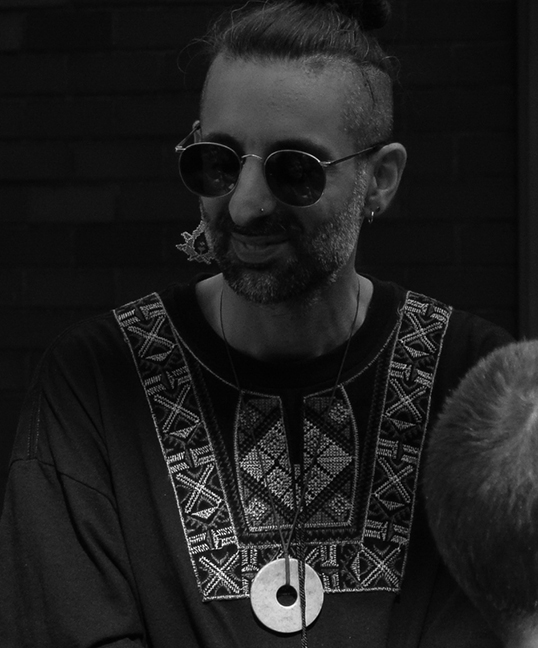
Arman Kazemi, co-executive director of MENA Film Festival. | Photo by Seeta Sadat.
“The film is deeply rooted in the reality of post-revolution Tunisian youth, which is incredibly important to me, both personally and politically,” says Guellaty.
The MENA Film Festival returns with over 40 shorts and features centered on the theme of “Love.” The festival, in its seventh season, continues to highlight voices from the Middle East and North Africa (MENA) as well as Southwest Asia and North Africa (SWANA) regions.
A declaration of love
Like many African countries, Guellaty points out, Tunisia’s very young population represents a significant demographic force – yet holds little political power.
“The idea came from my fascination with young people growing up full of dreams, but trapped by invisible borders,” she says.
Where the Wind Comes From follows two young Tunisians, Alyssa and Mehdi, on a road trip.
“The film is rooted in a strong sense of belonging, but also in a critical gaze, reflecting both love and frustration,” Guellaty shares, noting her intention to ground Where the Wind Comes From in Tunisian language, humor and energy. “It’s my way of engaging with my culture, honestly, without exoticism or nostalgia.”
The director sees it as a “light, sunny, feel-good” film that addresses how the country’s societal issues – unemployment, violence, exile and class conflict – impact its young people. Themes that Guellaty sees as universally resonating beyond Tunisia’s borders.
“I wanted to explore the tension between movement and immobility, between desire and reality,” she says.
The director adds that the two actors, Eya Bellagha and Slim Baccar, brought humour through “spontaneous lines” and depth through “silence.” The pair gave their characters’ friendship “even more layers” than she had originally imagined.
Curating for inclusivity
Being bold – which includes showcasing difficult conversations and challenging topics – is part of the festival organizers’ vision. According to festival co-executive director Arman Kazemi, the festival is also an opportunity to build bridges between communities, starting dialogues that break down barriers of nationality.
“I was very interested in breaking those walls down, and trying to see who our neighbours are, both in a physical sense but in a temporal sense as well,” says Kazemi. “How can we start to build those bridges?”
The festival has grown to represent a wider range of countries, cultures and communities. According to Ghinwa Yassine, co-executive director of the MENA Film Festival, they received approximately 150 film submissions this year; a team of about 30 volunteers screened the entries.
“These volunteers are really from all over the world, and this is something we’re very proud of,” adds Yassine.
A wider audience
The organizers rely on consultations with people from the films’ regions – with the goal of creating a safe, inclusive space. Kazemi adds that even the designation of MENA requires reflection.
In the festival’s early days, the team often received questions from potential applicants about whether their films fall into the “MENA” category. Rather than answering “yes” or “no,” Kazemi prefers to start a self-reflective conversation.
“How do you see yourself as part of MENA?” shares Kazemi of his curatorial approach. “Our job isn’t to police people’s identity – it’s more to call people into dialogue and [ask], ‘What does regional identity mean?’”
According to him, the festival has also grown its audience, attracting “film buffs” in search of internationally made, “progressive new works” regardless of their cultural background. It also continues to attract those who identify with the MENA and SWANA regions.
“I hope that audiences will be as charmed by Alyssa and Mehdi as I was,” adds Sarah Trad, director of programming for the festival. “Since this year’s MENA Film Festival is curated around the concept of ‘love,’ I hope that audiences will also note the complex, understated but beautiful friendship that exists between these two young people.”
For Guellaty, Where the Wind Comes From is a “declaration of love” for her country.
“The road-trip structure allowed me to travel through the country’s diversity, from what we call in Arabic ‘Tunis el Khadhra,’ meaning ‘Green Tunis’ to the arid southern desert, through the inner regions,” she shares. “The intention was always to show the richness and variety of these landscapes without falling into cliché.”
This year’s opening ceremony (Jan. 15, Vancouver Playhouse) features short films addressing the theme of love. Co-presented with Vancouver Civic Theatres, the evening will also feature a performance from Sudanda and catering from Mazahr Lebanese Restaurant.
For more information on the MENA Film Festival, see www.menafilmfestival.com
For more information on Amel Guellaty’s Where the Wind Comes From, see www.guellatyamel.com


Comments will load once you reach the end of the article.