
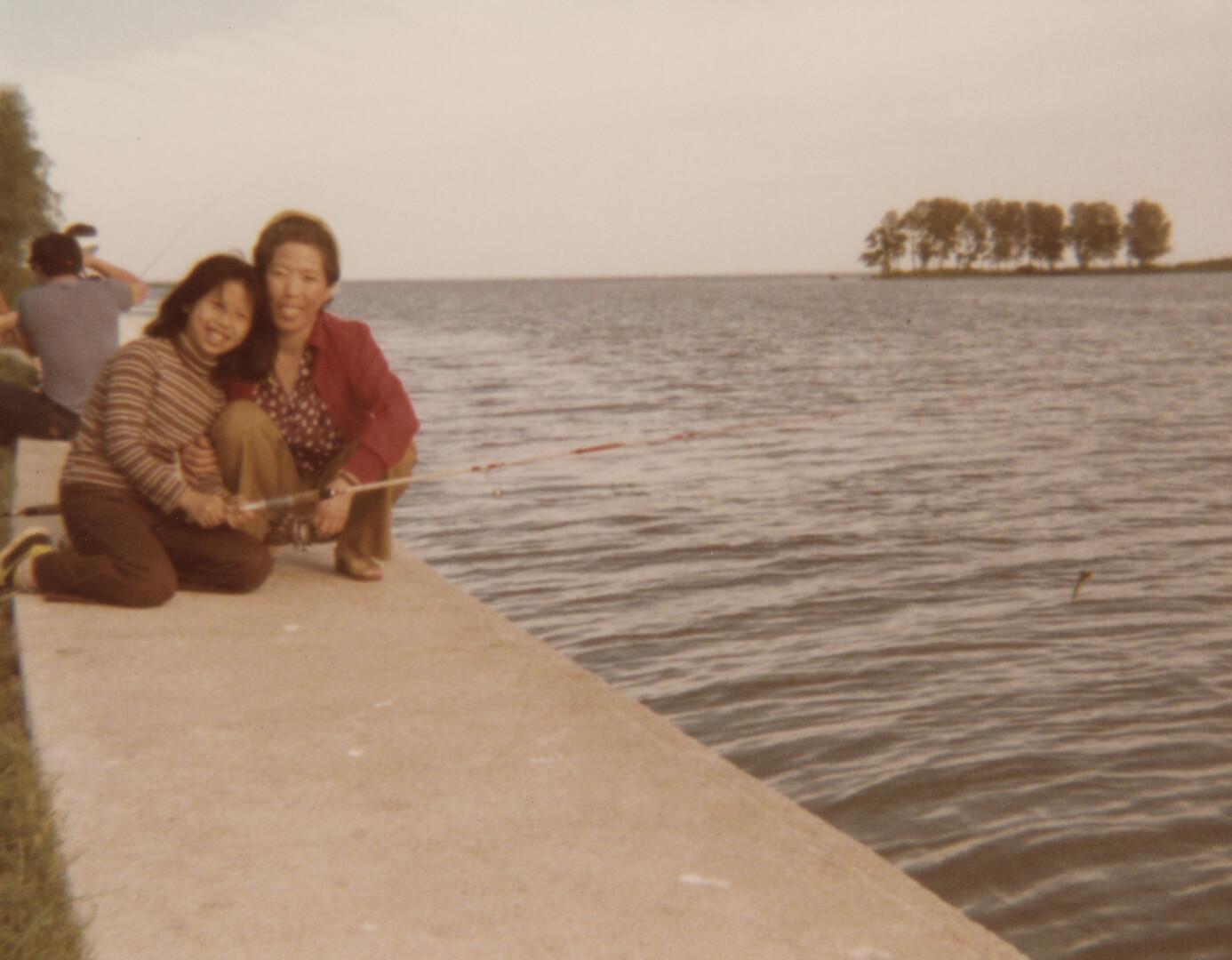
Min Sook Lee and her mother, Song Ji Lee (July 16, 1980) | Credit: Min Sook Lee’s family photo.
How does militarism—its training, activities and psyche—infiltrate the intimacies of private lives? Director Min Sook Lee puts this question at the core of her new documentary, There Are No Words (2025), which investigates her mother’s suicide in the context of her father’s former role as a member of Korea’s counterintelligence agency.
“There’s no random accident there—this is a straight-line trajectory of a social order built on violence, and those who are trained and celebrated as enforcers over a brutal military regime: they will bring it home, always,” Lee reflects. “What we know as headlines of history, they took root in very disturbing, often unspoken ways in our kitchen tables and in our bedrooms at home.”
The National Film Board of Canada production will be screened May 3 at Simon Fraser University’s Djavad Mowafaghian Cinema as part of DOXA Documentary Film Festival.
Reversing the camera
She has previously inserted herself in films as a “story device”—creating what she calls a “mechanical” effect. In There Are No Words, Lee took this process one step further, investing in herself as “a character.”
“This was a really different kind of film: [it] looks at something that has shaped my life,” Lee describes the film as personal, intimate and painful. “It’s been probably the one story that has overshadowed most of my life, and in many ways, informed the political and emotional decisions I made.”
Lee had been waiting for the right moment to tell this story—developing the creative skills and emotional capacity necessary to work on such a personal project.
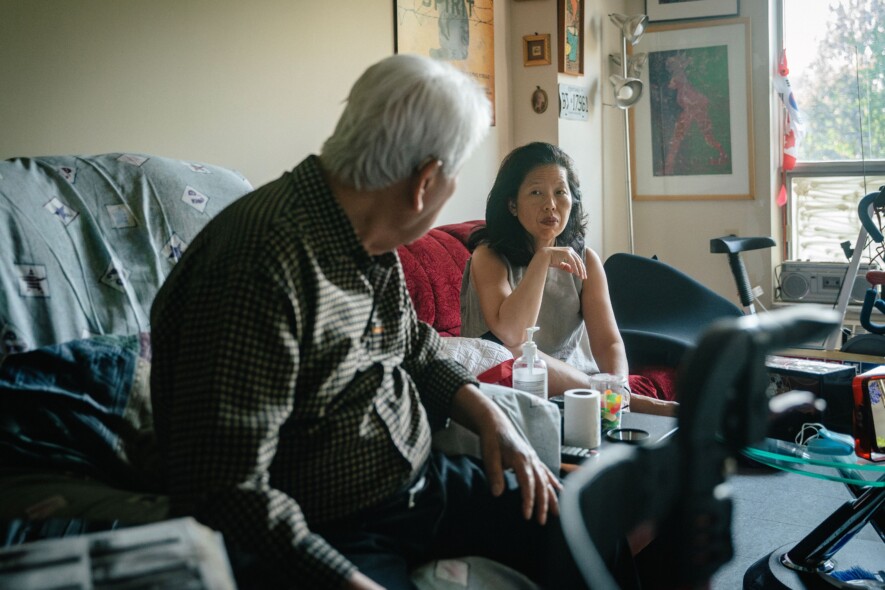
“Covid happened, and I realized that my father was aging, and it really did hit me: [there was] a material wall,” Lee recalls. “He wouldn’t be around much longer, and if there’s anyone I needed to talk to learn what I wanted to learn, it would be him.”
But there were many communication challenges. Lee doesn’t speak fluent Korean, and her father’s English is limited. Topics such as domestic violence and unstable parenting posed other difficulties.
“It’s interesting to watch yourself on camera: especially when I’m with my father, I’m very flat—there’s an emotional reserve that springs up,” says Lee, now her father’s sole source of support in Toronto.
Part of the film uncovers new information about her mother’s life as well as her parents’ relationship which were important to understand in the political context of the time.
“Both my parents were born during Japanese colonialism, so they were Japanese colonial subjects,” Lee explains. The director’s parents were young teens when Korean was liberated. Years of American occupation were followed by military dictatorships. “My father was valorized as a strongman, and he was part of the military apparatus…trained to root out North Korean spies.”
A familiar world
For Lee, that world is not dissimilar to the contemporary moment. She recognizes how authoritarian militarism continues to determine “who counts as human” and “what’s valued in terms of human activities.”
In There Are No Words, a parallel is drawn between her father’s worldview—as shaped by the military’s “harsh, authoritative and disciplinary rule of order”—and domestic violence. It’s a connection that Lee sees happening around the world, even today.
“When we hear about bombings of schools in Iran and soldiers who are celebrated and valorized for these actions, I think that what society and public conversation doesn’t take into account is that those individuals typically bring that activity, that violence home, and partners and children are often recipients of the residue of that violence,” she reflects.
Lee doesn’t think her story is unique. In fact, she believes there are similar stories around the world—of families “deeply traumatized and shaped” by publicly celebrated violence.
Lee’s father—now nearly 90—was open to talking about his actions. She says he wanted to prevent similar situations from happening again.
“He’s not making a full mea culpa, like ‘I’m full of remorse and I did wrong,’ it’s just more a cognition that, ‘These are not good things to do,’” Lee adds. The director also doesn’t see her father as making an apology but rather demonstrating a “reckoning” over his actions. “Part of the conversation that he probably still, to this day, doesn’t understand is the deep misogyny in militarized, authoritarian culture, and specifically, we’re talking about Korean militarism and the way in which women’s lives were devalued.”
Honouring lost stories
Lee has long recognized media as “an organizing space”—a platform to engage with diverse communities and address political issues.
“Getting behind the camera felt like a very powerful way to tell the stories I wanted to tell, to showcase the lives of people who were usually invisible, erased or written for a different gaze to complete a very specific narrative or ideological agenda,” she says.
Lee’s 2016 documentary Migrant Dreams had already been exploring these questions. It sought to mobilize movements for migrant justice in Canada—a process that encouraged the filmmaker’s reflections on accountability, representation and authorship when holding other people’s stories.
The film won the 2016 Canadian Association of Journalists Award for Labour Reporting. Through that process, Lee began to wonder whether she, too, could establish that trust and vulnerability with the camera as a film’s subject.
“First-person documentary filmmaking can often raise questions of: How do I make sure this is not an exercise in narcissism? How do I make sure this is my story to tell?” Lee says of not wanting to “trespass” onto another’s story. “How do I have clear, creative, ethical judgement? How am I accountable—when I’m in the film and when I’m directing the film?”
Lee titled the film, There Are No Words, to reflect the communication challenges with her father. The title also draws attention to the stigma associated with suicide—a sign of Lee’s commitment to challenging the oppressive silence that erases stories.
“My mother had to contend with many obstacles to live a life on her terms,” Lee reflects. “When you go through something that is really frightening, it’s sometimes just impossible to explain those feelings, and you’re wordless.”
As past steeps into the present, the director hopes audiences will recognize the multiplicity of voices still yet to be heard in history.
“[My mother] is not alone; there are many women like her who have been forgotten or assigned no value in history,” she says. “I know most of us have women in our lives—mothers, aunts, grandmothers—who have carried the household, carried the families, who have built communities, and they’re virtually unknown.”
The Doxa Documentary Film Festival returns April 30 – May 10. Lee has been nominated for the festival’s Colin Low Award for Best Canadian Director.
For more information on the DOXA Documentary Film Festival, see
For more information on Min Sook Lee, see https://www.minsooklee.ca/.
For more information on the National Film Board of Canada, see https://www.nfb.ca/.


Comments will load once you reach the end of the article.