
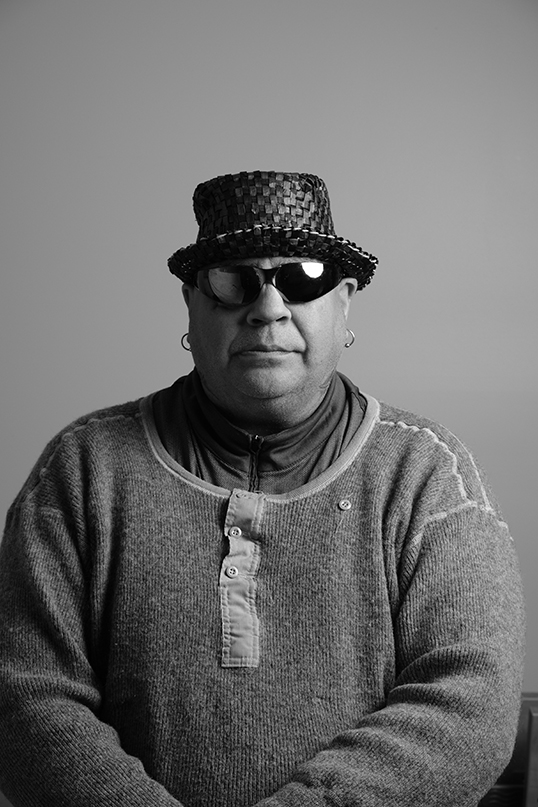
Joseph A. Dandurand.
“In all my stories for children, I was trying to incorporate the teaching of ‘always give something back,’” the playwright says, drawing from an example about harvesting cedar. “You only take one strip off each tree; we don’t strip each tree – you just take one and you move on.”
Rooted in Kwantlen First Nation storytelling traditions, Th’owxiya: The Hungry Feast Dish features the legend of the basket ogress Th’owxiya – a hungry spirit inhabiting a feast dish. The story follows a cheese-stealing mouse forced to save their family by finding two children for the ogress’ consumption. Drawing on traditional teachings often used to guide behaviour, it combines elements of fear, humour and consequence.
Shaped for the stage
Dandurand, who is from Kwantlen First Nation, did not initially see himself as a storyteller. That changed during his time as Vancouver Public Library’s 2019 Indigenous Storyteller in Residence.
“I know there’s a Hollywood idea of the ‘Native’ storyteller, I’ve never thought of myself as that; [then] slowly over time, it happened,” recalls Dandurand –
adding that his people’s ancestral stories were lost during his grandmother’s time. “I realized I had nothing for children, so I spent my residency writing short stories and short plays for children.”
He has since produced several children’s works in collaboration with illustrator and artist Elinor Atkins. These include A Magical Sturgeon (2022), The Girl Who Loved the Birds (2023), The Bears and the Magic Masks (2024).
His work reflects a storytelling tradition rooted in oral transmission – where tales are created, shared and reshaped through repetition rather than fixed in written form.
“There’s nothing written in a book for me to go to [in] regards to stories,” he adds. “All these children’s stories and short stories all come from my imagination.”
In this production, the central figure of Th’owxiya appears as a carved bowl at the centre of the stage; her presence comes through a voiceover. Different productions, he says, have played with these staging elements.
“It’s all done in masks, which is great because it doesn’t technically all have to be Native actors,” Dandurand recalls a production in Waterloo with a cast of young women of various nationalities.
Using masks shapes both the visual style and casting of the production, allowing performers from different backgrounds to take on the roles while maintaining the story’s form. In practice, the masks sit above the actors’ faces, allowing for each character’s expressions.
Carrying forward cultural teachings
The play features characters in addition to Th’owxiya and the mouse – including Raven and Sasquatch. The playwright was initially concerned that the cannibalistic elements might scare children.
“There are some lines in the play where Sasquatch is afraid of Th’owxiya, and she’s like, ‘I don’t want to be eaten, do you guys want to be eaten?’” says Dandurand. “There are always three or four kids who put up their hands and say, ‘Yes, I want to be eaten.’”
This level of interaction shapes how audiences experience the play, particularly younger viewers, who are encouraged to respond, participate and react in real time. One scene shows young bears being taught how to eat worms.
“There’s [candy] worms all over the stage and then the audience can come and learn how to eat,” he adds.
Music also shapes the performance. An old Kwantlen song will be performed, with hand drums accompanying the singing.
“Songs are like gifts and come from the air,” Dandurand explains. “When you’re done with them, they just go back – we can never own them.”
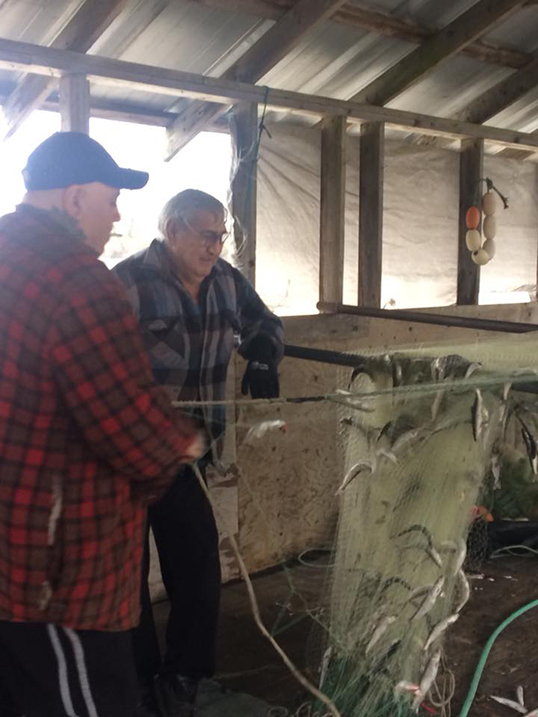
These teachings are reflected in the Kwantlen First Nation’s cultural practices, including approaches to harvesting and fishing – where taking from the land is paired with giving back and avoiding excess.
For Dandurand, these lessons are not confined to the stage but are meant to stay with audiences beyond the performance. The repetition of these teachings, he adds, is essential.
For more information on the Anvil Theatre performance, see https://www.newwestcity.ca/calendar-of-events/events/8695.php
For more information on the Totest Aleng performances, see www.surrey.ca/news-events/events/thowxiya-hungry-feast-dish


Comments will load once you reach the end of the article.