
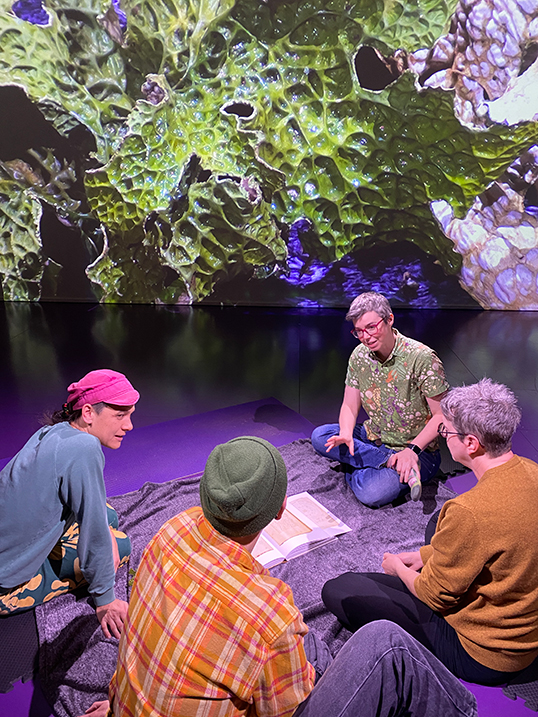
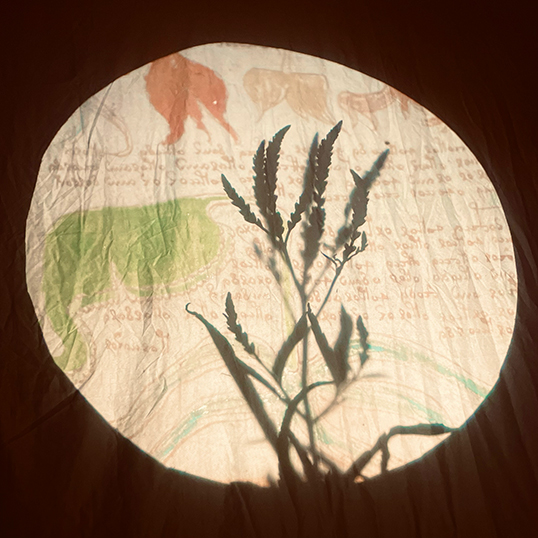
Creations from A Voynich Manifesto workshop. | Photo by Jessica Gabriel
“Things aren’t always what they seem, and the way that things are isn’t necessarily the way things have to be,” Hron shares what she hopes attendees will take away from the show.
The curator sees the show – described as “a dreamscape” – as inclusive of everyone, regardless of artistic background. Inspired by the mysterious Voynich Manuscript, the immersive audiovisual performance explores indecipherability and hidden meanings through improvisation.
Interdisciplinary connections
Vancouver New Music’s two-year On Curation project connects mentors with emerging Canadian curators interested in experimental approaches to sound. For Hron, it was a unique opportunity as musical curations are still quite rare.
“There was an excitement about the material, just how mysterious and inspiring it is,” Hron says of the creation process between the artists. “We all know [connection] was there very strongly, right at the beginning, and we were just enjoying it so much.”
Hron was matched with composer and music curator Peter Hatch (Salt Spring Island). She has long been drawn to working with old sources – and the Voynich Manuscript was no different.
“It’s written in a script that nobody recognizes in a language that nobody knows. It has a lot of pictures of plants that don’t exist on planet Earth,” she says. “It [describes] some constellations that are not visible from planet Earth.”
Hron approached curation by bringing together improvisatory artists and providing a prompt to use the Voynich Manuscript.
“[Houle] has a practice where she does what I think looks like asemic writing – a kind of writing that looks like it’s a script, but it’s really just the natural movement of a person’s hand,” Hron shares. “She does this using ink but also materials from the shoreline and makes beautiful art out of this kind of technique and uses it as a score for her [improvised] singing.”
The Mind of a Snail performers, Hron adds, have a “hybrid practice” where they work with overhead projectors and live cameras while creating soundtracks.
“At the time I was thinking a lot about our relations with the non-human world and how those have been really shaped in this very disturbing way by capitalism and imperialism,” the curator adds. “We live in an extremely exploitative society where we feel it’s okay to take without any thought of the repercussions it has on whoever we’re taking from.”
Collecting curiosities
The Voynich Manuscript’s parchment dates to the early 15th century. It is now in Yale University’s Beinecke Rare Book and Manuscript Library.
“I thought, ‘Maybe the reason we can’t understand it is because we’re so far gone in this weird relationship to land – that this is describing a different way of being,’” Hron says – adding the theory has no ground in scientific or historical research. “It was just something that popped into my mind.”
Her chosen artists were asked to improvise with each other, exploring themes evoked by the manuscript. They gathered in the fall for a weekend of workshopping.
“They use the material in such a playful and yet very respectful [way] – in the sense that they have a lot of admiration and love for the beauty of what the manuscript is,” Hron shares.
The curator describes the performers as having a “synergy” – a concentration that was noticeable in the room. Several themes emerged: herbarium and floating flowers, the cauldron as a medicine-making and magical place.
“I had a facsimile of the Manuscript in a big book, and we were just sitting around it in the middle of this theatre space,” she recalls. “We started to move around it, make sounds and improvise – it became like a cauldron.”
For Hron, the cauldron is particularly fitting because the Manuscript’s early popularity coincided with the European witch hunts. The manuscript was previously in the court of Rudolf II, Holy Roman Emperor (1552–1612).
“Rudolf II was an incredible collector of curiosities,” Hron adds. “He had a number of alchemists at his court – it was a time where people were very curious about mysterious transformations.”
The Manuscript then came to popularity again during the early 20th century, after coming into the possession of its namesake: Polish antiquarian Wilfrid Voynich. Hron’s team is also exploring the rabbit-holes that one can “tumble into” when researching the Voynich Manuscript.
“There was hardly ever a moment where I [thought], ‘What the heck are we doing?’” Hron reflects, adding it’s rare in improvisation to not have doubts. “It was very joyful and connected, and that for me, is very precious, especially these days.”
For more information on the upcoming show, see
www.newmusic.org/events/on-curation-voynich-manifesto
For more information on Terri Hron, see www.terrihron.com


Comments will load once you reach the end of the article.