
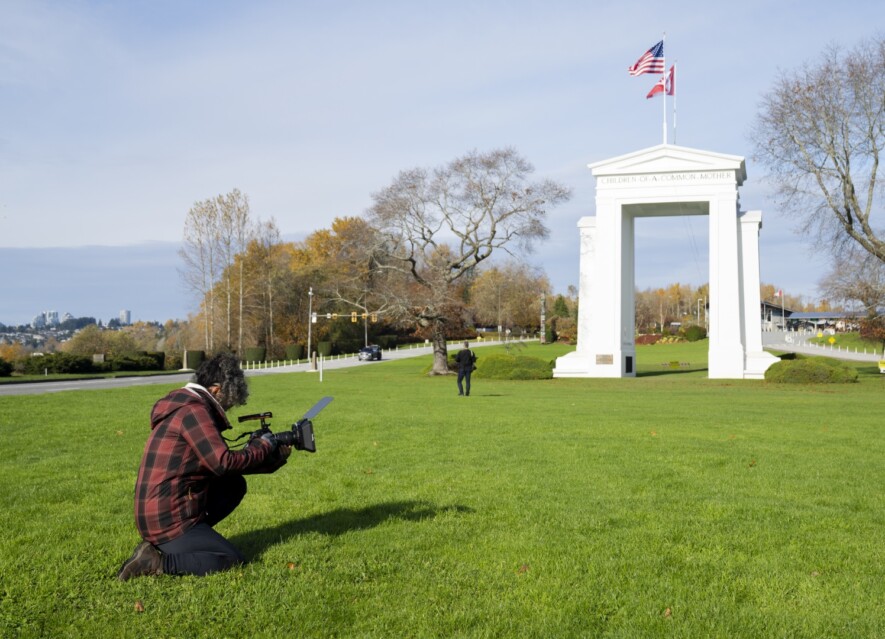
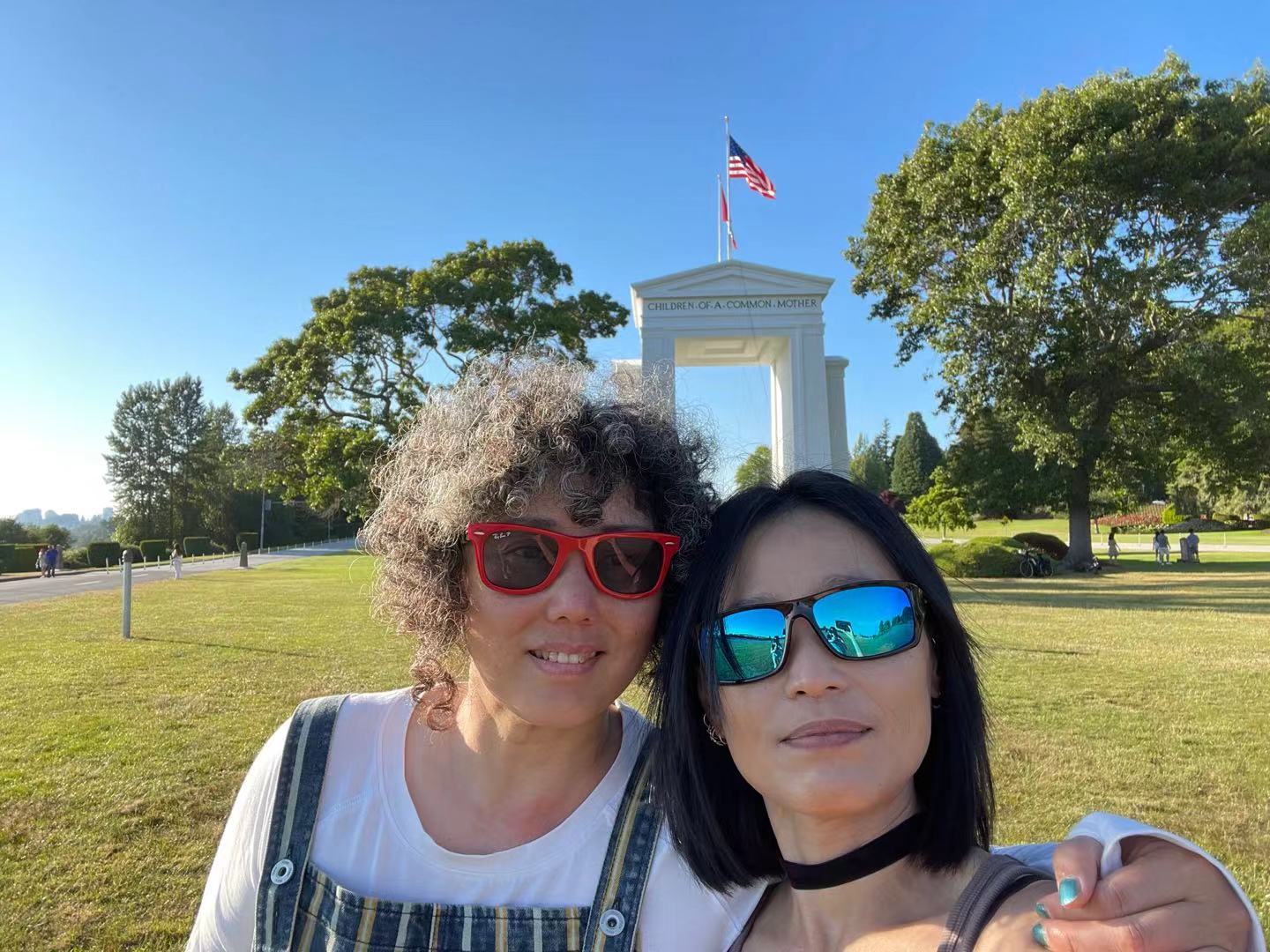
Director Ying Wang and her sister at the Peace Arch | Courtesy of Ying Wang
The Peace Arch State Park is a microcosm of our lives—reflecting both division and wholeness, says director Ying Wang. interplay_2026 will premiere her newest documentary, THE BORDER, on Jan. 24 at The Cinematheque.
“The way I put together the film is a kind of experimentation; it is also a kind of risk-taking,” she shares. “The film is not pro or against the border—I tried to put in as many different perspectives: some may not be ‘politically right,’ but I think they have their own reality, their own truth in it.”
Inspired by the U.S.-Canada border closures during the pandemic, the film reflects on the liminal space between connection and division.
A deconstructed paradise
When the Covid-19 pandemic hit Vancouver, Wang had just wrapped her previous documentary, The World is Bright (2019). The film explores connections between immigration and mental health.
Wang sees THE BORDER as extending this curiosity in global migration—an interest rooted in investigating how people encounter cultural and systemic barriers in a foreign country.
“I grew up in mainland China during the communist era, and I’m personally very sensitive to [the tension between] individual liberty versus state power,” she says. “My questioning of the border is a continuity [of questioning] our personal, independent thinking versus a collective narrative.”
Wang herself arrived in Canada as an international student, eventually becoming a landed immigrant. During the pandemic, her sister and only sibling lived in Seattle, while her mother resided in China.
“I just had an urge to do something as a filmmaker—to find a way to record this moment,” she recalls going to the Peace Arch and finding it “deadly quiet.”
After being separated from her sister for over a year, Wang started searching for ways to reconnect. While the B.C. side of the park remained closed, the director discovered that the U.S. side, known as the Peace Arch Historical State Park, was open.
Those holding a Canadian passport or permanent residency documentation could enter this park and meet their U.S.-based loved ones.
“I noticed that there were people from all over the world, all different cultures,” Wang recalls of her early visits. “The park in that moment became this paradise—it completely deconstructed my idea of a border.”
Recognizing the human
Wang sees the film as an unconventional documentary: it has a long runtime and takes a message-free approach. The documentary also includes controversial opinions, including concerns about reopening the border.
“How much do I really want to share what I own with other people?” Wang says of THE BORDER’s investigations. “Those human complexities towards what you have [and] how much you want to share adds another layer of ambiguity to the film.”
Wang recalls how some living near the border had “ambiguous feelings”—including that of intrusion. Some didn’t want to share “their backyard” with others.
“At the beginning, my focus was more on the people I encountered in the park: their story, why they came here, who they met,” the director shares. “And then, I started becoming interested in the park itself as well as the Peace Arch.”
This interest led to Wang interviewing the Chief of the Semiahmoo First Nation—learning how the border impacted his community.
“If there’s a message in the film, it’s a questioning of these boundaries we establish physically in our life on land and inside our lives,” she adds.
Working on THE BORDER has opened Wang to new perspectives, including those that she previously disregarded. The director spoke with anti-vaxxers and Trump supporters—searching for understanding by listening “deeply and carefully.”
“Once there is understanding, then we will have another perspective about division,” Wang reflects. “Everyone is a human being, everyone has their story to share, and everyone has their dignity that is worth respect.”
While listening may not bridge division, Wang believes it can provide a new perspective on these differences.
Now in its 13th edition, interplay_2026 is committed to highlighting works of experimentation and community building. An artist talk will follow the screening.
For more information on THE BORDER, see https://theborderfilm.com/.
For more information on interplay_2026, see https://interplay-arts.com/.


Comments will load once you reach the end of the article.