
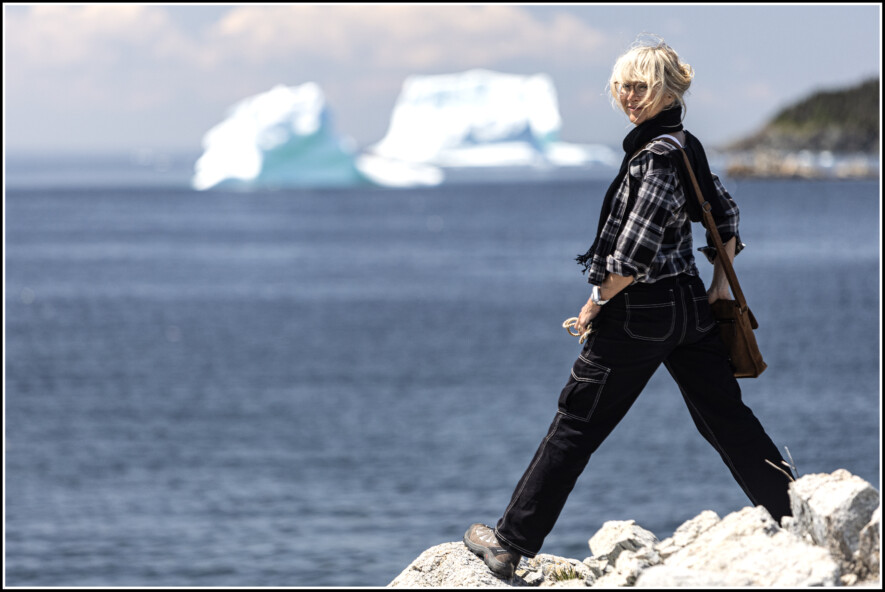
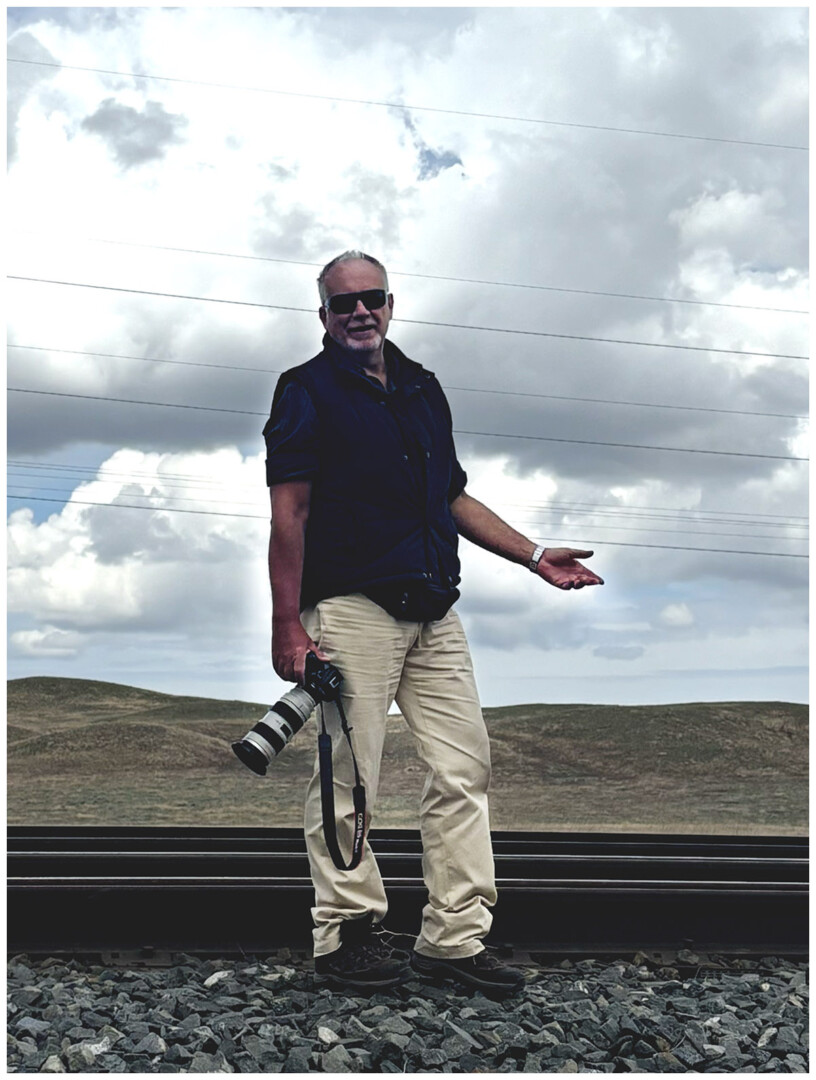
Stefano Gulmanelli | Credit: Arianna Dagnino
You can smell a good story, says local journalist Stefano Gulmanelli who travelled across Canada with fellow journalist Arianna Dagnino collecting people’s stories. These stories are published in their bilingual (English and Italian) newsletter, Canadiensis. Letters from Canada—highlighting the country’s contemporary and diverse identity.
“We really wanted to get out of the screen and meet people,” says Dagnino. “We wanted to meet the ‘real’ Canadians and get their stories from all walks of life.”
They will present insights from their 75-day, 21, 000-km trip at Simon Fraser University’s Morris J. Wosk Centre for Dialogue on Jan. 29. Titled “Canada, In Person. Meeting the People Who Make a Country,” the illustrated talk will discuss what they call “four cardinal points” of understanding the country—including its love-hate relationship with natural resources and prioritization of human rights.
“This is a great country, not only physically speaking, but for the sensation that you can get through meeting people and being in places,” adds Gulmanelli.
They have another six months’ worth of stories to publish; the journalists are also looking to compile these stories in a photographic and literary book—one that, in Dagnino’s words, “stitches the country’s stories together, one at a time.”
Travelling “sideways”
Dagnino and Gulmanelli originally wanted to explore west-coasters’ response to Donald Trump’s second presidency. Their focus shifted to a coast-to-coast Canada trip after hesitations to cross the U.S.-Canada border.
“We were not interested in crossing the country per se,” adds Gulmanelli. “The objective was not just to cover the distance: the objective was touching base with people who are living in Canada, as deeply as possible.”
After speaking with a Saskatchewan farmer—who had just gotten off his tractor—their focus shifted again. The farmer emphasized longstanding personal connections over high level politics.
“We understood at the political and institutional level—it’s something that bothers [and] irritates, but people want to carry on with their own lives,” Gulmanelli recalls. “That’s when we changed, a little bit, the focus of our trip—no longer asking, ‘What do you think about Trump, but tell us about you, about your life.’”
The journalists crossed ten provinces, conducting at least one interview in each province. They spoke with a diverse group of Canadians—including intellectuals, farmers, fishermen, artists, elders, newcomers and community leaders. Some interviews were planned, such as the one with writer Michael Springate. Others came about through improvisation, or as Gulmanelli puts it, “letting things come as they are.”
“We tried to get to the more rural areas in the interior—small villages, more than big cities—as much as possible,” adds Dagnino. “Depending on the story we’re researching, we tried to meet the right people, and sometimes, just by chance.”
Cities visited include Edmonton, Winnipeg, Toronto, Quebec City, Halifax and St. John’s. They tried to avoid big cities and highways, opting for what Gulmanelli describes as a “sideways” style of travel.
A magical experience
People were welcoming wherever we went, adds Dagnino. Rather than being “seen as strangers,” they encountered those wanting to share their stories.
“As soon as they realized what we were doing, they were open to talking to us,” says Dagnino, who recorded conversations—with the interviewees’ permission—on a device tied to her wrist. “They were so happy that someone was recording them.”
“Sometimes the car did the trick; you have your plate in B.C. and you’re in Newfoundland, and people will come to you,” Gulmanelli adds.
Dagnino fell in love with the Maritimes, intrigued by people’s resilience in maintaining their traditions. She witnessed flourishing Irish and Scottish Celtic traditions in the region’s fishing industry and music despite hardships, such as province-wide fishing bans.
The region also reminded Dagnino of her Italian seaside hometown. Her favourite memory is seeing icebergs in Newfoundland’s Twillingate—an experience she calls “magical.”
Finding unity
Another notable cultural treasure lies Manitoba’s northern region where they encountered a community of Canadian Icelanders who have kept their cultural traditions alive.
“Unless you really drive through it, you really can’t realize how big this country is,” Dagnino reflects. “Wherever we would go, we would stop in motels…and in these motels, we usually found migrants from India, Bangladesh, Southeast Asia or Pakistan.”
She adds that these migrants came from difficult situations; some were refugees. The journalists were “struck” by the interdependent relationship between these migrants and Canadian motels: the former was being hosted by Canada, but at the same time, their presence contributed to the country’s motel enterprises.
Gulmanelli adds that the prairies are not just “a boring flatline.” In fact, he recalls an infinite blue sky during the summer and crossing through canola fields—a mixture of yellow and blue that was “fantastic.”
“You have to be prepared to live with hot temperatures and some crazy, freezing temperatures: that is resilience,” he says. “That is being able to survive in a very difficult situation; they earn my respect.”
Dagnino noticed a trend of young people moving away from big cities, preferring smaller communities and a slower pace of life. Both journalists thought a major difference between the west and east coast is the level of bilingualism.
“When you get into Ontario, Canada becomes really, really bilingual. French is there, and it is well practiced—the further east you go, the more you see this,” Gulmanelli explains. “It’s not that Vancouver is not multicultural, but the east has a different way of mixing [cultures], and the interactions between cultures are a bit more [integrated].”
The last segment of their talk will discuss human rights in Canada. Gulmanelli—with a doctorate in sociology—has wondered how a country as diverse as Canada remains united. The answer, for him, lies in Canadians’ reverence for human rights.
Dagnino adds that McGill law professor John Peters Humphrey drafted the first version of the UN Universal Declaration of Human Rights.
“I’ve never seen anything like it, and that’s probably one of the reasons why such a diverse country is able and wants to stay together,” Gulmanelli says. “[Human rights] is not just a tradition; it’s a lived practice.”
The talk is presented by the Dante Alighieri Society of BC in Vancouver, in collaboration with SFU’s Graduate Liberal Studies and the Consulate General Italy of Vancouver. Dagnino and Gulmanelli have also reported internationally—including from Australia and South Africa. For the past 14 years, they have called Vancouver ‘home.’
For more information on the upcoming talk, see https://www.dantesocietybc.ca/upcoming-events.
For more information on Arianna Dagnino, see https://www.ariannadagnino.com/.
For more information on Stefano Gulmanelli, see https://www.stefanogulmanelli.com/.
To sign up for Dagnino and Gulmanelli’s Canadiensis. Letters from Canada, see
https://canadiensis.substack.com/.


Comments will load once you reach the end of the article.