
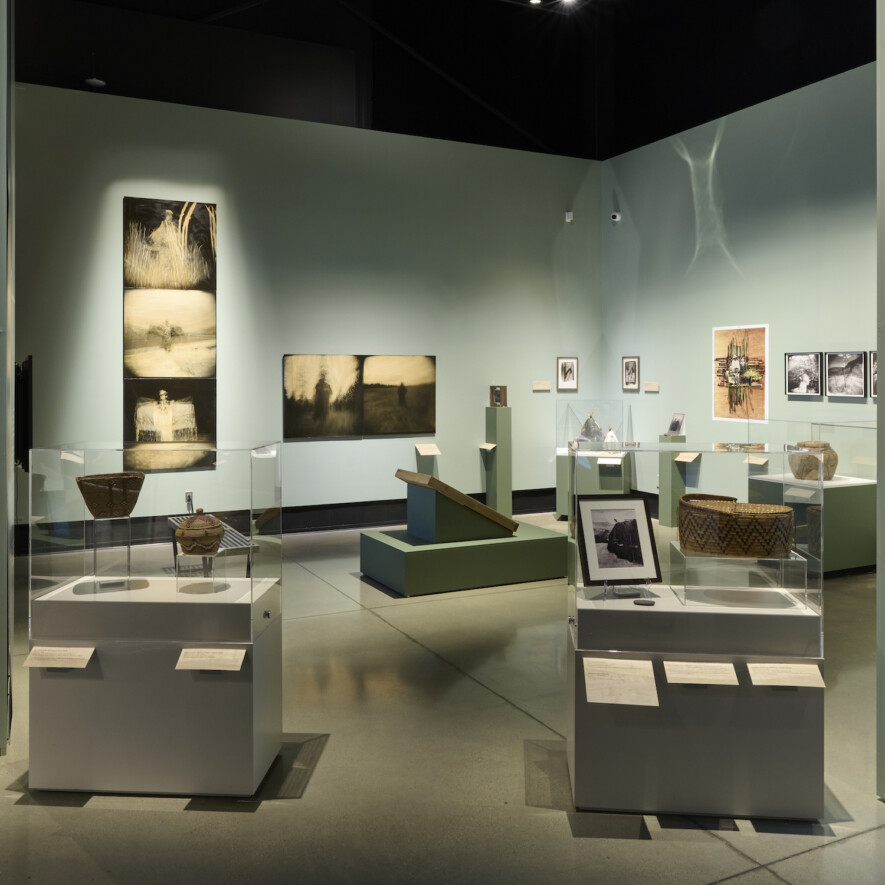
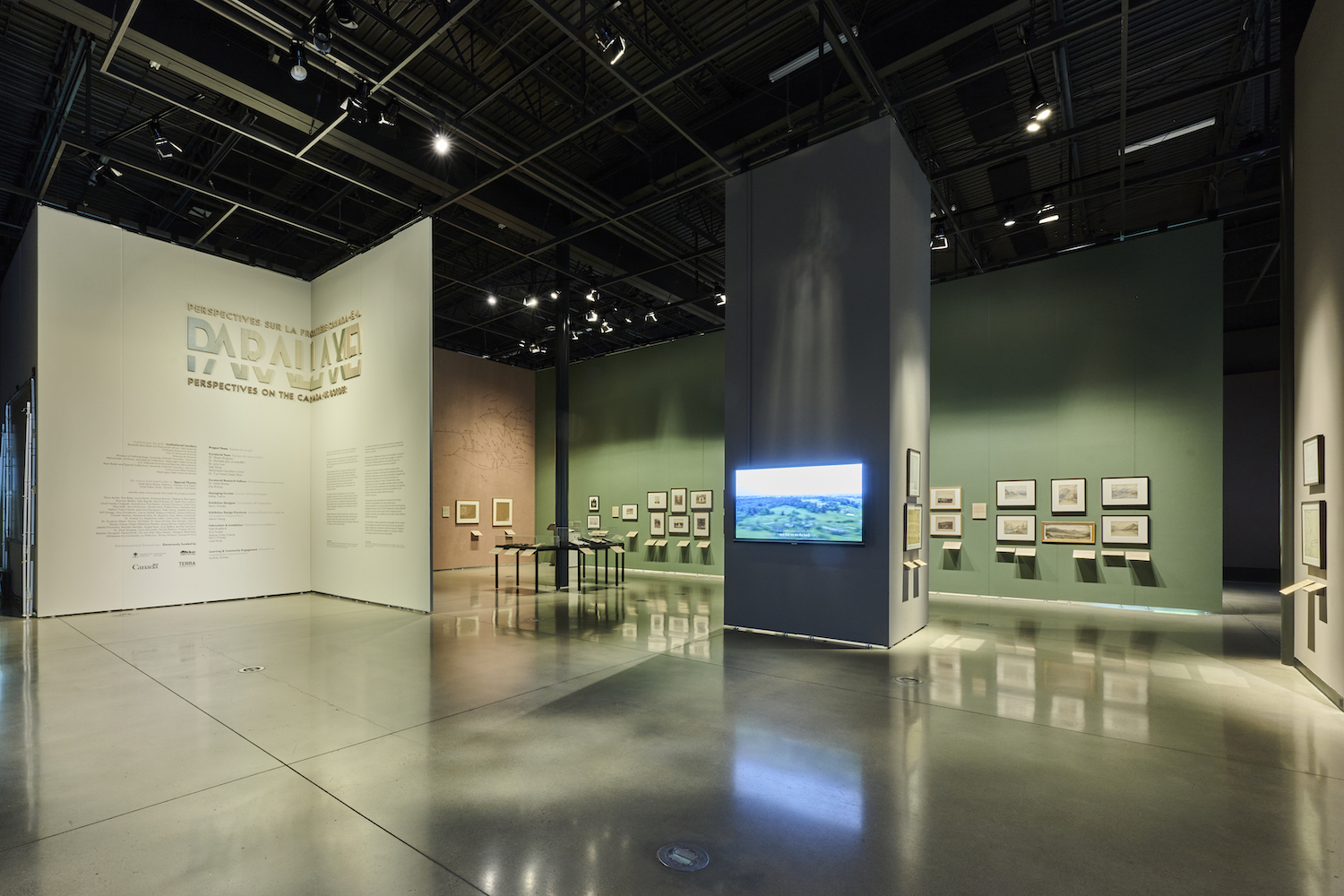
Installation view of Parallax(e): Perspectives on the Canada–U.S. Border / Perspectives sur la frontière Canada–É.-U., The Reach Gallery Museum, 2025. Photo credit: Dale Klippenstein Photography
The Reach Gallery Museum presents Parallax(e): Perspectives on the Canada-U.S. Border / Perspectives sur la frontière Canada-É.-U. —exploring the history of the 49th parallel—until May 30. For Kelley Tialiou, Reach’s curator of art and visual culture, the exhibition is an opportunity to reflect on ideas of nationhood.
“Parallax(e), at its highest level, takes the historical context of the Northwest Boundary Survey as the point of departure for pluralizing and expanding its view of history in a way that prioritizes Indigenous perspectives,” Tialiou says. “These weren’t empty lands, these were lands that had groups of Indigenous people who had very complex, sophisticated ways of governance structures.”
Destabilizing borders
Nearly seven years in the making, the project was stewarded by a curatorial team including Julia Lum and five Indigenous artists. At the time, Lum was conducting research on the Northwest Boundary Survey through both Canadian and British archives.
“Out of those conversations came some key points and ideas, one of which was that some of the earliest colonial images of western Canada and the Pacific Northwest were actually produced in the context of the Northwest Boundary Survey,” Tialiou shares.
The Northwest Boundary Survey (1858-62) was a U.S.-U.K. joint endeavour to map the border at 49th parallel from the Rockies to the Pacific coast. According to Tialiou, this visual archive had two categories. The first was “a photographic archive” created by the British Royal Engineers; the second was a series of watercolour depictions led by the Americans.
“One of the main premises of the exhibition is that the border is first and foremost a visual invention,” Tialiou reflects. “It became clear that this was not a complete story—a significantly large number of Indigenous territories had been transferred by this boundary line, but no Indigenous voices were found.”
The curatorial team commissioned works from five Indigenous artists whose ancestral territories were impacted by the border. These artworks ranged from literal depictions to conceptual or abstract ones.
These pieces include Deb Silver’s (Coast Salish, Sumas First Nation) Searching for the Line, which juxtaposes the artist’s photographs with traces of her journey in learning how to use watercolours.
T’uyt’tanat-Cease Wyss’ (Sḵwx̱wú7mesh / Stó:lō / Hawaiian / Swiss) Remembering Kanaka Ranch: X̱échx̱ech ta Swá7am-cht (Remembering Our Ancestors) reconstructs her family’s memories of living on Kanaka Ranch in what is now known as Stanley Park and Coal Harbour. A multimedia installation featuring photographs, text and oral testimonies, the work highlights the historical connections between Skwxwú7mesh and Hawaiians.
“[The artists] had more agency over their solo spaces, and they were asked to propose historic objects relating to particular micro-histories they were exploring in their commissions—historical objects that in some shape or form amplify the histories they were telling,” Tialiou adds of the Reach Gallery’s decision to bring these artists on as curatorial collaborators. “For some artists that was an obvious choice, but for other artists, there was an opportunity to explore archives and find images.”
Time immemorial
The exhibition also showcases loans from different institutions—including London’s Victoria and Albert Museum. It features additional contemporary artists, such as Sonny Assu, Claude Zervas and Henry Tsang.
“I was honoured to be included in this project so that my piece would have this conversation along with First Nations artists,” shares Tsang, who hopes the exhibit opens conversation about justice, equity and relationships to land. “The inclusion of so many Indigenous artists is really significant because it’s their land that this line on a map goes through, and it’s where they’ve been living since time immemorial.”
Tsang’s work Tansy Point (2019) is an interactive video installation centering on the Anson Dart Treaties of 1851—a now-broken agreement made between the Superintendent of Indian Affairs for Oregon Territory and the Chinook people. The treaty was never ratified by the American Congress, and the Chinook people were dispossessed of their land.
“It’s a double projection, video installation where two different projectors create one single image,” Tsang says of his work. “When you walk into space, your body ends up blocking one of the projectors, and you create this shadow; your body then exposes text scrolling across the video.”
The text is the English translation of the voiceover, which features two perspectives. The first is from a 19th-century white settler, James Swan, criticizing his government’s role in breaking the treaty. The second is from the chair of the Chinook Nation, Tony Johnson, who shares the treaty’s lasting impacts on his people.
The artist’s interest in the Chinook language began in the early 1990s while researching west coast history. He was particularly driven to the intercultural aspects of Chinook.
“I returned to [the topic] a few times, on occasion, really interested in how different cultures come together to, at first, trade, but also share and build community,” Tsang says of the historical context including both English and French settlers. “At some point in time, people had children together, but their only common language was Chinook.”
For Tsang, Parallax(e) is a chance to consider the artificial nature of borders—and their very real impacts on Indigenous communities.
The curator emphasizes how the objects and artworks on display illustrate Indigenous nationhoods and epistemology. Examples include two maps, made by Indigenous guides, borrowed from the archives of Washington D.C.
“What’s super fascinating about these maps is that the way they represent distance on land doesn’t conform to western notions of Euclidean geometry and cartography, as in, you take a standard unit of measurement and scale up [or] down,” Tialiou explains. “They measure distance as the time it takes to navigate the land.”
For more information on the exhibition, see https://thereach.ca/exhibition/parallax-perspectives-on-the-canada-u-s-border/.
For more information on Henry Tsang, see https://henrytsang.ca/.


Comments will load once you reach the end of the article.