
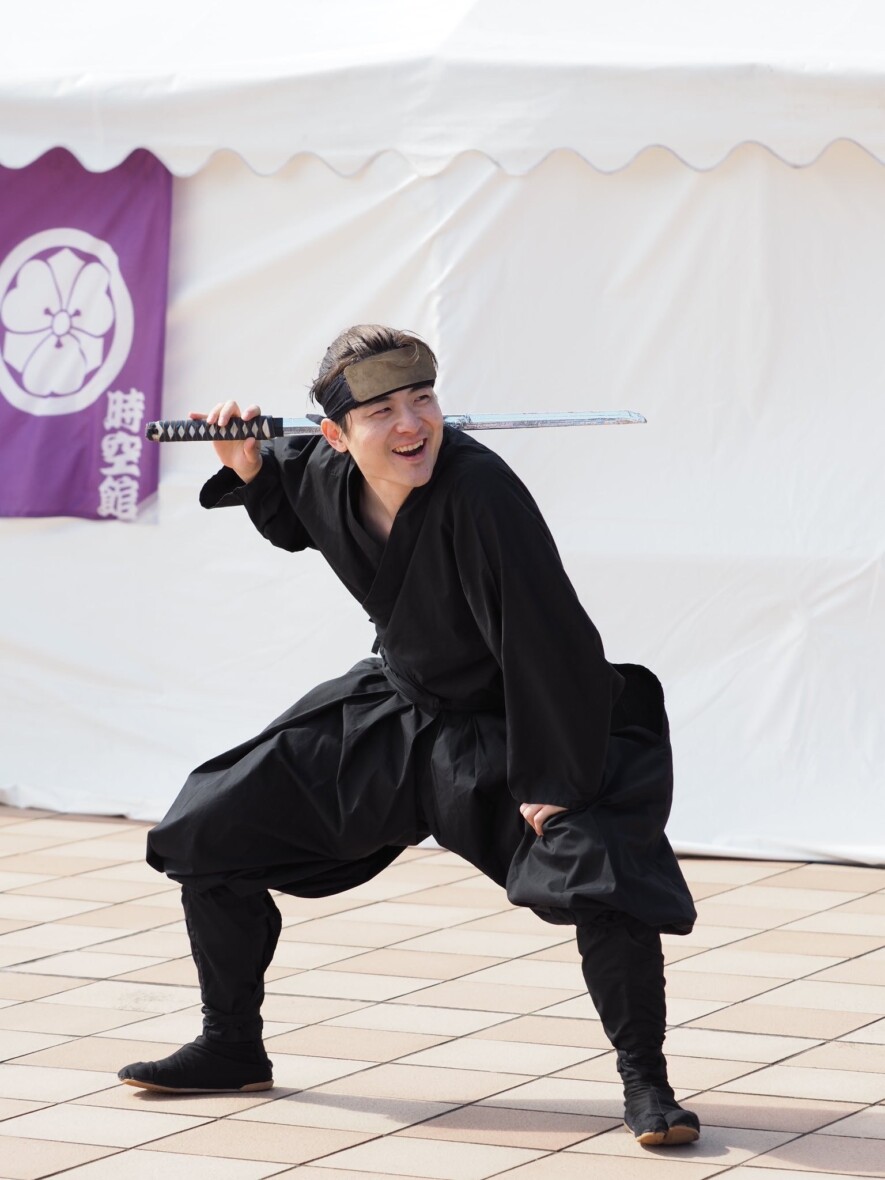
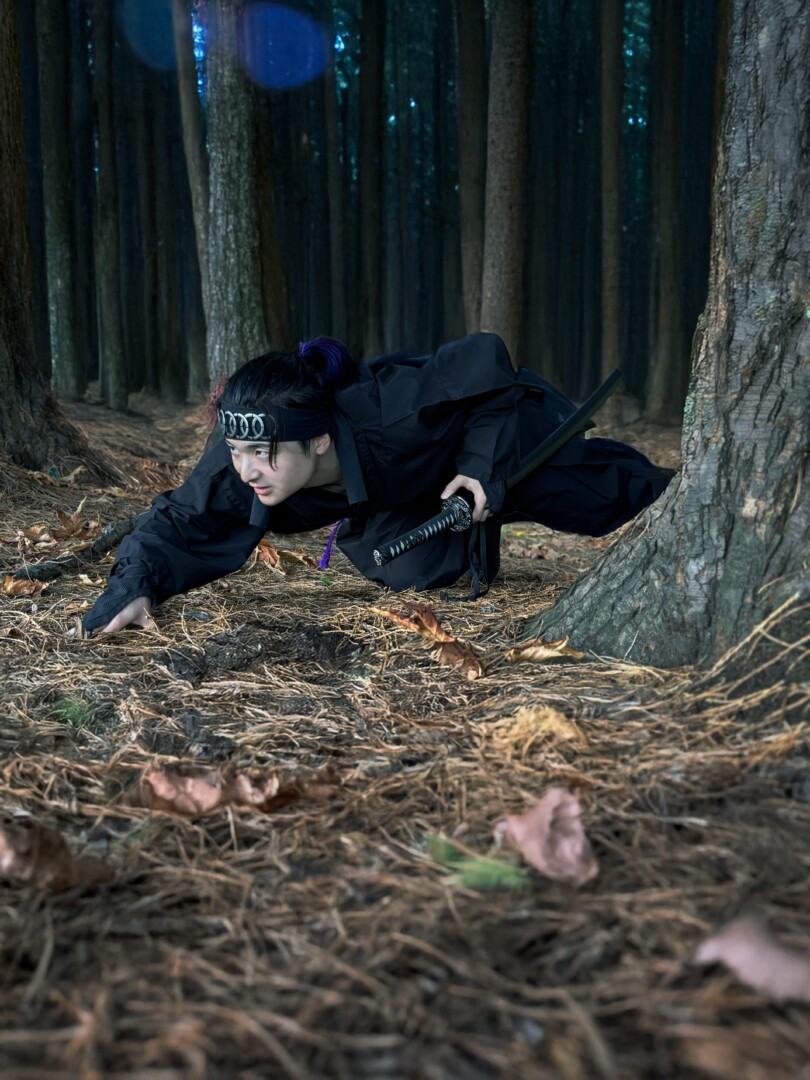
SABO Yu Amasawa hiding in the forest. | Photo Courtesy of Yu Amasawa.
Being able to prevent conflicts or resolve them without drawing one’s sword is the skill of an excellent ninja, says SABO Yu Amasawa, local practitioner and instructor of Ninjutsu. SABO will offer an Introduction to Ninjutsu workshop (Apr. 5, Nikkei National Museum & Cultural Centre)—welcoming participants to this Japanese tradition rooted in harmony.
“The character nin[忍] has two meanings: ‘to endure’ and ‘to conceal oneself; both are essential principles in Ninjutsu training, but as one continues to refine them, they eventually lead to a state of accepting others,” he shares. “When you reach that point, you no longer become angry or impose your views on others and conflict disappears.”
The workshop will teach Ninjutsu’s core concepts and mindsets, including mental regulation, breathing techniques and meditation. Participants will also learn the fundamental practices of using a Shuriken—a traditional concealed weapon with spikes—along with a sword and blowgun.
Surviving mind and body
Survival and the safe return to “own’s own territory” is Ninjutsu’s primary objective, says SABO. Most ninjas, he adds, traditionally “blended into society”—carrying out their missions unnoticed.
“Unlike many other martial arts that focus on defeating an opponent, Ninjutsu teaches ways to avoid fighting altogether, as well as how to escape or hide,” SABO explains, adding the practice is no longer associated with espionage. “It emphasizes not only physical techniques but also theoretical knowledge, communication skills and mental training to remain composed under extreme conditions.”
SABO sees the tradition as a “comprehensive survival system”—involving spiritual, mental and physical elements. Historically, ninjas were trained to survive extreme hardships—preparation for being on enemy territory.
“This included building tolerance to physical pain, even training the internal organs to withstand poison,” the instructor shares. “In modern times, most of that is no longer necessary, so physical training now focuses more on balance, weapon techniques and sharpening the five senses.”
In contrast, the mental practice—keeping one’s mind calm and emotions under control— have remained the same. According to SABO, ninjas embrace the concept of Fudōshin, an ability to retain one’s composure in any situation and “perceive the truth clearly.”
For SABO, this mental training is important in contemporary society where stress is rampant. He adds that, around 400 years ago, Ninjutsu was also rooted in spirituality —a view that has been replaced with scientific understandings of the mind.
“Daily practices such as prayer, visiting shrines, chanting sutras and copying scriptures were incorporated into everyday life as part of training,” SABO says this spirit still exists, reflected in practices like showing rei (respect) before and after training and matches. “We believe that a spirit resides in the space and in each tool, and we express our greetings and gratitude accordingly.”
A growing community
SABO was trained—under the guidance of a samurai tradition successor—at a dojo in Tokyo’s Asakusa. He learned swordsmanship and stage combat, unaware that the dojo was practicing Ninjutsu.
“I simply thought skills like concealed weapons techniques and breathing methods were part of a samurai’s discipline,” he recalls. “In fact, in Japan during the 1600s, Ninjutsu was considered one of the essential skills that the samurai were expected to learn.”
It was also at the dojo that SABO began thinking about hosting workshops in North America.
“At the dojo, I noticed that foreign visitors’ attitude toward training felt different,” he reflects. “I wanted to better understand what value Ninjutsu held for them, what made it worth dedicating part of their limited stay in Japan, and what they were seeking from us.”
SABO’s local participants have approached their training “with great seriousness”—demonstrating sincerity and commitment that the instructor finds encouraging. Some have even attended all of the workshops to date.
“I enjoy all aspects of training, but breathing techniques are especially valuable in modern daily life,” SABO shares his favourite part of Ninjutsu—one that directly impacts the body, allowing practitioners to easily feel bodily sensations. “Depending on the situation, you can switch between breathing methods to calm the mood, boost your energy or endure hardship.”
Traditionally recognized as a profession, Ninjutsu teachings were kept secret, allowing practitioners to maintain what SABO calls “a strategic advantage.” He adds that this perspective is changing, as more people wish to share this practice—which can better one’s life—with others.
“I hope to see more amateur practitioners around the world who learn Ninjutsu and apply it to their daily lives, work and hobbies—similar to how yoga or Tai Chi has become a widely embraced life practice,” he adds. “If you are interested in Ninjutsu or ninjas but aren’t quite sure what they are, I encourage you to join [the workshop].”
The workshop is co-facilitated with fellow Ninjutsu meditation practitioner and Shorinji Kempo martial artist Ginpei. Participants are asked to wear comfortable clothes and bring water.
For more information and to register, see https://www.eventbrite.ca/e/introduction-to-ninjutsu-tickets-1984491404211?aff=ebdssbdestsearch.


Comments will load once you reach the end of the article.