
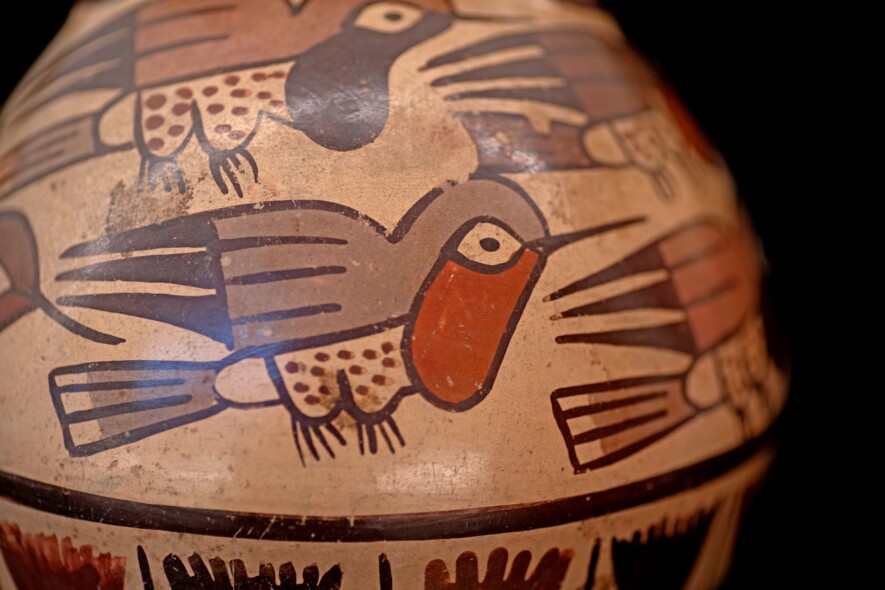
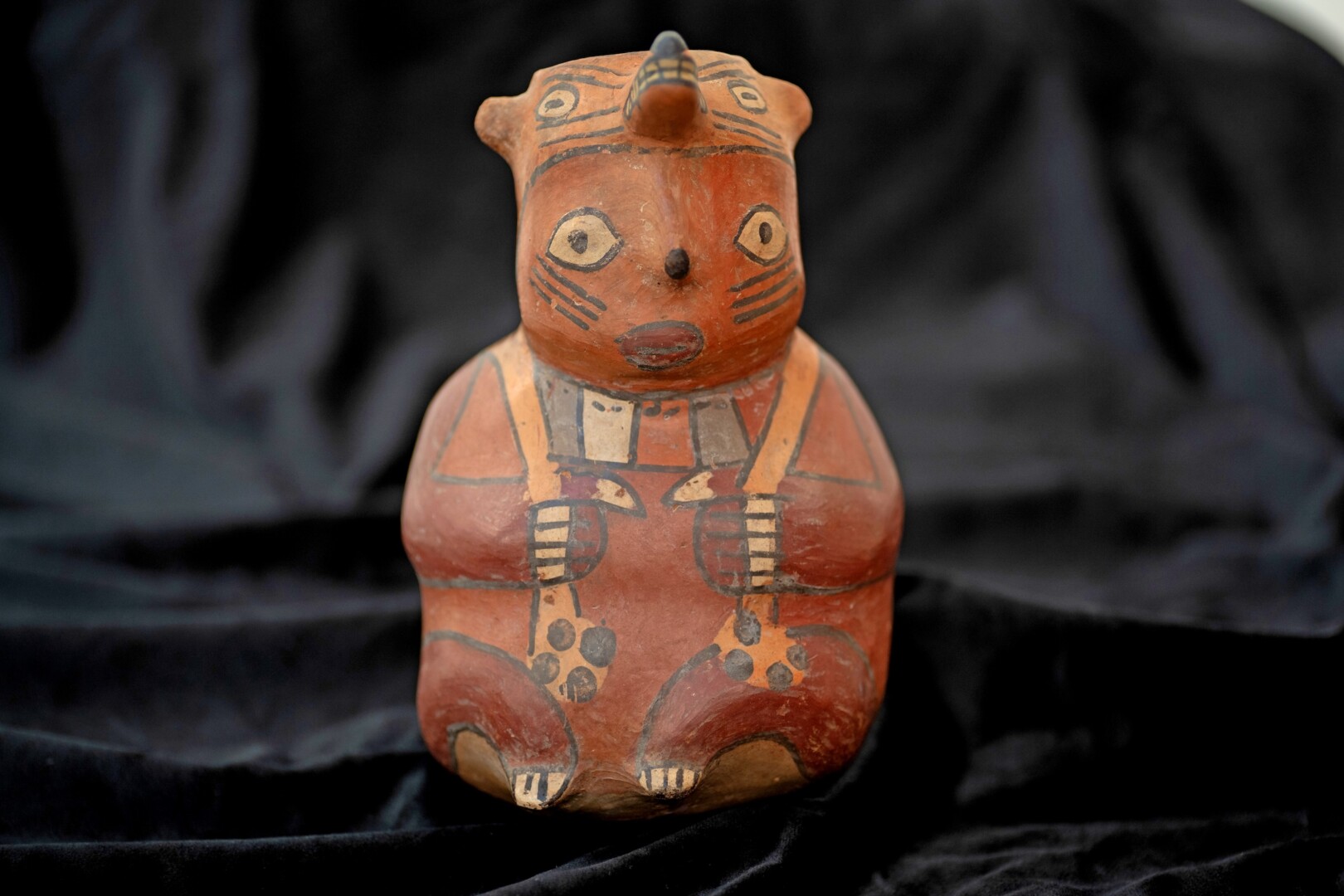
Fox vessel. Vessel. Peru: Ica, Nasca, 100 B.C.E.-800 C.E. MOA Collections 2990/113. Photo by Joshua Doherty.
Tupananchiskama is a Quechua word meaning “until life brings us together again, “says Luis Manuel González, guest curator for the latest exhibit—“Tupananchiskama: Ancient Andean Cosmovision”—at the University of British Columbia’s Museum of Anthropology (MOA). Quechua is a widely spoken Indigenous language family, and while Quechua-speaking communities colloquially use the term as a farewell, González notes it has a deeper meaning indicating a promise.
“It’s a belief that we will meet again,” he says. “In this exhibition, I am enacting that promise by curating these objects—I’m meeting my ancestors again, not just in spirit, but through these belongings.”
Curated in English and Spanish, the exhibit runs until Jan. 3, 2027. The MOA will host “Not-Your-Average Tours: Tupananchiskama” (April 30, May 28, June 25, Sept. 24)—a series of public tours featuring specialists in ceramics, Andean cosmology and historical collections. González sees the exhibition as “a small window” into the Andes region’s diverse lineages and ideologies.
He hopes that visitors leave with a sense of wonder towards the past and the possibility for connections, memories and hope for the future. More than an archaeological representation of the region, Tupananchiskama is a philosophical exploration into remembering and connecting with ancestors.
To meet again
“It’s about how we remember, how we connect and how we keep our ancestors alive through their things,” González says, encouraging visitors to “slow down” and sit with their own ancestors. “The Andes are not just a collection of ancient civilizations: they are a living, breathing and transforming world.”
The MOA invited González to curate a showcase featuring donated artifacts—including pre-Columbian ceramic, bone, textile and wood pieces—from former art historian and UBC professor Alan R. Sawyer. In 2015, the museum acquired this collection; some pieces date back to more than 2,500 years.
“As a Peruvian, this was also a personal journey,” says González. “As a person who has Indigenous, European and African heritage, I feel a strong responsibility to my own Indigenous ancestors…I imagine this exhibition can be a way to reconnect with them and tell our stories and invite others to do the same.”
González—who has over two decades of research experience in the Andes—started by surveying the collection. Referring to the process as a learning experience, he then selected objects that reflected Andean cosmovisions.
These pieces demonstrate the Andean understanding of the world, death, time and space. In the Andean cosmovision, there are three realms: the celestial (Hanan Pacha), what González calls “our world” (Kay Pacha) and the underworld (Uku Pacha).
“The [Quechua] word ‘Pacha’ means time and space,” he explains, noting other languages use different words to describe each of these concepts. “For the Andes, time is cyclical: time is continuing, but it is returning.”
He adds that the underworld is not the westernized conception of hell; rather, it is the place where beings are born—as seeds—and germinate.
“This cosmovision is the lens through which ancient Andeans understood the world,” he explains. “In the Andeans, this worldview was expressed through every object—a bowl, textiles, a flute—these were not just things but living beings.”
These beings carry memories, energies and presence of ancestors. González’s curation also emphasizes the diversity of this region—from the Moche culture in the north coast to the Nasca culture in southern Peru.
Returning to constellations
Wind is not just air in the Andean cosmology; it is a sacred force bridging the spiritual and physical worlds, adds González. The wind carries messages and prayers from the “mountain spirits,” along with “energy from the ancestors.”
For him, the ancient wind instruments—a conch shell-constructed trumpet, panpipes, and ocarinas—on display are particularly meaningful.
“I started to play these instruments—I can feel the vibrations of the energy and this connection,” González says. He hopes visitors can also tune into these instruments’ sounds, feeling the vibrations for themselves. “[They] can stay a few minutes, close their eyes and are transported to another place.”
The goal, for González, is to reflect on how the “power of sound” connects individuals to their ancestors. Another meaningful piece is an animated projection of contemporary Peruvian artist Miguel Araoz Cartagena’s oil painting—which depicts the Milky Way.
Through two projections—one showcasing the light constellation, the other showcasing the dark constellation—this piece emphasizes the Inka’s understanding of a dual constellation system. A recording accompanies the projections.
“The dark constellation highlights how these spaces in the Inka time represented the llama, toads, serpents [and other animals],” he says—adding an intention to draw connections between what the ancient Inkas saw and current Andeans see. “For the Andes, in the Inka time, they described not only the [connecting] of stars; they also saw, in these gassy spaces in the Milky Way, long spots with bright things and darker spaces.”
González adds that, in this darkness, the Inkas started to imagine animals, creating the llama, toad, fox, serpents and others. He shares that these constellations were recognized as living beings integrated into daily life. The Inkas and other cultures, for example, may have used the Milky Way to mark changing seasons.
“I hope [visitors] feel the stillness, beauty and hope in the idea that we will see our ancestors again, not in a literal sense, but in a way their memory, values and presence live in through us,” González adds.
For more information, see https://moa.ubc.ca/exhibition/tupananchiskama/.


Comments will load once you reach the end of the article.