
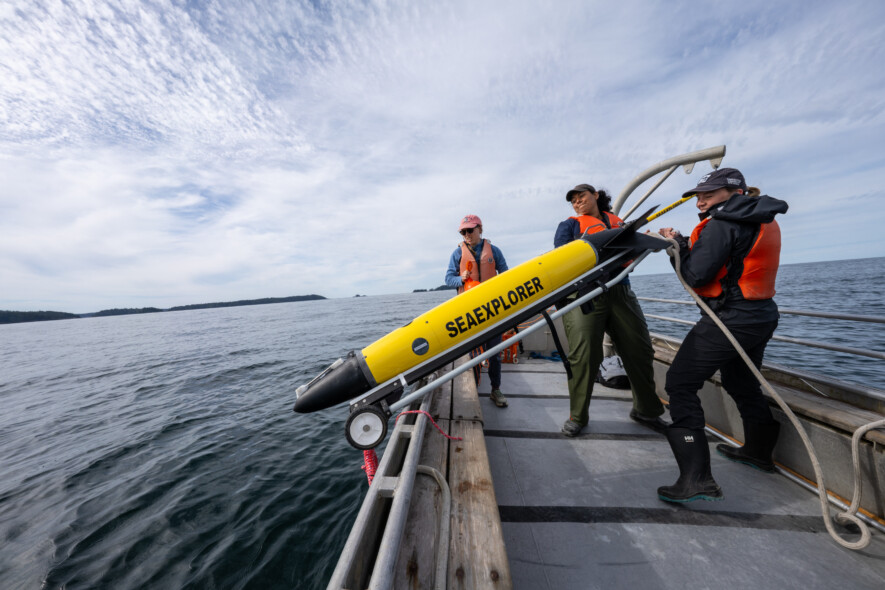
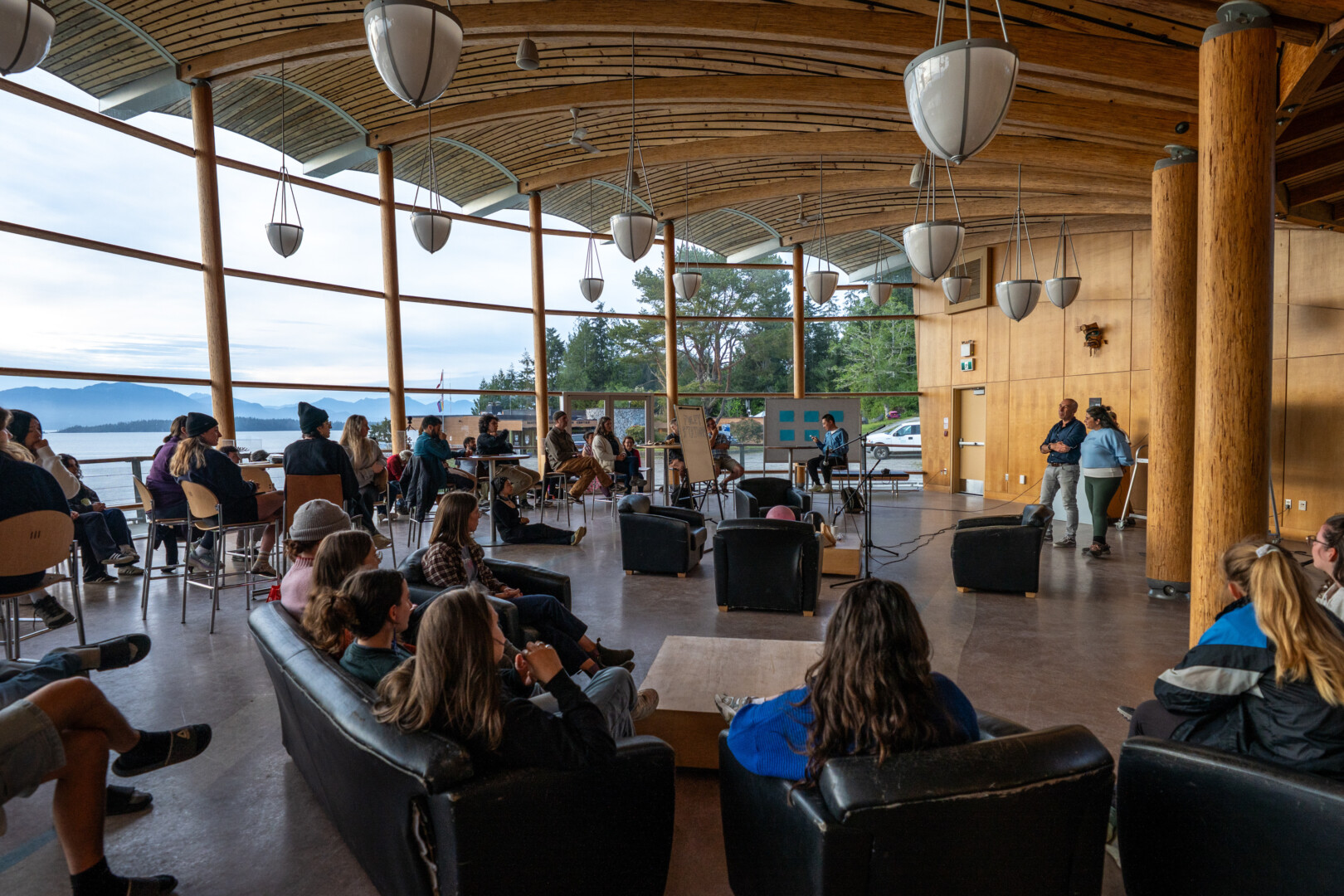
Canadian-Chilean research partnership at the Bamfield Marine Sciences Centre | Photo by Katherine Cheng.
“Different parts of the water have different ages—with respect to the time they were last in contact with the atmosphere,” says Philippe Tortell, sea-going oceanographer and professor at the University of British Columbia (UBC). The age of seawater, he adds, can be identified through carbon-14 dating, much like in archaeological research.
Tortell has been leading a Canada-Chile research collaboration through B.C.’s Pacific Marine Science Alliance (PMSA). For him, the highlight of this partnership are its field schools—which alternate annually between Canada and Chile. This year’s field school was recently held at the Bamfield Marine Sciences Centre (BMSC) on B.C.’s Westcoast.
“We work with them on providing skills, education and training in the collection of ocean data sets: How do we collect information about the ocean using sophisticated sensors?” Tortell shares of the field school. “How do we interpret it? How do we communicate it to people who are not scientists that need high quality data to make good decisions about ocean management and risk mitigation?”
Last November, this collaboration was further formalized with a new partnership between PMSA and the Chilean National Consortium of Ocean Science.
Warming waters
One out of every two molecules of oxygen that people breath is produced by the ocean’s organisms, says Tortell. The researcher first visited Chile in 2000. At the time, he was a graduate student on a research cruise that sailed from San Diego, California to Northern Chile.
“I got off the boat, and I was just so enamoured with Chile,” he recalls. “I just decided there and then—I didn’t know how, why, what or when—but I knew I just had to go back and work there.”
He then returned to Chile, visiting its southern side. The researcher soon realized that this Chilean coastline was “virtually identical” to the one found in B.C.
“I think about them as long-lost siblings, separated by birth,” he shares. “They are remarkably similar in terms of their geography, climate [and] a whole suite of ocean processes and challenges.”
According to Tortell, the two bodies of water are both naturally “very low in oxygen” and contain “quite acidic waters”—making them particularly susceptible to “ongoing patterns” of global deoxygenation and acidification.
Deoxygenation of deeper waters is a major challenge facing oceans, says Tortell. He points out that as waters become warmer, more acidic and lower in oxygen, benthic organisms—which live on the bottom of the ocean floor—are becoming displaced.
“When the water warms, that actually increases their metabolic rate and increases their demands for oxygen,” he adds. “So, oxygen and temperature stress combine to have impacts that are perhaps greater than what either would have had individually.”
The professor points out that oxygen levels also affect the water’s chemistry, which in turn, impacts the production of other greenhouse gases.
A worthwhile case study
“Both regions have very significant seismic hazards,” Tortell says of Canada and Chile. “Those hazards are associated with oceanic plates subducting underneath continent crust.”
Another similarity is the countries’ relationships with their respective Indigenous populations regarding resource stewardship and land rights. Tortell also points out that the two countries share political, cultural and other differences—which provides an interesting case study into how “two nations can manage their coastal resources.”
The program has been funded by the Natural Sciences and Engineering Research Council of Canada (NSERC) under its Collaborative Research and Training Experience (CREATE) Program. According to Tortell, this funding will run out next year.
“The biggest impacts of climate change seem to be happening in the polar regions: the Arctic and the Antarctic,” the professor adds. “This is another area where Canada and Chile can work together.”
This research partnership also contains an artistic component: Tortell notes that composers have been invited to translate data into musical forms, allowing people to engage with information in a more emotional and concrete way.
“We’re now looking for other ways to expand the partnership to keep it going beyond the time of that award,” he adds. “The summer schools, in particular, are an important vehicle for exchange between Canada and Chile.”
Formerly known as the Western Canadian Universities Marine Sciences Society, PMSA comprises of five universities: UBC, University of Victoria, Simon Fraser University, University of Calgary and University of Alberta. It established the BMSC in 1972.
The UN recognizes World Oceans Day on June 8, drawing attention to the essential role of oceans in supporting Earth’s biodiversity.
For more information Philippe Tortell, see https://www.eoas.ubc.ca/people/philippetortell.
For more information on the Pacific Marine Science Alliance, see https://pacificmsa.ca/.
For more information on the Bamfield Marine Sciences Centre, see https://bamfieldmsc.com/.


Comments will load once you reach the end of the article.