
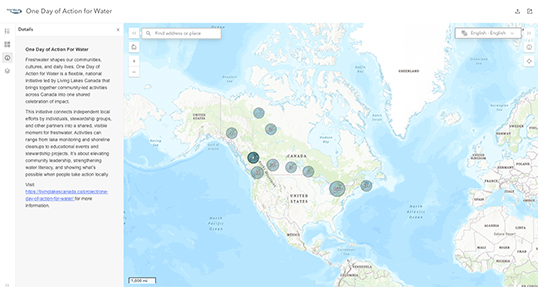
Screenshot of One Day of Action for Water, an interactive map from Living Lakes Canada where you can find events across Canada.
“No lake is the same,” says Kat Hartwig, executive director and co-founder of Living Lakes Canada (since 2004). In Canada, specifically, the non-profit organization Living Lakes Canada intends to promote the welfare, restoration, and long-term protection of Canadian lake and other bodies of water.
Celebrating and protecting Canada’s lakes
“Ninety per cent of freshwater on the surface is lakes,” says Hartwig. “So, we’re really dependent on lakes for our
wellbeing.”
For over two decades, Living Lakes Canada has collaborated with Indigenous and non-Indigenous communities to maintain the sanctity of freshwater sources in Canada.
“It’s a great opportunity to help people remember the importance of lakes within their communities,” says Hartwig.
Among the initiatives organized by Living Lakes Canada is One Day of Action for Water, “an interactive mapping platform,” explains Georgia Peck, lake program manager of Living Lakes Canada, “where we have freshwater and lake-related events that are happening across Canada being tracked and monitored throughout the summer.”
In preparation for the UN World Lake Day, Living Lakes Canada – via posts on their website as well as other media channels such as Instagram, LinkedIn, and Facebook – plans to raise awareness on climate change, by demonstrating the different approaches to research on Canada’s freshwater sources, and its detrimental effects on Canadian lakes.
Climate change hits Canada’s lakes
Since 90 per cent of freshwater on the surface originates from lakes, a community’s welfare is severely affected by symptomatic issues stemming from climate change.
“Algae bloom, floods, droughts, they’re all really started by anthropogenic climate change,” says Peck.
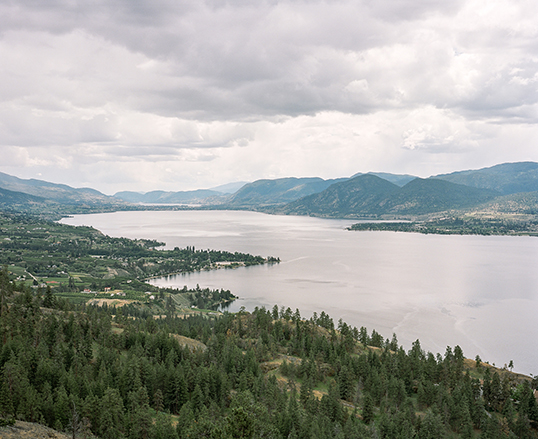
However, for the first time in a decade, they have had to postpone two shoreline studies at both Lac La Biche in Alberta and Okanagan Lake in British Columbia – the former because of huge floods raising the lake to four feet above what was normal from last year, and which locals have dubbed “The June Monsoon”; and the latter due to wildfires in Bradley Creek.
“A big part of our collaboration is meeting in the middle, and being able to support each other during these devastations,” says Peck.
Community partnerships in the face of wildfires
Living Lakes Canada has long partnered with the Okanagan Indian Band in conducting shoreline surveys in the region – boats for data collection, drone pilots, and multiple field technicians all came from the Okanagan Indian Band alongside the Westbank First Nation.
“All we want to be able to do in these moments is support them the best way we can,” says Peck.
While the destruction of properties and the onset of evacuations have been the most obvious consequences of Okanagan Lake’s wildfire issues, ecological challenges will also arise in the aftermath.
As heavy ash, soot, and charcoal fall into Okanagan Lake, nutrients like nitrogen and phosphorus are added which will exacerbate algae blooms in the water.
Furthermore, without native vegetation along Okanagan Lake’s shorelines for the next couple of years, erosion intensifies, pollution enters the lake without plants as a filtration system, and sediments and particles suspended in the water will affect the biodiversity reliant on the lake.
“For Okanagan Lake, it’s a heavily used drinking water lake, so there’s a lot of potential human health impacts to what we’re seeing because of climate change,” says Peck.
Taking action for freshwater
Even as an extreme of water deters research in Lac La Biche, just as an extreme of fire prevents shoreline surveys in Okanagan Lake, Living Lakes Canada continues to be positive and proactive in stewarding lakes in Canada.
“Freshwater biodiversity is the fastest disappearing biodiversity in the planet,” says Hartwig, “and there’s another reason why we have to look after our water.
One Day of Action for Water is one way locals can engage with lake-related activities and freshwater biodiversity advocacies, and the upcoming UN World Lake Day is an ideal impetus to spread awareness on the relevance of the planet’s lakes and the issues these bodies of freshwater face.
For more information on Living Lakes Canada, please visit:


Comments will load once you reach the end of the article.