
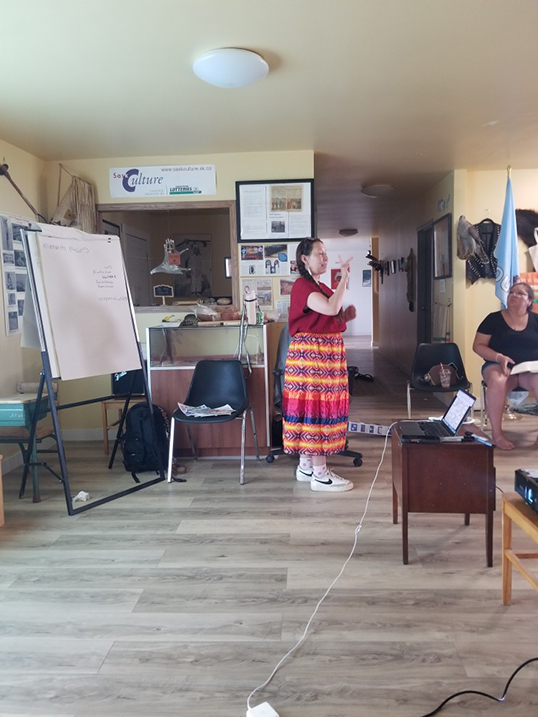
Sign language class. | Photo courtesy of Floyd Favel
Today, however, this ancient system faces a crisis of preservation.
“I think when we lose the gestures, the punctuation to a spoken language, we also lose the original language,” Favel explains. “The signs are a vital learning tool to retain and teach a spoken Indigenous language. We lose a means of expression, an art, a knowledge.”
September 23, the International Day of Sign Languages, offers an opportunity to champion and preserve the cultural diversity and linguistic identity of deaf communities and signers worldwide.
The roots of ancestral sign
Favel leads the Poundmaker Museum and Gallery near Cut Knife, Saskatchewan. It advances cultural repatriation and language revitalization. He asserts preserving PISL is not simply about preserving history; it is about saving the core of Indigenous communication and identity.
Favel, who grew up on a reserve in Saskatchewan speaking Cree, began his theatre career as a young boy, visiting his grandmother in the North and creating shadow plays for her. His cousin taught him to create and animate stories.
“Pantomime was the only way I could communicate to my grandmother;” he reflects. “I understand now that her gestures came from her ancestors all the way back to Creation. By repeating signs or practising signs, I am anchored to Creation and ancient history.”
Favel recalls an Assiniboine Elder sitting in a traditional camp. “Watching him sign felt like opening a doorway into ancient knowledge. It was a reminder that PISL is deeply bound to the land itself,” he says.
The signs describe shared natural environments such as mountains, plains, sky, horses, and buffalo. Hundreds of tribes understood these signs for basic human actions like walking, running, and eating. PISL enabled diverse Indigenous nations from the Arctic to Mexico to communicate, trade, and build relationships across vast territories.
Reversing colonial interruption and silence
Colonial policies and residential school systems caused the language’s decline. The visual punctuation and artistic nuance of spoken Indigenous languages are compromised when sign language dies.
“Colonialism stopped the sign language;” Favel notes. “It made us still and unexpressive, so much so that that is one of the features that non- Native people define Indigenous people by, as unexpressive and stoic, when in reality, we were very expressive and descriptive in our movements.”
Undoing this damage requires revitalizing the language’s physical spontaneity. PISL mirrors the flexible, non-linear syntax of spoken Cree, serving as the vital bridge for language reclamation.
Grassroots models for language survival
Preserving PISL means instruction must reject Western institutional norms.
“Colonial university institutions are not the place to be teaching our Indigenous languages,” Favel argues. Their “Graeco-Roman educational structures and English-based grammar systems failed to capture Indigenous signing’s living essence.
Rather, he advocates for “a grassroots, community-based way of teaching language in our own structures, in our own communities, in our own laws, based on spiritual and ancestral teachings”.
Just as daily human interaction relies on a small core set of concepts, teaching 100 to 200 practical signs enables younger generations to absorb this visual system rapidly.
Passing the torch
Favel says that elders are passing on the knowledge, but young people must step forward to carry it forward. That also means bringing PISL into modern artistic and cultural spaces.
Winner of an Indigenous Multimedia Language Arts Award Favel weaves PISL into contemporary works like his multilingual drama Sweet Cherry Wine, alongside Cree, Māori, Polish, Bengali, and Sylix, showing that sign remains a dynamic, evolving medium.
There will be a Performance Festival and Plains Indian Sign Language Workshop in Vernon, B.C., at the end of October.
For more information email [email protected].


Comments will load once you reach the end of the article.