
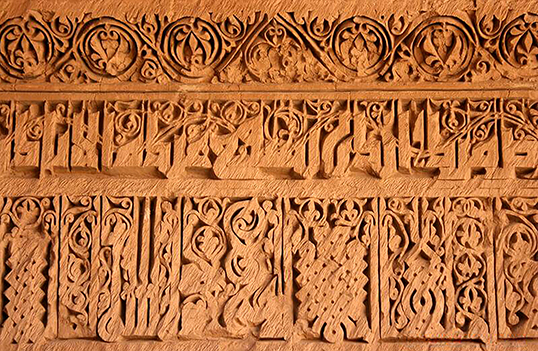
Ribat- i Sharaf, a caravanserai in Iran. | Photo courtesy of Farzan Kermani.
Words have often conjured more vivid images than pictures and paintings ever could. This is especially true within the distinct art-forms and beautiful writing in Persian/Iranian calligraphy, an evocative medium that respects the Arabic taboos of not depicting humans and animals visually but rather textually. Throughout Islamic cultures, one will often see calligraphy decorating the walls and facades of buildings like those in the Ribat-I Sharaf, a historic caravanserai in Iran.
“Iranian calligraphy is a vibrant and essential branch of Islamic calligraphy with a history spanning over fourteen centuries,” says Farzan Kermani, a Vancouver-based graphic designer and the founder of Karin Graphic Studio Incorporated. “Since my youth, practicing it has provided me with a deep sense of personal tranquility and meditation. Beyond fostering creativity, calligraphy enhances focus, attention to detail and mental clarity – engaging both the mind and the spirit.”
This October, Kermani plans on celebrating Islamic History Month Canada by hosting a free three-session workshop introducing participants to Persian calligraphy at the Simon Fraser University.
“While three sessions won’t turn someone into a master,” says Kermani, “I hope participants gain an intimate appreciation for this art form and experience the joy of creative practice.”
An art
Kermani and his contemporaries have understood that Iranian calligraphy has always operated beyond the simple delivery of religious or literary texts. Because of historic and cultural limitations placed on other visual media such as painting and sculpture, Iranian calligraphy emerged as “the primary vehicle for artistic expression across these regions.”
“By creating dynamic visual compositions and evoking emotion through form, it transformed daily life,” says Kermani. “It graced virtually every aspect of historical living – from manuscripts and illuminated books to ceramics, textiles, and both sacred and secular architecture.”
Calligraphy, for Kermani, reflects the Islamic community’s aesthetic sensibilities and artistic refinement, with complementary arts – such as illumination (tazhib), bookmaking and miniature painting – developing around and in service of calligraphy.
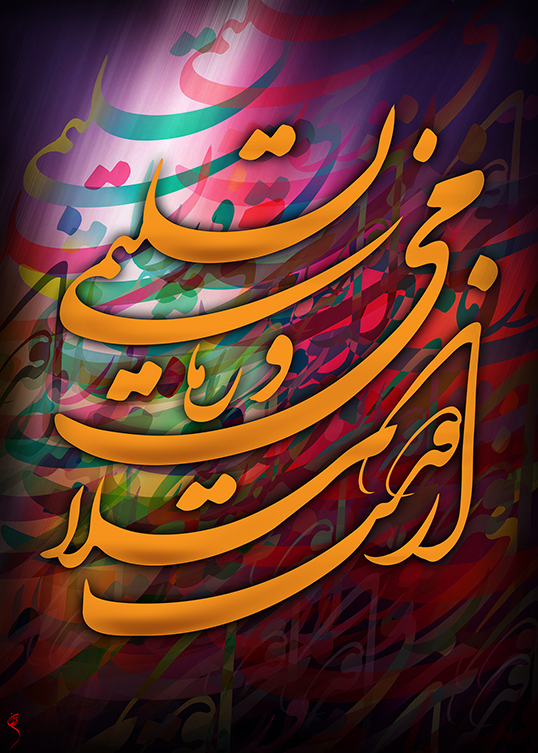
One of Kermani’s calligraphic pieces, Salam O Taslim (Greetings and Surrender), captures these sensibilities and refinements with modern nuances. Inspired by a line of poetry by Bidel Dehlavi, a prominent 17th-century Persian-language poet from India, Kermani utilized the Shekasteh Nasta‘liq script to create a bridge between long-standing calligraphic traditions and modern painterly values.
“Shekasteh Nasta‘liq is the latest major style of Iranian calligraphy developed four centuries ago and reaching its zenith around 300 years ago,” says Kermani. “In this piece, while strictly adhering to every rule and nuance of traditional calligraphic proportion, I introduced a modern aesthetic through colour choice, spatial composition and presentation tailored to contemporary sensibilities.”
An identity
For Kermani, Persian calligraphy represents one of the most peaceful and accessible facets of Islamic culture. Its visual beauty transcends the boundaries of epochs and regions to foster mutual understanding and meaningful intercultural dialogue.
“In a time when Islamophobia and prejudice unfortunately persist, calligraphy offers a shared visual language,” says Kermani as he highlights the underrepresented medium of textual art among Muslims and Iranians in Canada, despite local classes and branches of the Iranian Calligraphers Association operating in cities like Vancouver and Toronto.
He also emphasizes that while calligraphy certainly serves as a prominent religious art form in Islamic culture, it is not inherently bound to religion. Major Iranian scripts like Nasta‘liq and Shekasteh Nasta‘liq have predominantly served poetry, secular literature and everyday correspondences even today. The works of Mir ‘Imad al-Hasani, a renowned Persian calligrapher from the 1500s, have made their impact on the Nastaʿlīq style for generations, inspiring modern calligraphers like Kermani with their elegant scripture.
“Rooted in Iranian and Islamic heritage, [calligraphy’s] visual beauty transcends boundaries to foster mutual understanding and meaningful intercultural dialogue,” says Kermani.
A practice of life
Yet, practicing art is not without its hardships.
“The challenges [in Persian calligraphy] mirror those of fine art education generally, with the added context that many students are recent newcomers navigating settlement,” Kermani explains. “Sourcing authentic traditional materials – like reed pens and ink – was historically difficult, though local art stores have recently begun stocking them.”
Despite these struggles, Kermani continues to offer educational experiences and insights into Persian calligraphy, especially during his upcoming sessions in SFU on Oct. 13, Oct. 27, and Nov. 10.
The workshops are free and open to everyone, and you can register at:
https://events.sfu.ca/event/50319-learning-iranian-calligraphy-with-dr-farzan


Comments will load once you reach the end of the article.